Press Statement
UNAIDS launches bold transformation to sustain progress and end AIDS by 2030
10 May 2025 10 May 2025As the global HIV response faces rising risks, UNAIDS shifts to a leaner, sharper model focused on country impact
GENEVA, 10 May 2025—In the face of continued high numbers of new HIV infections and declining global funding, the Joint United Nations Programme on HIV/AIDS (UNAIDS) is launching a bold transformation to support countries in ending AIDS as a public health threat by 2030, and to ensure the HIV response remains strong and sustainable into the future. This shift will help governments and communities transition to a sustainable and domestically financed HIV response, grounded in data, equity, and human rights.
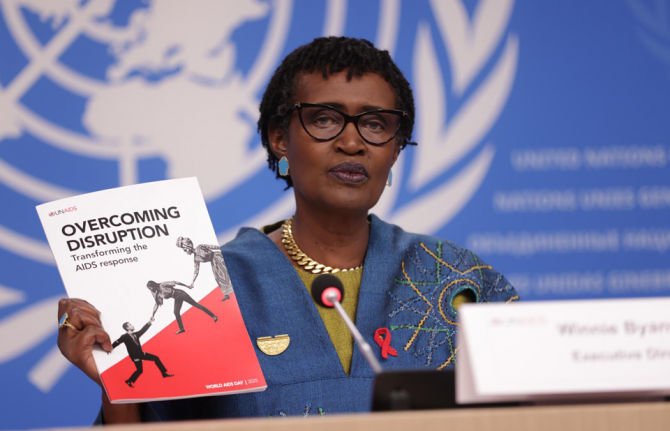
“UNAIDS’ transformation is a direct response to a fast-changing landscape, from a shifting geopolitical context to shrinking resources,” said Winnie Byanyima, Executive Director of UNAIDS. “We are reshaping how we work so that we can support inclusive, community led, multisectoral national HIV responses with greater precision and impact.”
UNAIDS restructuring and reform processes are closely aligned with wider UN processes through the UN80 initiative and promote enhanced efficiency, integration, consolidation and coordination.
The restructuring of the UNAIDS Secretariat is informed by the work of a High-Level Panel which has been working since October 2024. The Panel called for transforming the Joint Programme now and through to 2030 and recommended a smaller, sharper focused model for the Secretariat. It called on the Secretariat to focus on four core functions: leadership; convening and coordination; accountability; and community engagement.
Disruptions in the HIV response
UNAIDS modelling suggests that we are now seeing 2300 additional new HIV infections every day on top of the 3500 infections that were already occurring. These reversals are happening as a result of human rights push backs on women and girls and key populations coupled with disruptions in lifesaving services as international assistance from donor countries stopped. UNAIDS estimates that the funding cuts could lead to an additional 6.6 million new HIV infections and 4.2 million AIDS-related deaths by 2029. A tragedy for people living with and affected by HIV.
Reshaping to deliver in a changing context
UNAIDS is facing a big transition and is reforming to continue to support the response in the most efficient and cost-effective way. The Secretariat is consolidating its country footprint and will be moving global staff to be closer to the people we serve.
The physical in-country presence of the Secretariat will be reduced to approximately 35 countries while continuing to be able to support around 60 countries directly. The change is based on a typology of countries with high HIV burden, significant stigma and discrimination against key populations, and heavy reliance on international aid for the HIV response. The restructuring plan includes a 54% reduction in Secretariat staffing strength to ensure UNAIDS is fit for purpose and working within current core resource forecasts.
UNAIDS’ transformation is about supporting countries to protect the critical gains made in stopping new HIV infections and preventing AIDS-related deaths. UNAIDS will continue to support countries in monitoring their epidemics and making strategic investments for HIV prevention and treatment, as well as addressing human rights and policy barriers. It will convene partners, engage communities and stand with people living with and affected by HIV.
“This is a moment for global solidarity,” said Ms Byanyima. “With determination, and partnership, together we can still achieve the goal of ending AIDS as a public health threat by 2030 and ensure sustainable, inclusive, multisectoral national HIV responses into the future.”
In 2025, UNAIDS will shape and deliver a new Global AIDS Strategy to accelerate political, programmatic and financial commitment and sustainability and provide guidance to drive progress towards the goal of ending AIDS as a public health threat by 2030. The Strategy will be adopted by the UNAIDS Programme Coordinating Board in December 2025. It will provide the foundation for a new Political Declaration and 2030 HIV targets, to be adopted by a High-Level Meeting of the UN General Assembly in 2026.
UNAIDS
The Joint United Nations Programme on HIV/AIDS (UNAIDS) leads and inspires the world to achieve its shared vision of zero new HIV infections, zero discrimination and zero AIDS-related deaths. UNAIDS unites the efforts of 11 UN organizations—UNHCR, UNICEF, WFP, UNDP, UNFPA, UNODC, UN Women, ILO, UNESCO, WHO and the World Bank—and works closely with global and national partners towards ending the AIDS epidemic by 2030 as part of the Sustainable Development Goals. Learn more at unaids.org and connect with us on Facebook, Twitter, Instagram and YouTube.
Feature Story
The Breaking Point: A Story from Ethiopia
06 May 2025
06 May 2025 06 May 2025In April 2025, silence fell over Bahir Dar. Once a lifeline for people living with HIV, key populations, and young people—as the US funding pause began to bite. Funding cuts disrupted services. A few held on without salaries but eventually, even they stopped showing up. Confused and anxious clients arrived to find the gates closed. Some waited. Others turned away.
The crisis quickly spread from Bahir Dar, where key population programmes came to a halt. Outreach workers, who had built trust door by door, were laid off. Fear took hold. Clients asked for extra medication, unsure whether services would return. Peer support groups vanished, and with them, protection against stigma and transmission.
"I often find myself overwhelmed with stress,” said a woman from a women led association. “If the medicine and other services stop coming, where will I go? I simply don’t have the financial means to afford the treatment I need.”
The data collected by the women-led association of people living with HIV is stark. For two months, no new clients have been enrolled in PrEP, the prevention prophylaxis taken orally that protects from HIV infection.
“One of my biggest concerns is the fear of not having access to condoms,” said a case manager from the women led association. “Without them, we know HIV can spread much more easily.”
In the face of this collapse, the UNAIDS Ethiopia team visited Bahir Dar and surrounding towns to document the impact firsthand. They spoke with organizations, youth groups, and people living with HIV. They visited what remained of the services and listened to voices that too often go unheard—adolescents, mothers, peer educators—people still holding the line, even as systems crumbled around them.
“I worry deeply about the spread of HIV,” said a female member. “Will medicine still be available? Will we still have access to viral load testing? If condoms run short, we risk seeing the virus continue to spread, along with other infectious diseases.”
"Without a financial budget, our members are left without the basics they need to survive; no food, medical care, or even hope," said the association manager. "They have families, they have children, and they rely heavily on this support. It would make a huge difference if members could access free medical treatment and hospital services. Today, many can't even afford one meal a day. Their health is deteriorating; their children are suffering. What they need most is dignity, food, and a fighting chance."
“There’s a real fear that if funding ends, everything else will follow—medicines, condoms, even access to medical personnel,” said a member from the women led association. “Without these, proper care becomes almost impossible.”
And yet, even in collapse, communities are refusing to give up.
Young volunteers have stepped in. They have formed informal networks, checked in on peers, and created WhatsApp groups to stay connected. Mothers banded together to support their children’s treatment. Youth collectives used community radio and shared airtime to spread critical information. Where formal systems failed, communities built their own safety nets.
Bahir Dar was both a breaking point and a wake-up call. It laid bare the fragility of systems built around a single funding stream—when the money stopped, so did the services, the trust, and the hope.
This crisis makes clear that resilience must be built in, not left for later. Emergency preparedness must be a core part of national HIV responses. Community-led organizations must be recognized as essential. And youth-led innovation must be scaled up—because it is young people who keep the response alive when everything else falls apart.
"Resilient communities are the backbone of the HIV response," said Tina Boonto, UNAIDS Country Director for Ethiopia. "When systems collapse, it is communities that hold the line. Their leadership, courage, and innovation are not optional—they are essential. Building lasting responses means putting communities first, not as an afterthought but as the foundation of everything we do."
HIV must remain central to humanitarian, development, and recovery agendas. The intertwined challenges of conflict, displacement, gender-based violence, and HIV demand integrated, people-centered solutions. This won’t happen if HIV is treated as an afterthought or reduced to clinical care alone.
The story of Bahir Dar shows what happens when systems fail, and what people do in their absence. It is a testament that resilience is forged in crisis by those most often left behind who still find ways to move forward.
Related resources
Region/country
Feature Story
The impact of US funding cuts on HIV programmes in Democratic Republic of Congo
02 May 2025
02 May 2025 02 May 2025Documented impact on services
Stockouts of HIV medication and condoms are expected in the next 3-6 months.
The antenatal testing of pregnant women, delivery care for women living with HIV, early infant diagnosis and paediatric treatment services are all affected.
Data collection at some facilities/service points continues, but data quality control and data collation are affected
Human rights, key and vulnerable populations
There is disruption to PrEP services for adolescent girls and young women (AGYW), a reduced capacity of service delivery points for HIV prevention and a discontinuation of AGYW-specific outreach programs.
There is a limited availability of HIV testing services for AGYW, reduced availability of HIV prevention education and awareness campaigns, and reduction in the availability of counseling and social support services for AGYW.
All programmes on stigma and discrimination have stopped with key populations, AGYW, young people, people living with HIV and other populations affected.
Government convening, mitigation measures
The Ministry of Health has been convening impact assessment meetings, with a special commission set up for this purpose.
The ministry of justice has been leading an impact assessment on human rights violations and the protection of key populations. There have been consultations between the Ministry and organizations representing key populations.
The Ministry of Family and Child’s gender working group has conducted an assessment and a gender-based contingency plan is available.
Civil society impact, resilience and response
Civil society organizations in Haut-Katanga have conducted a risk assessment. Steps are also being taken to set up a public-private partnership with civil society organizations. Advocacy for the mobilization of local resources is underway.
Community-led organizations are at risk of closure or severe reduction in services.
There is an increased difficulty in accessing government or donor support, loss of funding for monitoring activities and a reduced ability to collect and report data.
The involvement of community-led organizations in policy design, advocacy, and work on societal enablers has been affected, resulting in a limited ability to advocate for key issues, a shift in focus due to funding constraints, and a reduced participation in policy discussions.
Service delivery by community-led organizations has been affected by the reduction or suspension of services, with an increased demand with fewer resources, loss of staff or funding cuts.
UNAIDS response
The MPox/HIV project for key populations is underway with partners in Kinshasa.
There is support for resource mobilization with a 2-year Department of Health project.
Support is being provided to the Ministry in charge of Gender and the Ministry of Human Development for the organization of a national HIV forum and mobilization of resources.
Advocacy with German and Canadian embassies, African Development Bank, World Bank and the EU to position the HIV response.
Data support is also being provided to assess the impact of the funding cuts on new HIV infections and AIDS-related deaths.
Related resources
Region/country
Related
Feature Story
US foreign aid cuts puts the lives of people who use drugs at risk
05 May 2025
05 May 2025 05 May 2025Godfrey Swai is shaken. Since the end of January, the US aid funding cuts have meant that he can only afford for his staff to work a couple of hours twice a week compared to a full five days.
As the Executive Director of an organization called Methadone Family Against Drug Abuse based in Tanzania he has had to scramble. “Despite clinics being partly opened, our outreach in hotspots came to a halt,” he said. “The community is scared.”
In many countries, like Uganda, centres distributing opioid agonist maintenance therapy (OAMT), also known as medically assisted treatment, closed for a month. OAMT is often prescribed as oral medication to alleviate withdrawal symptoms and reduce injecting drug use, which in turn lowers the risk of acquiring HIV. In 2022, the risk of acquiring HIV was 14 times higher for people who inject drugs than for people in the overall adult population.
“We know that disruption to OAMT is a threat to life,” said Catherine Cook, Sustainable Financing Lead at Harm Reduction International (HRI).
Banza Omary Banza, Director of Community Peers for Health and Environment Organization in Tanzania, agrees. “Fearing a stock out of methadone–the OAMT medicine–we have witnessed people returning to heroin use and hitting the black market,” he said.
A setback that has a myriad of repercussions.
According to a recently published survey by International Network of People who Use Drugs (INPUD) there has been large-scale suspension of outreach and harm reduction programmes, including needle and syringe distribution, HIV and hepatitis C testing, overdose prevention and legal support services.
“The hardest hit has really been the peer-led outreach,” said Aditia Taslim, Advocacy lead at INPUD. “Three months later no alternative solutions have been put in place. It’s like we are being erased from the HIV response.”
For harm reduction advocates this crisis isn't just financial, it's profoundly human.
“Peers and peer outreach have been the backbone of the harm reduction response," said Juma Kwame, Director of Tanzania Network of People who Use Drugs (TANPUD). “Without people seeking out their peers you don’t have linkages to treatment to health services or to recovery.”
Team leader at a network of women who use drugs in Dar es Salaam, Grace Mbalawa, said that most people living with HIV who use drugs have little income or a stable home, so the loss of support programmes has upended their lives.
“They no longer have a safe space and many are stretching out their HIV treatment by skipping days in case they can no longer get their medicine,” she said. People living with HIV must take daily treatment to stay healthy and suppress the virus. In addition, when the viral loads of people living with HIV are suppressed, sexual transmission of HIV does not occur.
International donor funding comprised 67% of total harm reduction funding in 2022. Most of the money went towards HIV prevention programmes for people who inject drugs. The US President’s Emergency Plan for AIDS Relief (PEPFAR), a decades-long initiative, supported OAMT to 27 000 people in seven countries (India, Kenya, Kyrgyzstan, South Africa, Tajikistan, Tanzania and Uganda). In many cases these were and are the only services available. They also supported harm reduction programmes in Mozambique, Myanmar and Kazakhstan.
Many fear the loss of funding threatens to undermine human rights and marginalize communities already battling stigma and years of neglect with women bearing a big portion of the impact.
“One in three people who use drugs are women but women only account for one in five people accessing services due to the stigma of being a woman using drugs,” said Ms Cook from HRI. “They risk having to admit drug use and face stigma, arrest, losing custody of their children or even violence from the wider community.” Any services tailored to women like the one Ms Mbalawa works for are key as are all peer-led services.
Ms Cook is concerned that if funding for communities and civil society support dries out, the entire harm reduction response may collapse. INPUD also warns that without immediate and strategic intervention, the world could witness a resurgence of HIV, hepatitis C, and overdose epidemics.
UNAIDS, UNODC and partners have been working with governments to encourage increasing domestic funding and mapping out sustainability plans. Central to these include having organisations led by people from the community participating as well as moving funds away from punitive approaches like criminalising drug use to reduce stigma, and inequalities.
“As countries look at new models for how to integrate specific HIV services tailored to serve the needs of people living with HIV or at risk of HIV, including people who use drugs, into general health services, this must include the integration of harm reduction services ” said Suki Beavers, UNAIDS Director of Equality and Rights for All. “And peer-led outreach is part of that equation.”
Mr Kwame stressed, “We need our voice to be heard so that people who inject drugs are part of the health agenda, and our needs are met.”
Related resources
Feature Story
Impact of the US funding cuts: A snapshot on HIV commodity availability and management risks
01 May 2025
01 May 2025 01 May 2025The sudden pause and suspension of US Government foreign assistance has resulted in a multifactorial increase in the risks, challenges, and uncertainty related to HIV commodity[1] availability and management.
The analysis below presents findings from 56 countries (including 100% of PEPFAR-supported countries) which reported on the status of their HIV commodity stocks and supply chains between February and April 2025.[2]
The nature of PEPFAR support is different in all countries, and inclusion in this fact sheet does not necessarily mean that PEPFAR funded HIV commodities or supply chains specifically in that country, nor that all the issues faced are directly attributable to the US funding cuts.
This fact sheet reflects the situation based on information available as of 28 April 2025. Given the rapidly shifting situation, the information presented could change significantly as the situation evolves.
SUMMARY
- Funding for antiretrovirals often comes from diverse sources and their availability and effective delivery to those who need them depends on well-coordinated stakeholder efforts. Some 14% of countries reported six or less months of stock in at least 1 antiretroviral line.
- The degree of public uncertainty and concern over the continued availability of and access to free antiretroviral treatment has increased significantly. Some 18% of countries flagged public reactions to uncertainty, among others changes in individual behavior related to antiretroviral treatment.
- The most frequent variations in antiretroviral dispensation in countries include reductions in multi-month dispensing periods and in dispensing of emergency supplies, restricted switches to alternative antiretroviral regimens, closures of certain antiretroviral treatment dispensing points, and antiretroviral stock redistribution. Authorities have often sought to preempt or respond to rumors and uncertainty by proactively communicating about antiretroviral availability.
- Global Fund existing (or incoming) antiretroviral stocks are helping some countries ensure HIV commodity availability. National authorities are also securing supplementary domestic budget allocations to ensure HIV commodity availability and management.
- Despite the precarious situation faced by many community-led organizations because of the USG shift, they continue to play a central role in engaging and informing communities, addressing rumors, advocating for mitigation actions, and providing early warning on ARV availability, accessibility and cost.
- Significant disruptions affecting combination prevention commodities have been reported as a result of the USG shift. This is due to the dominant role played by PEPFAR in prevention commodity procurement, distribution or delivery in many countries. Some 23% of countries reported six or less months of condom or PrEP stocks.
- Around 21% of countries reported six or less months of stock in at least 1 HIV testing commodity. Careful monitoring of individualized country situations is necessary to mitigate any possible increase in stockout risks.
- Even when HIV commodities exist in-country, they may not always be reaching health facilities – creating patient-facing shortages that undermine trust in treatment continuity. Some 46% of countries reported supply chain management issues.
- The repercussions of the USG shift on the global HIV commodity markets should not be underestimated in the medium term. Sustained predictability in HIV commodity demand forecasts is essential to guarantee a stable supply, maintain prices, and ensure the availability of affordable generic medicines for national HIV responses.
[1] Commodities include ARVs, HIV tests, VL and other lab tests, early infant diagnosis reagents and supplies, as well as prevention commodities (including PrEP and condoms).
[2] The data analysed comes primarily from three sources: 1) Open-text reporting by UNAIDS country offices through the UNAIDS tool “Monitoring HIV Programmes’ Continuity Amidst US Shifts” for the period 5 February – 28 April 2025; 2) UNAIDS country office ad-hoc email updates for the period 18 -24 March and 16-23 April, and 3) UCO / RST consultations with national and regional PLHIV networks on 18-20 March.
Related resources
Related
Press Statement
UNAIDS statement at the UN Permanent Forum on Indigenous Issues
25 April 2025 25 April 202524th session of the United Nations Permanent Forum on indigenous issues, Agenda item 4: Discussion on the six mandated areas of the Permanent Forum (economic and social development, culture, environment, education, health and human rights), with reference to the United Nations Declaration on the Rights of Indigenous Peoples and the 2030 Agenda for Sustainable Development.
NEW YORK, 25 April 2025 — Indigenous Peoples often face higher rates of health risks, greater unmet needs for health and social services and poorer health outcomes than non-Indigenous populations. Indigenous Peoples in some contexts are more vulnerable to and disproportionately affected by HIV, tuberculosis and Hepatitis C due to multiple and intersecting inequalities that they face, including racism, poverty, discrimination and marginalization.
Through various initiatives, UNAIDS ensures that the rights and health needs of Indigenous Peoples, including Indigenous women and two spirit people, are part of its efforts. We remain committed to promoting intercultural sensitivity and inclusivity in planning and delivery, addressing the root causes of the HIV disparities faced by Indigenous communities.
UNAIDS is dedicated to addressing the significant disparities in HIV prevalence among Indigenous Peoples, particularly in Latin America, where, in some areas, rates can be up to six times higher than in the general population. This alarming situation arises from systemic challenges, including the lack of decentralized, differentiated, and interculturally sensitive health approaches tailored to the specific HIV needs of Indigenous communities.
To combat these inequalities, UNAIDS, together with other partners, facilitated the launch of an Indigenous-led Coalition on HIV in Latin America. This Coalition promotes a regionally coordinated approach, emphasizing the design and implementation of culturally appropriate strategies to tackle HIV within Indigenous populations.
The Global AIDS Strategy for 2021–2026 and the 2021 UNGA Political Declaration on HIV/AIDS have, for the first time, recognized Indigenous Peoples as a priority population for HIV response. UNAIDS defines priority populations as groups of people who in a specific geographical context (country or location) are important for the HIV response because they are at increased risk of acquiring HIV or disadvantaged when living with HIV, due to a range of societal, structural or personal circumstances. Both documents set bold targets to be met by 2025 among all demographic groups and geographic settings.
Work is under way to develop the next Global AIDS Strategy for 2026-2031. It will inform deliberations of the 2026 High-Level Meeting of the UN General Assembly on HIV/AIDS and its expected Political Declaration.
It is important to make sure that the progress and challenges in addressing the AIDS epidemic among Indigenous Peoples are adequately considered in the development of the new Global AIDS Strategy. Meaningful participation and contribution of Indigenous Peoples will be essential. The current representation of Indigenous Peoples —through the membership of National Native American AIDS Prevention Center (NNAAPC), representing the geographic region of North America— in the NGO Delegation of the UNAIDS’ Programme Coordinating Board (PCB) is an important avenue for effectively including community voices in the development of the new Strategy. Indigenous Peoples’ organizations have also been invited to participate in the global consultations on community leadership, and regional and country consultations in Latin America and Caribbean.
UNAIDS calls on Member States, UN and other stakeholders and partners to strengthen efforts for the empowerment and participation of the Indigenous Peoples in the decision making related to their health, including HIV.
UNAIDS
The Joint United Nations Programme on HIV/AIDS (UNAIDS) leads and inspires the world to achieve its shared vision of zero new HIV infections, zero discrimination and zero AIDS-related deaths. UNAIDS unites the efforts of 11 UN organizations—UNHCR, UNICEF, WFP, UNDP, UNFPA, UNODC, UN Women, ILO, UNESCO, WHO and the World Bank—and works closely with global and national partners towards ending the AIDS epidemic by 2030 as part of the Sustainable Development Goals. Learn more at unaids.org and connect with us on Facebook, Twitter, Instagram and YouTube.