



Feature Story
Protecting girls and young women in Zimbabwe: a health and human rights matter
12 June 2015
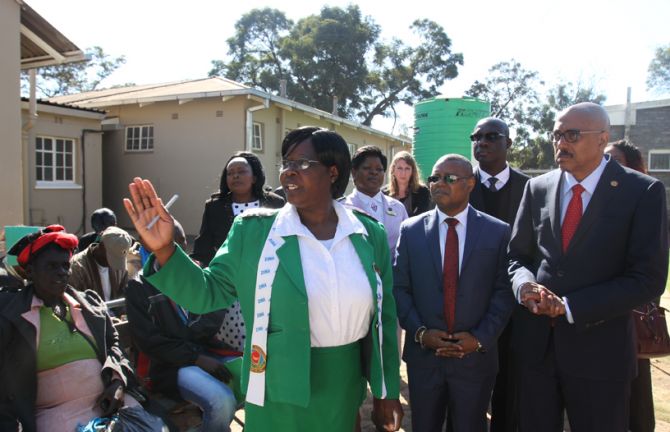
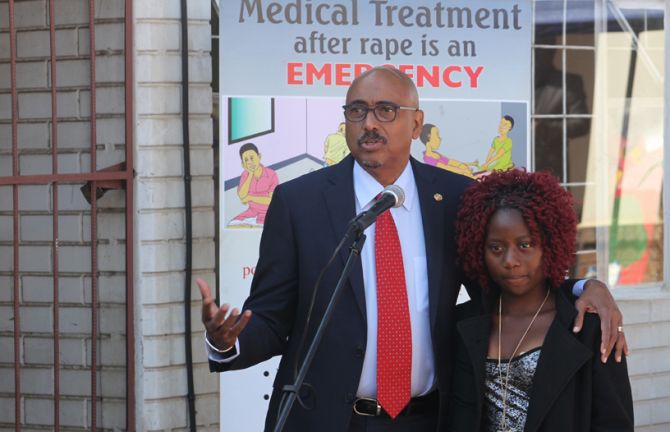
12 June 2015 12 June 2015UNAIDS Executive Director Michel Sidibé visited the Mbare City Health Clinic in Harare, Zimbabwe, on 11 June. The public clinic runs an antiretroviral treatment programme that also provides services for victims of rape.
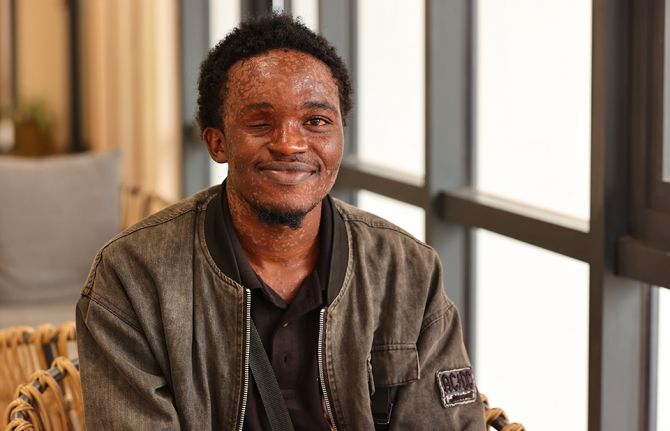
During the visit to the clinic, which is supported by the City of Harare and Médecins sans Frontières, he met people living with HIV, including 19-year-old Thandiwe. Mr Sidibé heard the harrowing story of how she contracted HIV through rape and described her tears as, “A sign of our collective failures. We must do better for her and all women and girls.”
Speaking at the clinic, traditional leader Chief Chiveso denounced violence against women and called on men to be activists against gender-based violence. Mr Sidibé hailed the Chief as a champion for gender equality and for ending gender-based violence and the AIDS epidemic.
Earlier, Mr Sidibé engaged in a dialogue with community leaders, who told him of the challenges that marginalization and unemployment bring. Mr Sidibé said that adolescent girls are affected by the poor economic situation, which has resulted in more girls being infected with HIV compared to their male peers.
Two thirds of the population in Zimbabwe is under 25 years and HIV prevalence is almost two times higher among women aged 15–24 than among men of the same age. Zimbabwe has the sixth highest number of annual adolescent AIDS-related deaths in the world.
Mr Sidibé lauded the combined efforts of Zimbabwe’s civil society and government, which have resulted in a drop in HIV prevalence and the number of AIDS deaths, but warned that the country needs to do more to Fast-Track the response to HIV in order to end the AIDS epidemic in Zimbabwe by 2030. “If we are not careful, after 2015 people will forget about AIDS, complacency will creep in and people will look at other crisis,” he said.
Region/country
Feature Story
Understanding HIV through phylogenetic research
08 June 2015
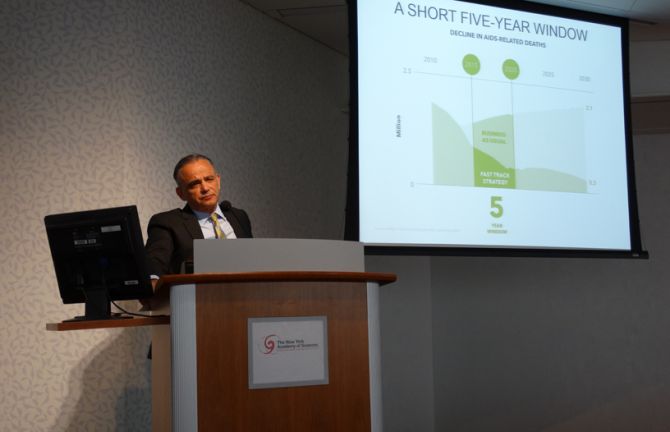
08 June 2015 08 June 2015Phylogenetic research—the analysis of molecular sequencing data to study evolutionary relationships among groups and organisms—needs to be scaled up to end the AIDS epidemic, according to the participants at a symposium held on 4 June at the New York Academy of Sciences called HIV 2015: Using Phylogenetics to Enhance the HIV Response.
Speaking at the symposium, UNAIDS Deputy Executive Director Luiz Loures said that an evidence-driven, focused and rights-based approach is needed to Fast-Track the HIV response in the next five years and end the AIDS epidemic by 2030. “Science has been the major component of the progress we have made so far. Advancing phylogenetics will help us sharpen our focus on the most vulnerable groups, their locations and the progression of the HIV virus,” said Mr Loures.
Molecular genetics and biodata will provide high-quality information on the diversity of HIV strains among people living with HIV and their evolution and on the dynamics of HIV transmission. “A molecular clock study enables us to identify important characteristics of people transmitting HIV and understand how to reduce high incidence among vulnerable groups, for example young women in Africa,” said Tulio De Oliveira from the Africa Centre and the University of KwaZulu-Natal in Durban, South Africa. “Recent advances in phylogenetic methods and molecular evolution show that data that combine genetic, spatial, immunological and social information can transform our understanding of epidemic dynamics.”
In the past few years, scientists have been closely researching the effectiveness of available antiretroviral medicines and the implications of drug resistance to tailor treatment programmes for specific populations. A phylogenetic study on HIV transmission and drug resistance in 27 areas representing 72% of new diagnosis in the United States of America, among many other findings, showed that 18.9% of men who have sex with men living with HIV transmitted drug resistance mutations between 2010 and 2012. The study also showed higher transmission rates among African-American men who have sex with men and young men who have sex with men. “There is a great opportunity to incorporate phylogenetics and molecular epidemiology into HIV prevention and treatment programmes to improve sustainability,” said Alexa Oster, Lead, Molecular HIV Surveillance at the Division of HIV/AIDS Prevention, Centres for Disease Control and Prevention.
However, the participants agreed that the significant challenges around genetics and HIV research among key populations, including ethics and human rights issues, will need to be addressed to fully benefit from the potential of phylogenetics.
The annual symposiums convened by the New York Academy of Sciences and UNAIDS bring together scientists, activists, human rights defenders and policy-makers to discuss emerging advances in science relevant to accelerating the HIV response.
Related
Feature Story
First Lady of Cameroon honoured for her work on HIV
04 June 2015
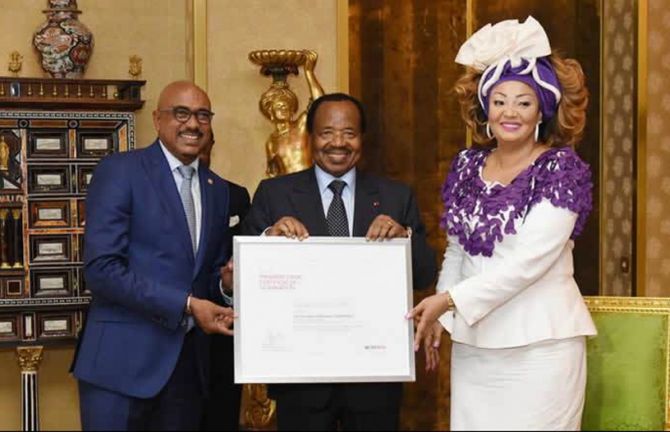
04 June 2015 04 June 2015During a three-day visit to Cameroon, UNAIDS Executive Director Michel Sidibé named the First Lady, Chantal Biya, as a Special Advocate. Through her foundation and the non-profit organization African Synergy against AIDS and Suffering, Ms Biya has been advocating for the protection, education and health of women and children for more than 20 years, especially in the context of HIV.
“This award recognizes the work the First Lady has done for decades for mothers and their children, said Mr Sidibé. “We cannot forget the pioneers.”
President Paul Biya, who participated in the ceremony, which was held at the Unity Palace on 1 June, expressed his commitment to the AIDS response and said, “The government and African Synergy against AIDS and Suffering will double their efforts in the response to HIV.”
During his visit, Mr Sidibé met with 16 mayors from the cities of Douala, Bamenda and Yaoundé, home to 30% of people living with HIV in Cameroon. The mayors signed the Paris Declaration on Fast-Track Cities, which calls for ending the AIDS epidemic in cities by 2030.
Mr Sidibé also met representatives of civil society, including religious leaders, and joined Minister of Health André Mama Fouda at the launch of an HIV prevention campaign with truck drivers. In a meeting with the minister, Mr Sidibé noted that the country’s increase in national funding for the AIDS response had had good results and would have a positive impact on development.
Region/country
Feature Story
Ensuring access to HIV services for internally displaced people in South Sudan
01 June 2015
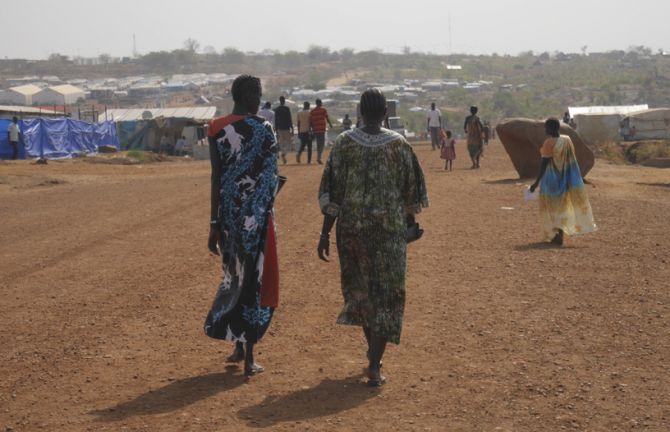
01 June 2015 01 June 2015In the north-eastern city of Malakal in South Sudan, an HIV support network with around 150 members met on a regular basis to talk about the challenges they faced in accessing antiretroviral medicines and the food they needed to stay healthy. But in 2013, when the civil war broke out and fighting reached Malakal, everything changed.
Hundreds of people were killed and thousands more fled their homes, many to the camp run by the United Nations Mission in South Sudan (UNMISS) in the outskirts of Malakal. Only six of the members of the network found their way to the camp. Joseph Leggi Pio, who works at the HIV Unit in UNMISS and was one of the founding members of the group, doesn’t know what happened to the rest.
Life isn’t easy for anyone in the camp, but it can be especially difficult for people living with HIV. Medical facilities inside the overcrowded camp are facing logistical problems, including shortages of antiretroviral medicines and food and long waiting times to see health workers. Mr Pio said one of the patients living with HIV at the camp had recently died. Another person managed to move to Juba, where there is better access to HIV treatment services. Many more people living with HIV regularly visit Mr Pio’s office to find out when the medicine will arrive.
More than 100 000 internally displaced people are crammed into 10 UNMISS protection sites throughout the country, none of which were built to shelter anywhere near that number of people.
“Everything is a priority,” said Leku Dominic Samson, Senior Medical Assistant with the International Organization for Migration. “The HIV needs are only starting to be addressed.” Health workers have focused on emergency first aid, while also dealing with widespread diarrhoea and an increasing number of malaria cases.
The Government of South Sudan and health workers are committed to finding ways of providing HIV prevention and treatment services to internally displaced people in the UNMISS sites. Humanitarian organizations and United Nations agencies, including UNMISS, UNAIDS and the Office for the Coordination of Humanitarian Affairs, provided technical and financial support to open an additional primary health-care centre, where HIV testing and counselling services are available.
These organizations are also advocating to install a CD4 machine at the United Nations Hospital in the Malakal camp to help health workers monitor the viral load of people living with HIV. In the meantime, HIV prevention and treatment messages are being disseminated to more than 20 000 people living in the camp.
“Awareness is always an issue in the camp as people continue to arrive from all over the country, including rural areas where access to health information is limited,” said Mr Pio. He added that people’s behaviour in the camps, where they tend to take more risks, is worrisome. He is especially concerned that young people, many of whom were separated from their families during the fighting, are having unprotected sex, at times due to lack of access to condoms.
Mr Pio and other health activists are training groups of HIV counsellors to mobilize people around the camp to talk about HIV and encourage them to protect themselves. The counsellors also take this opportunity to distribute up to eight boxes of condoms a day.
The counsellor trainings and community dialogues are beginning to show positive impact. For example, Tungwar Wuor—a resident at the Malakal camp—said he had little knowledge about HIV before he went through the training session to become a counsellor in March. Now he has red ribbons on all his clothes and talks easily about how people can protect themselves and others from HIV infection. “I wanted to help other people know their HIV status and how to prevent HIV,” said Mr Wuor. “HIV infection is something that can be stopped.”
He added that many people are initially wary when he starts talking to them about the virus, because of the stigma associated with HIV. He said some of them associate HIV with immorality. He has also been working with religious leaders to include HIV prevention messaging in their services.
“I explain to them that it is possible for anyone to contract the virus if they do not protect themselves and that people living with HIV can access treatment to lead positive lives,” said Mr Wuor.
Region/country
Related

Feature Story
A Journey of Motherhood
11 May 2015
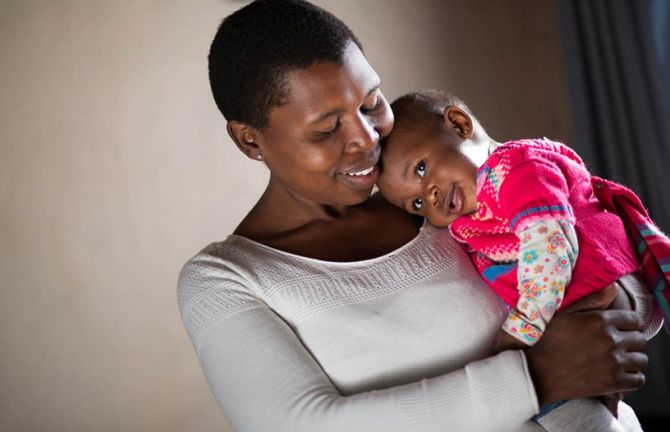
11 May 2015 11 May 2015To commemorate this year’s Mother’s Day, UNICEF and the Global Fund to Fight AIDS, Tuberculosis and Malaria (Global Fund) released a new video and special website featuring mothers who are HIV-positive.
In 2013 and 2014, UNICEF and the Global Fund asked six women in South Africa and Malawi to share their reflections, hopes and fears as they went through their pregnancies and the delivery of their babies, and in the months after their children were born.
A Journey of Motherhood acknowledges the particular challenges HIV-positive mothers experience to give birth to healthy HIV-negative children, and to remain healthy themselves. The initiative also stresses the progress made in providing HIV medicines to prevent new HIV infections among children worldwide.
Each year, approximately 1.5 million women living with HIV give birth. With no medical intervention, the risk of passing on the virus to their babies during pregnancy, delivery and the breastfeeding period can be as high as 45%. But today, medicine to prevent mother-to-child transmission of HIV—a single, daily pill—reduces that risk to 5% or less.
Resources
Related

Feature Story
China’s dating application for gay men to expand HIV prevention among users
06 May 2015
06 May 2015 06 May 2015The man known as Geng Le, who launched Blued, the world’s largest gay dating smartphone application, was a respected police officer in China almost 20 years before he left the force in 2009 after fellow officers objected to working with him because of his sexual orientation.
Now Geng Le is the Chief Executive Officer of the Danlan gay men’s network, the non-profit organization behind Blued. During a meeting 6 May with UNAIDS Executive Director Michel Sidibé in Beijing, China, Geng Le pledged to expand Danlan’s HIV prevention programme.
Blued has almost 15 million users, mostly in China, but its popularity is growing outside the country. As a service to its users, it provides information on the risks of unsafe sex and the rights of men who have sex with men. Users are asked questions aimed at increasing their knowledge of HIV treatment, prevention tools and care options. In addition, they are pointed to locations where they can access HIV testing and counselling.
Geng Le said, “We are doing our best to use science and technology to improve the lives of lesbian, gay, bisexual and transgender communities, including their health. Our vision is that all young people can live in dignity, be free of stigma and discrimination and share love no matter where they come from, what they are doing, what their sexual orientation is and what their HIV status is.”
Mr Sidibé’s visit included a demonstration of the application and an online exchange with users.
Danlan runs a free HIV rapid testing outlet, which provides services to men who have sex with men in partnership with public health agencies. “Danlan is an example of an organization for the future. It protects the rights of people not reached by services, everywhere," said Mr Sidibé.
Danlan has organized campaigns against discrimination and gives technical support on web-based HIV prevention and treatment initiatives. It is expanding into other countries and is currently establishing offices in the United States of America and Thailand.
Region/country

Feature Story
China and Africa strengthen partnerships for health and development
06 May 2015
06 May 2015 06 May 2015The clean energy company Hanergy Holding Group and UNAIDS have agreed to cooperate on philanthropic and corporate responsibility initiatives to achieve zero new HIV infections, zero discrimination and zero AIDS-related deaths in Africa.
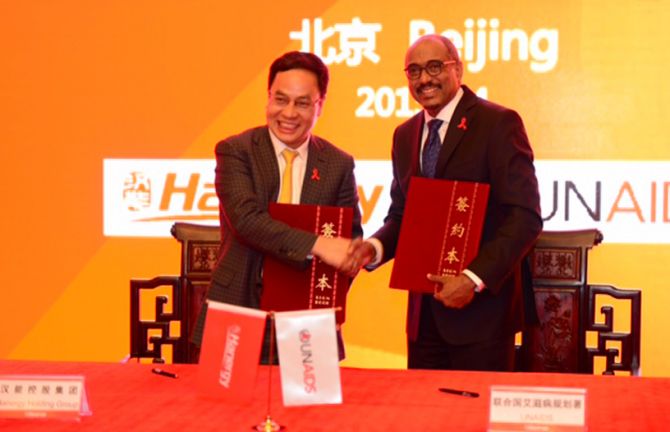
The Chair of Hanergy, Li Hejun, and the Executive Director of UNAIDS, Michel Sidibé, signed a memorandum of understanding in Beijing, China. Under the deal, UNAIDS and Hanergy will work together on a number of social development programmes and will partner to bring clean power solutions to the continent. They will work directly with communities, focusing on the health and education sectors.
Li Hejun said, “We are committed to building on our work on AIDS and expanding our initiatives to African countries. It is not only a responsibility, it’s the right thing to do.”
Mr Sidibé said, “The provision of clean energy to households, schools and health facilities within Africa is central to ensuring that the total well-being of people is at the centre of a healthy society.”
The agreement was signed during a joint mission to China by Mr Sidibé and Mark Dybul, the Executive Director of the Global Fund to Fight AIDS, Tuberculosis and Malaria (Global Fund). One of the objectives of the visit was to encourage new strategic partnerships between China and Africa, including investments in infrastructure and the economy and innovation in health and human development.
Africa imports 80% of its antiretroviral medicines. Many of the active ingredients come from China. Mr Sidibé and Mr Dybul met with Chi Jianxin, Chief Executive Officer of the China–Africa Development Fund, to promote joint ventures between China and African countries on the local production of medicines and health commodities. They also offered technical support from both organizations on enabling strategic partnerships.
Mr Dybul said, “There is huge potential for cooperation between China and Africa on innovation and the transfer of technology in many sectors and we look forward to taking this further.”
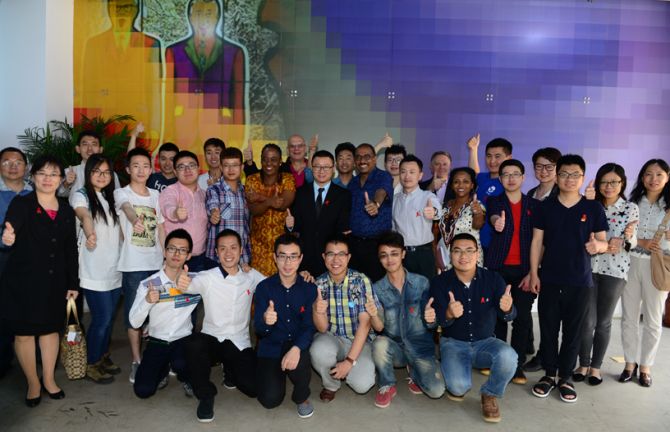
The China–Africa Business Council will promote communication and understanding between young people in China and Africa with the Towards Zero AIDS youth social benefit campaign. Mr Sidibé attended the launch of the campaign at Beijing’s University of Science and Technology and encouraged young Chinese people to show leadership in the AIDS response. The campaign is organized and run by young people from 60 universities in China.
Wenxia Li, a student from Beijing Forestry University, said, “We call for action on safe sex, we call for using condoms properly so that we and others can enjoy a healthy life.”
Mr Sidibé also participated in a policy dialogue on better health in China and Africa. Also present were the Ambassador of Djibouti, Abdallah Abdillahi Miguil, Feng Yong, Director for Africa at the Department of International Cooperation, China National Health Family Planning Commission, and Christoph Benn, Director of External Relations at the Global Fund.
Ambassador Abdullah Abdillahi Miguil said, “For the African continent to go beyond where it is now for its people, we need to build the capacity of our people for innovation.”
The dialogue sought to identify areas of cooperation and innovation and the types of strategic partnership between China and African countries that can be galvanized to support better health.
Region/country

Feature Story
Sexuality education programming set to reach millions of young people across eastern and southern Africa
28 April 2015
28 April 2015 28 April 2015Young people in eastern and southern Africa, like many of their peers around the world, often receive conflicting and inaccurate information about sex. This can lead to badly informed decisions about how, when or with whom to have sex and how to protect themselves against HIV.
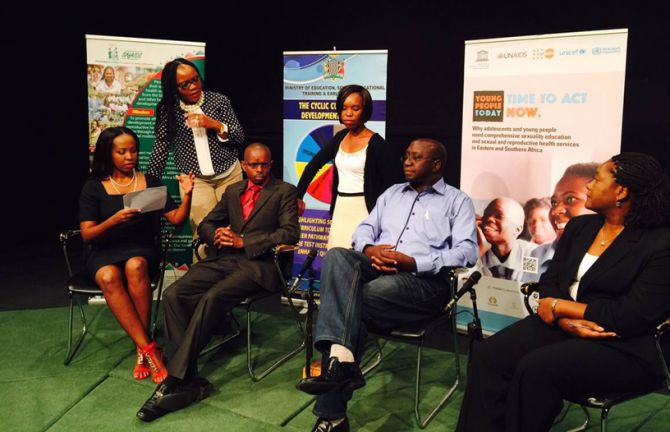
With support from UNAIDS, UNESCO and SAfAIDS a major regional series of radio and TV programmes has been launched to address this gap. It is designed to deliver comprehensive sexuality education to young people and give them a forum to discuss issues around sex and sexuality, in a region where HIV prevalence is high. Across Africa, AIDS-related illness is still the leading cause of death among adolescents, and adolescent girls and young women are especially vulnerable to new HIV infections.
According to Charity Banda, HIV/AIDS Coordinator at Zambia’s Ministry of Education, this move is very important. “By facing puberty without being prepared, young people are left confused and unsupported. This ultimately makes them vulnerable to high-risk behaviours that increase their chances of contracting HIV. That’s why this new initiative is so timely.”
The series was first launched in Zambia on 21 February 2015 and is set to be broadcast in five other countries later this year: Malawi, Mozambique, Namibia, South Sudan and United Republic of Tanzania. The Zambian series has 26 TV episodes, 13 radio episodes and includes a 15 minute live talk show every Saturday called The Sexuality Talk Challenge.
It is being aired on the largest television and radio network in the country, the Zambia National Broadcasting Corporation, which reaches more than 4 million people every day on TV alone. The programmes are being translated into several local languages.
Guests on the show include young people, youth-led organizations, teachers, government officials, policy-makers and civil society representatives. Topics discussed on air have touched on: love, sex and healthy relationships; self-esteem and understanding yourself and your rights as an adolescent; peer pressure; and challenging misconceptions. One episode has also been dedicated to improving communication between young people and the significant adults in their lives.
“Evidence has shown that teenagers who have discussed issues with their parents or guardians are more likely to make safer, smarter decisions about sex and their sexuality,” said Patricia Machawira, UNESCO’s Eastern and Southern Africa Regional Advisor on HIV and Education. “This includes waiting longer to begin having sex, having fewer sexual partners, using contraception and having the confidence to say “no” to doing anything they are not comfortable with,” she added.
The series’ frank and open discussions have already been sparking debate. The partners hope that by the time the programme finishes its run in Zambia at the end of June such discussions will have helped break down barriers to communication, with access to accurate information empowering young people to make informed choices for a better, healthier future.
As Medhin Tsehaiu, UNAIDS Country Director for Zambia, sums up, “Information is power and young people need to be equipped with the right information and skill to make right decisions.”
Related

Feature Story
Community must play a much greater role in HIV treatment delivery especially for people being left behind
20 April 2015
20 April 2015 20 April 2015Strengthening and expanding community-based approaches to delivering HIV treatment is vital to the long-term success of the AIDS response, according to a report launched on 20 April by Médecins sans Frontières (MSF) and UNAIDS.
The report highlights MSF’s innovative approaches to the critical challenge of how to scale up treatment to ensure that people living with HIV have access to antiretroviral therapy through ways that fit in with their daily lives.
Taking place in London, on the occasion of the Board Meeting of the Partnership for Maternal and Child Health and of the Strategy and Coordination Group of Every Woman Every Child initiative, the launch was an opportunity to show that the meaningful involvement of the community in antiretroviral therapy delivery, adherence and retention initiatives works. It was emphasized that the scale-up of financing and implementation of community-based service delivery will be essential to end the AIDS epidemic by 2030.
During the launch, Amina Mohammed, the Secretary-General’s Special Adviser on Post-2015 Development Planning, said, “I am glad that we have an opportunity to be reminded of the importance of ensuring that services and commodities reach the people and communities most in need.”
According to Tom Decroo, Operational Research Coordinator at MSF, “This document presents experiences of how community-based antiretroviral therapy delivery can improve both the level of access to HIV treatment and the quality of health outcomes for people living with HIV. They are not one size fits all solutions, but they illustrate that community-based antiretroviral therapy delivery is efficient, effective and responds to the specific needs of people.”
Despite the progress made—there were 13.6 million people on treatment as of June 2014—there is still a long way to go. Only 38% of adults living with HIV and under a quarter of all children living with HIV have access to the life-saving medicines.
Luiz Loures, UNAIDS Deputy Executive Director, noted that the move towards greater emphasis on community involvement could help better identify people in need of treatment, especially among the most marginalized and hard to reach populations. He stressed that community-based antiretroviral therapy delivery is not only good for individuals, their families and their communities, but has been shown to be more cost-effective, owing to better uptake, adherence and lower service provision cost.
Mr Loures also agreed that the pivotal role that civil society and communities have traditionally played in the AIDS response will need to be bolstered further.
“UNAIDS has launched a call for countries to Fast-Track towards ending the AIDS epidemic by 2030. If we are to reach this goal, we expect that by 2020 the percentage of community-based services will need to increase from 5% to 30%. I am proud to share with you today the efficient and effective innovations by MSF. UNAIDS will continue to support the many other organizations who are working to strengthen community-based service delivery to ensure all people in need have access to HIV treatment.”
The publication presents a number of concrete models of relevant and appropriate community-based antiretroviral therapy delivery systems that are adapted to their particular contexts. These strategies have been explored in eight countries: Democratic Republic of the Congo, Guinea, Kenya, Lesotho, Malawi, Mozambique, South Africa and Zimbabwe. They are largely focused on patients who have been taking HIV medication successfully for some time and who have no concurrent illness and immune systems that are showing signs of improved health.
Examples of community-based antiretroviral therapy programmes include: adherence clubs, where peer counsellors dispense medicines and complete basic medical checks; free community antiretroviral therapy distribution points closer to patients’ homes; self-formed community antiretroviral therapy groups, where members take turns to collect medicines from the clinic and distribute them to others living nearby; and appointment spacing and fast-track refills in which clinical consultations occur less often and medicines are obtained for a longer period.
Adapted to a variety of situations, most of these often unconventional strategies have demonstrated reduced burdens for patients and health systems. They have resulted in more people staying on medication, lowered service provider costs and helped enable people living with HIV to live healthier and more productive lives.
Related
 Communities, authorities and UNAIDS coordinate to maintain HIV care during emergencies in Colombia and Venezuela
23 September 2026
 UNAIDS, WHO and Unitaid bring manufacturers and governments together in Geneva as HIV financing enters a new era
14 September 2026
 Built on trust - Community-led HIV responses in Thailand
26 August 2026

Feature Story
Women living with HIV in New Zealand talk about stigma
09 March 2015
09 March 2015 09 March 2015In the lead up to International Women’s Day, UNAIDS Deputy Executive Director Jan Beagle joined a group of women living with HIV in Auckland, New Zealand, to hear about their experiences. The meeting was one of the regular meetings of Positive Women, a support organization for women living with HIV and their families. The group works on raising awareness of HIV in the community through educational and anti-stigma programmes.
Jane Bruning, National Coordinator of Positive Women Inc. said, “Living with HIV can be very isolating as many women don’t want to tell anyone about their status. So it’s extremely important to have a safe space where women can gather and speak openly without fearing they will be judged.”
Ms Beagle, who is originally from Auckland, said she was touched by the women’s stories. “I’ve visited women living with HIV in many countries, but it is special to hear from women living with HIV in my own country. I am moved by their stories and I am committed to work with them to address the stigma and discrimination that is so much a part of their daily lives.”
The women told Ms Beagle about their fear of disclosing their status publicly. Their reasons were often different. For some, there was concern over losing their employment, while others were worried their children would be ostracized because their mother is living with HIV.
Judith Mukakayange, who is now open about her status, said she came to New Zealand 15 years ago as a refugee, fleeing civil war in Rwanda. When she arrived she was overjoyed to start a new life. However, that dream quickly crumbled when as part of her application process to emigrate she took an HIV test and learned that she was HIV-positive. “When you hear you have HIV you feel so isolated, so it’s important to connect to other people who understand you,” said Ms Mukakayange.
“I have this story that I don’t tell anybody. Even my close friends don’t know. I just can’t say I have AIDS. It’s awkward, awkward, awkward. Coming here to Positive Women is great. I can’t imagine life without Positive Women,” another woman at the meeting said.
From the early days of the AIDS epidemic, New Zealand has taken a lead in the response. The country implemented evidence-informed programmes to ensure that key populations at higher risk of acquiring HIV received priority attention. In 1987, New Zealand was among the first countries to introduce needle exchange programmes for people who use drugs. It was also a regional pioneer in decriminalizing sex work and sex between men.
These initiatives are widely credited with having curbed the epidemic in the country. New Zealand has a very low HIV prevalence, with the Ministry of Health reporting around 0.1% of adults aged 15 to 49 living with HIV. In 2013, around 180 people were newly diagnosed with the virus.
However, despite this progress, people living with HIV still face stigma and discrimination. A recent survey conducted by local AIDS organizations found that 50% of people surveyed would be uncomfortable having food prepared by someone living with HIV.
Of Positive Women Ms Bruning said, “We may be a small organization but we punch well above our weight. I am proud of what we do.”