

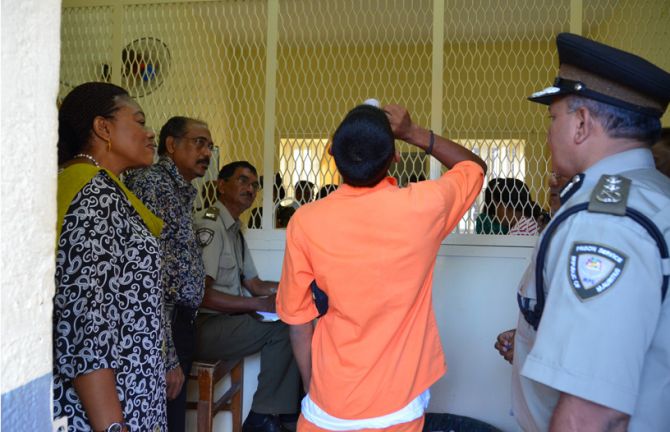
UNAIDS Executive Director Michel Sidibé visiting the opioid substitution programme at the Central Prison in Beau-Bassin, the largest prison in Mauritius, on 19 April 2014. Credit: Government of Mauritius.
Feature Story
Harm reduction among prison inmates in Mauritius
22 April 2014
22 April 2014 22 April 2014In 2006, the Government of Mauritius started harm reduction programmes—needle exchange programmes and opioid substitution therapy (methadone)—to reduce the transmission of blood-borne infections among people who inject drugs both inside and outside prison. Government figures from 2012 show that more than 5 400 people were enrolled on opioid substitution therapy, and the Global AIDS response progress report for Mauritius for 2012 shows that HIV transmission through injecting drug use in Mauritius declined from 73% in 2010 to 68% in 2011.
During an official visit to Mauritius, UNAIDS Executive Director Michel Sidibé visited the Central Prison in Beau-Bassin, Mauritius’s largest prison, to learn about its opioid substitution programme, which allows inmates to continue receiving a daily dose of methadone while imprisoned.
During the visit, Mr Sidibé commended the Government of Mauritius and nongovernment organizations for putting in place a programme that ensures the well-being of inmates. “The quality of the treatment of prisoners reflects the level of humanity in Mauritius,” said Mr Sidibé. “The Central Prison in Beau-Bassin is restoring human dignity in all its dimensions.”
Government figures show that in March 2014 an estimated 2 289 convicted and remand detainees were held in nine prisons in Mauritius. Almost 40% of male inmates in the country are imprisoned due to drug-related crimes, and 30% of inmates are living with HIV. Sharing of smuggled injecting equipment is common in jail, which increases the risk of HIV infection while in custody.
Mauritius is proud to be among the few countries to implement a methadone programme in prison, which covers more than 200 inmates,” said Jean Bruneau, Commissioner of Prisons in Mauritius. “Because of this programme, Mauritius has been able to reduce HIV transmission among prisoners who use drugs.”
“I am grateful to the government for supporting the methadone programme and other important services at the prison care centre,” one prison inmate told Mr Sidibé. “This is preparing me to get back to a normal life and be a valued member of my community.”
During his visit to Mauritius, Mr Sidibé also met with representatives of civil society organizations and networks of people living with HIV to discuss opportunities and challenges in the national AIDS response.
“My discussion with civil society was a moment of truth, an exchange that brought a face to the epidemic,” said Mr Sidibé. “As we look to our post-2015 goals, we must make sure that no one is left behind.”
Stigma and discrimination towards people living with HIV remain critical to the national AIDS response. The People Living with HIV Stigma Index shows that in Mauritius 30% of respondents—people living with or affected by HIV—had fears about being insulted or verbally threatened or harassed, while 23% feared physical assault. Additionally, 28% of respondents reported being denied access to health services due to HIV, while 40.5% reported discriminatory or very discriminatory responses to disclosures of their HIV status to health-care workers.
“People are stigmatized and discriminated because of their HIV status—they are continuously denied services, excluded from their communities and face the threat of deportation. These are the realities of people living with HIV in Mauritius,” said Nicolas Ritter, Executive Director of Prévention Information et Lutte contre le SIDA.
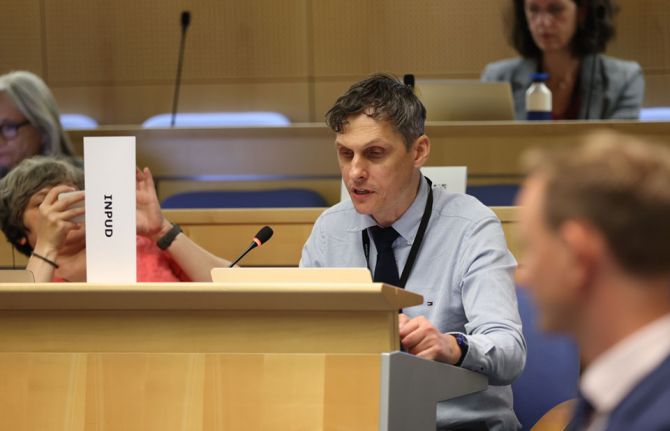
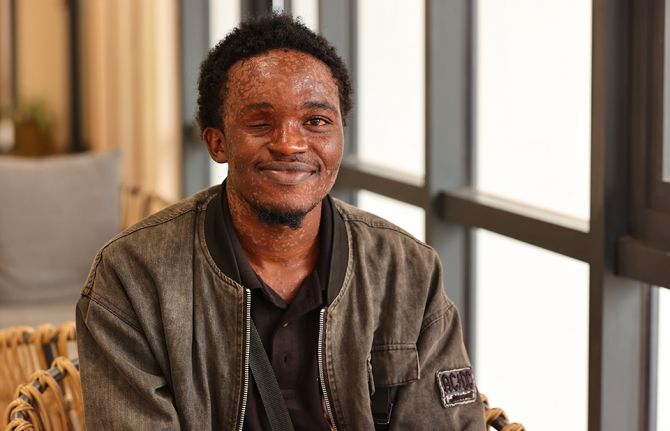
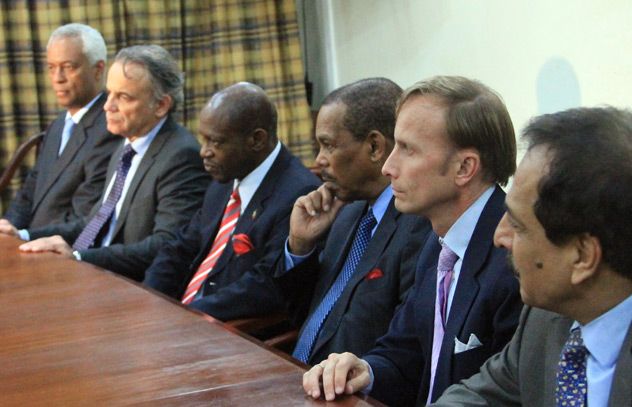
L to R: UNAIDS Caribbean Regional Support Team Director, Ernest Massiah; UNAIDS Deputy Executive Director, Luiz Loures; St. Kitts and Nevis Prime Minister, Denzil Douglas; United Nations Secretary General’s Special Envoy on HIV for the Caribbean, Edward Greene; Global Fund Executive Director, Mark Dybul; and United Nations Resident Coordinator for Jamaica, Arun Kashyap.
Feature Story
The Caribbean, answering the global call to end stigma and discrimination
11 April 2014
11 April 2014 11 April 2014The Caribbean response to HIV has known many successes in recent years. Since 2001 there has been a 54% decline in AIDS-related deaths while new HIV infections have dropped by 49%. Twenty times more people are accessing HIV treatment now than there were ten years ago. And several countries are on track to virtually eliminate new HIV infections among children by 2015.
However, stigma and discrimination are still hampering efforts to reduce new HIV infections, increase the numbers of people accessing antiretroviral treatment and ensure that all people living with HIV can live full and productive lives. Prejudice towards people living with HIV and other key populations such as men who have sex with men, transgender people, sex workers, people who use drugs, homeless people and prisoners, remains a major obstacle throughout the region.
“HIV is a by-product of social inequities,” said Carolyn Gomes, Executive Director of the Caribbean Vulnerable Communities Coalition at the Caribbean Consultation on Justice For All in Kingston, Jamaica. “We need a bottom-up approach. We have to find ways to be heard. We have to apply resources to what we know would bring about transformative change.”
The “Justice For All” initiative is meant to link the voices and actions of members of civil society with governments, faith communities and the private sector. It is an attempt to collectively propel Caribbean countries toward improving citizens’ access to justice and equity. It also aims to build alliances in order to increase awareness and support for human rights.
Coordinated by the Pan-Caribbean Partnership Against HIV and AIDS (PANCAP), the effort is led by the United Nations Secretary General’s Special Envoy on HIV for the Caribbean, Professor Edward Greene, supported by UNAIDS.
“The world now knows what to do to end this epidemic,” UNAIDS Deputy Executive Director, Luiz Loures told participants. “We have the tools but we have entered a phase in which some people are getting left behind. The Caribbean is part of this contradiction. The general epidemic is going down but there are still laws, attitudes and practices that stop us from achieving our goals.” Dr Loures encouraged participants in the consultation to choose concrete targets and milestones to chart their progress towards ending stigma and discrimination.
The Executive Director of the Global Fund to fight AIDS, Tuberculosis and Malaria, Mark Dybul, noted that this regional approach to building a culture of respecting human rights is unique. "The Caribbean can become the leader in ending AIDS,” said Mr Dybul. “We are at an historic moment when we can end AIDS as a public health threat. No other epidemic is pushing us to respond to one another differently and to embrace everyone, every small subset of people, as part of the human family.”
Mr Greene identified key areas of focus including reducing gender inequality, promoting sexual and reproductive health and rights and repealing discriminatory laws that infringe human rights. Sex between men is a criminal offence in 11 nations in the region and several Caribbean countries prohibit aspects of sex work. Some countries also have laws that restrict entry on the basis of sexual orientation, HIV status and disability. The Prime Minister of St. Kitts and Nevis, Denzil Douglas, assured that “Justice For All” will be a focus of discussion for the region’s political leaders.
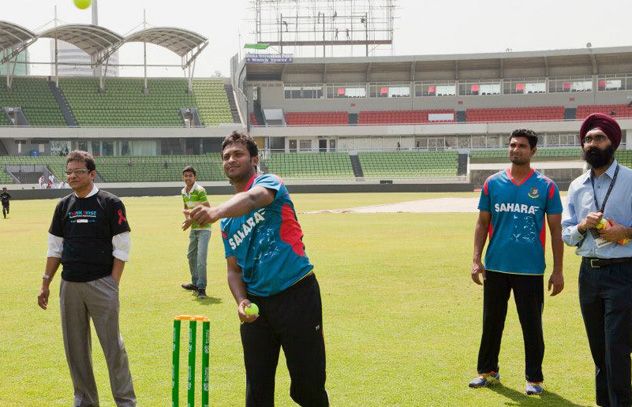
Bangladesh international cricket all-rounder and Think Wise champion Shakib Al Hasan bowls to young participants at a Think Wise coaching clinic at the Sher-e-Bangla National Cricket Stadium in Dhaka, Bangladesh. Credit: UNICEF/BANA2014-00798/Mojumder
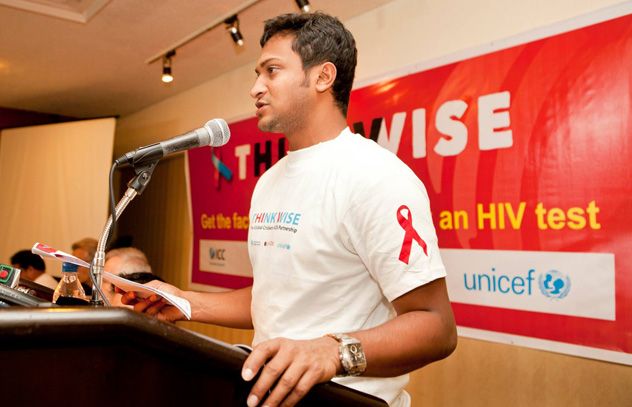
Bangladesh international cricket all-rounder and Think Wise champion Shakib Al Hasan underlines the importance of increasing HIV awareness among young people at a Think Wise press conference in Dhaka, Bangladesh. Credit: UNICEF/Mojumder
Feature Story
Cricket heroes Think Wise about HIV
04 April 2014
04 April 2014 04 April 2014Cricket players from around the world are once again showing their support to young people living with HIV as part of the global Think Wise partnership on HIV.
Throughout the International Cricket Council (ICC) 2014 World Twenty20 (WT20) tournament—which runs in Bangladesh until 6 April—cricketing stars from a variety of international teams are taking part in coaching sessions and site visits. They are meeting with young people living with and affected by HIV, raising awareness of the importance of accessing HIV information and services.
The Think Wise initiative is a long-running partnership between ICC, UNICEF and UNAIDS that uses the power of cricket to reach out to large numbers of people on HIV issues. The partnership, which emphasizes messages on HIV prevention and the need for the elimination of HIV-related stigma and discrimination, has been profiled throughout the 2014 WT20. Players and match officials have worn red ribbons in solidarity with people living with HIV and Think Wise messages are profiled in the stadiums.
As part of the Think Wise activities carried out in Bangladesh, players from the Australia, Bangladesh, West Indies and South Africa teams held special cricket coaching sessions and events for children and young people. As well as practical cricket instruction from the players, the young participants spent additional time with them discussing HIV and life skills issues. Young participant Pranto Sarkar, aged 11, underlined his excitement at having time with the cricketing stars to play with and learn from them. “I just can’t believe that I have played with them, for me it’s a dream come true,” he said.
A special site visit was arranged for members of the Bangladesh women’s international team to the Ashar Alo Society, an organization of people living with HIV. Players met children living with and affected by HIV, who shared their stories about the challenges they face.
Stressing the importance of partnership with the Bangladesh National AIDS Programme, the Bangladesh Cricket Board and the civil society partners that helped to facilitate events, trainings and site visits, the Chief of HIV at UNICEF Bangladesh, Dr Tajudeen Oyewale said, “The events in Bangladesh are a demonstration of the effective power of sport in reaching adolescents with HIV prevention information. The uniqueness of the training lies in the integration of HIV messages into cricket training drills, as well as the broad partnership between UNICEF, UNAIDS and ICC, and the national partners.”
Think Wise has inspired many leading cricketers to join efforts to promote HIV prevention and reduce HIV-related stigma and discrimination. For the 2014 WT20, Bangladesh international all-rounder Shakib Al Hasan championed Think Wise—speaking about HIV prevention and stigma at a number of public events, starring in a Think Wise public service announcement that was shown in cricket grounds throughout the tournament and taking part in the in-tournament Think Wise activities with his colleagues.
“I feel privileged to be a part of the Think Wise campaign. As a sportsperson I know how far-reaching an impact we can make in addressing key issues around HIV, especially in developing countries like Bangladesh,” said Mr Al Hasan.
Commenting on the importance of the involvement of sports stars in the profiling and dissemination of key HIV and health messages, UNAIDS Country Director for Bangladesh Leo Kenny said, "We are thankful to the WT20 partnership with ICC and UNICEF and its ambassadors like Shakib Al Hasan for using cricket as a vehicle for making HIV everybody's business.”

WINDHOEK, 6 March 2014—The President of Namibia, Hifikepunye Pohamba, lights a candle in memory of all women and children victims during the national day of prayer against gender-based violence in Namibia. (Photo by J.Nekaya, NAMPA.)
Feature Story
Strengthening efforts to overcome gender-based violence in Namibia
02 April 2014
02 April 2014 02 April 2014A new assessment report released by Victims 2 Survivors and UNAIDS is looking at the structural and institutional response to gender-based violence (GBV) in Namibia.
The report was disseminated during the commemoration of Orange Day, observed across the world on the 25th of every month, which takes its title from the official colour of the United Nations Secretary-General’s Unite to End Violence against Women campaign.
Gender-based violence (GBV) in Namibia: an exploratory assessment and mapping of GBV response services in Windhoek analyses the challenges encountered by survivors while trying to access services. It also makes key recommendations, including strengthening multisectoral coordination mechanisms, developing relevant standards and protocols to guide service provision, integrating GBV prevention and survivor support into reproductive health and HIV programmes and establishing a free national GBV helpline.
Bience Gawanas, Special Adviser to the Minister of Health of Namibia, emphasized the need for a change in the gender norms of the country and an end to tolerance for GBV. “Let us make the invisible visible, and give a voice to the voiceless.”
According to WHO, one third of Namibian women have experienced or will experience intimate partner violence during their life. Nine out of ten victims of domestic violence are women and 33% of young women who were sexually active before the age of 15 report that their first experience was forced.
In his address to the nation on 21 February, the President of Namibia, Hifikepunye Pohamba, highlighted concrete measures to be taken by the government to reduce the alarming increase of violence against women. These included amending constitutional acts to tighten the requirements for bail and denying parole and giving longer prison sentences to perpetrators of GBV.
President Pohamba also declared 6 March as the national day of prayer for action against GBV in Namibia. “The lives of too many women and girls have been destroyed or disrupted,” said President Pohamba. “Gender-based violence, in all its manifestations, should not be tolerated in Namibia. Let us join hands, to make our country safer, for all, including our women and girls.”
During the Orange Day event, Father Richard Bauer emphasized the importance of involving faith communities in the fight against GBV. “Faith leaders can be crucial allies if they are empowered to intervene, prevent and heal. It’s an incredible amount of work, but can become a reality, if we all work together and acknowledge our mutual strengths,” he added.
Related

'Charting the course of education and HIV' provides an overview of how approaches to HIV education have changed over time, examining lessons learned and the way forward.
Feature Story
Education and HIV: where we’ve come from and where we need to go
01 April 2014
01 April 2014 01 April 2014A new UNESCO publication explores the evolution of HIV education and how it can be made more relevant to young people.
Charting the course of education and HIV examines what has been learned in the AIDS education journey, its opportunities and challenges. It then proposes a way forward in an area that is seen to be critical to the success of the overall AIDS response.
According to UNESCO Global Coordinator for HIV and AIDS Chris Castle, “HIV education can help learners to not only develop and maintain safer behaviours, but also reduce stigma and discrimination towards people affected by, and living with, HIV.”
Exploring the mechanisms and machinations of culture, values, beliefs and relationships of power has become more prominent and acknowledging that education and health are inextricably linked is now seen as vital. For example, HIV education can help to tackle some of the structural drivers of the epidemic, such as harmful gender norms, which can increase the vulnerability of women and girls.
According to the book, one of the major lessons learned in AIDS education has been the need to broaden the scope of HIV education and ensuring a more open and holistic approach to it. In that respect, largely gone are the early tendencies to teach HIV as a science topic concerned only with the biology of transmission, along with the scare tactics often used to discourage young people from becoming sexually active.
Instead, skills-based approaches have emerged that stress communication and coping strategies. Using interactive, student-centred methods of teaching, rather than heavily didactic ones, has been proven to be more successful.
HIV education can help learners to not only develop and maintain safer behaviours, but also reduce stigma and discrimination towards people affected by, and living with, HIV.
UNESCO Global Coordinator for HIV and AIDS Chris Castle
Nowadays, many countries have adopted the newer paradigm. A survey carried out across 13 countries in the Caribbean in 2008 found that all of them provide skills-based health education. Equally, all 21 nations in east and southern Africa have a policy or strategy to promote life skills-based HIV education.
However, the book shows that there is still a long way to go on the ground. Many young people across the world still do not possess even basic knowledge about the virus. HIV education often remains marginalized. Numerous curricula are found to be deficient, with little reference to key aspects of sex and sexuality and a lack of information about where to access relevant services. Often, teachers do not feel confident about delving into topics they may find embarrassing and do not allow their students the space to explore these issues in a frank and open way.
Charting the course of education and HIV recognizes the need to reframe HIV education to respond to such deficits and rethink teacher training and support and integrate skills-based activities with school health programmes. HIV education will also have to be adaptive to the changes in the epidemic and encompass not only HIV prevention but treatment, care, support, and stigma and discrimination. There should also be redoubled efforts to meet the growing demands from young people, and increasingly their parents, for comprehensive sexuality education, joining with ministries, school heads and other teachers to develop a common agenda to help young people make informed choices about how to live healthy and fulfilled lives.
Related


Press Release
Cooperation for the local manufacturing of pharmaceuticals in Africa intensifies
29 March 2014 29 March 2014African Union, UNAIDS, UNECA, UNIDO convene event with African finance ministers
GENEVA/ABUJA, 29 March 2014—African leaders and key multilateral organizations are strengthening and broadening support for the local production of essential medicines on the continent. This was one of the key outcomes of the Seventh Joint African Union (AU) Conference of Ministers of Economy and Finance and the Economic Commission for Africa (ECA) Conference of African Ministers of Finance, Planning and Economic Development held in Abuja, Nigeria, from 25 to 30 March.
On the sidelines of the annual conferences, the AU, UNAIDS, UNECA and UNIDO held a high-level meeting, Local Manufacture of Pharmaceuticals: an Untapped Opportunity for Inclusive and Sustainable Industrial Development in Africa, with African ministers of finance and economic planning. The event highlighted the opportunities for developing a high-quality pharmaceutical industry in Africa, which will bring important health and economic development benefits.
African Union Commission Deputy Chairperson, Erastus Mwencha stressed the benefits of the local production of medicines. “Local production of generic medicines promises affordability and availability of needed drugs, employment opportunities and overall public health benefits, including shortened supply chains, hence helping to reduce stock outs, as well as enhancing the capacity of local regulatory authorities to oversee the quality standards of essential medicines for their countries.”
The Pharmaceutical Manufacturing Plan for Africa business plan, the Action Plan for the Accelerated Industrial Development of Africa and the AU Roadmap on Shared Responsibility and Global Solidarity for AIDS, TB and Malaria Response in Africa have been endorsed by African Heads of State and Government as strategic continental frameworks for developing the pharmaceutical sector from both the public health and industrial development perspectives.
UNAIDS Executive Director Michel Sidibé welcomed the broader support from financial and industrial leaders for the local manufacture of medicines. “The time for Africa to break its dependency on foreign imports is now. The local manufacture of pharmaceuticals in Africa is an opportunity to develop a broader manufacturing and knowledge-based economy,” he said.
Mr Sidibé called for a major continental meeting before the end of 2014 on local production with ministers of finance, trade, industry and health, regional economic communities and the pharmaceutical industry.
Africa is the continent most affected by the AIDS epidemic, but remains hugely dependent on imported pharmaceutical and medical products. It is estimated that more than 80% of antiretroviral medicines (ARVs) medicines are imported from outside Africa. Local production of ARVs is vital to secure continued access to life-saving treatment for the 7.6 million people already accessing ARVs in Africa and the millions more, who still need access to treatment. Local production is important not only for the AIDS response, but for other existing and future health challenges faced by the continent.
UNECA Executive Secretary Carlos Lopes said “We must develop a business case if we want to convince African banks to invest in the pharmaceutical industry.”
The immense need for ARVs and other medicines presents a big market opportunity for pharmaceutical companies on the continent. Total pharmaceutical spending for the continent in 2012 was estimated at US$ 18 billion and is expected to reach US$ 45 billion by 2020.
The Director General of UNIDO, LI Yong, is committed to working in partnership with key continental stakeholders. “Together, we can develop the pharmaceutical industry in Africa; this will contribute to improved public health and will help alleviate human suffering. In line with our mandate to promote inclusive and sustainable industrial development, we will support efforts to enhance public health and enable populations to be increasingly economically productive through the development of viable high-quality industries in this important knowledge-intensive sector in Africa.”
The challenges the pharmaceutical industry faces in upgrading facilities and production practices in Africa include the requirement for large capital investments and the need for experts, specially trained workers, increased regulatory oversight and regulatory harmonization at the regional and continental levels in order to create bigger markets. However, there is growing consensus that strengthening the local production of essential medicines is a priority, along with advancing industrial development and moving the continent towards sustainability of treatment programmes for HIV, tuberculosis and malaria, and improving access to safe and effective medicines to treat a broad range of communicable and non-communicable diseases.
African Union
The African Union spearheads Africa’s development and integration in close collaboration with African Union Member States, the Regional Economic Communities and African citizens. The AU Vision is that of an integrated, prosperous and peaceful Africa, driven by its own citizens and representing a dynamic force in global arena. Learn more at: http://www.au.int/en
UNAIDS
The Joint United Nations Programme on HIV/AIDS (UNAIDS) leads and inspires the world to achieve its shared vision of zero new HIV infections, zero discrimination and zero AIDS-related deaths. UNAIDS unites the efforts of 11 UN organizations—UNHCR, UNICEF, WFP, UNDP, UNFPA, UNODC, UN Women, ILO, UNESCO, WHO and the World Bank—and works closely with global and national partners to maximize results for the AIDS response. Learn more at unaids.org and connect with us on Facebook and Twitter.
UNECA
ECA's mandate is to promote the economic and social development of its member States, foster intra-regional integration, and promote international cooperation for Africa's development. ECA’s policy work aims to shape Africa’s transformation by supporting a growth path which addresses the vulnerabilities that impact on people’s lives. ECA’s strength derives from its role as the only UN agency mandated to operate at the regional and subregional levels to harness resources and bring them to bear on Africa's priorities.
UNIDO
The mandate of the United Nations Industrial Development Organization (UNIDO) is to promote and accelerate inclusive and sustainable industrial development in developing countries and economies in transition. In recent years, UNIDO has assumed an enhanced role in the global development agenda by focusing its activities on poverty reduction, inclusive globalization and environmental sustainability. The Organization draws on four mutually reinforcing categories of services: technical cooperation, analytical and policy advisory services, standard setting and compliance, and a convening function for knowledge transfer and networking. UNIDO's vision is a world where economic development is inclusive and sustainable and economic progress is equitable.
Contact
UNAIDS GenevaSaya Oka
tel. +41 22 791 1552
okas@unaids.org
UNAIDS Dakar
Jeanne Seck
tel. tel. +22 1 775 650 235
seckj@unaids.org
UNECA Addis Ababa
Flavia Ba
tel. +251 11 544 3504
fmendesBa@uneca.org
UNIDO Vienna
Alastair West
tel. tel. +43 1 26026 3882
a.west@unido.org
Press centre
Download the printable version (PDF)

At the training of trainers seminar where children learn about the importance of adherence to antiretroviral treatment.
Feature Story
Adolescents living with HIV in Uzbekistan show their peers the way to a new life
20 March 2014
20 March 2014 20 March 2014Samir, a shy 15-year-old, has come a long way. Living in Uzbekistan and diagnosed as HIV-positive around a year ago he thought at the time his life was over. He felt hopeless and depressed. Now, however, he is looking forward to a brighter future thanks to his involvement as a peer-to-peer trainer in an innovative project spearheaded by UNAIDS and UNICEF in Tashkent.
During the most recent project workshop Samir joined 22 other adolescents living with HIV in the Uzbek capital. They were there to learn more about how to provide peer-to-peer support for other adolescents living the same experience in their home regions.
The trainees learned more about HIV prevention, care and support services as well as the increasing availability of HIV treatment options and the related improvement in quality of life. Learning how to challenge stigma and discrimination, which are still very prevalent in Uzbek society was also on the agenda. Many people living with HIV still fear being rejected and so keep their status secret.
For Samir the programme has made all the difference and he is now much more confident and optimistic. “I’m proud of having two hands, two legs and a head and I’m grateful to be alive. The most important things are family, health and a job that you like,” said Samir who wants to work in a bank in the future.
This initiative provides an opportunity for adolescents diagnosed with HIV to not only effectively cope with their own status but to also become leaders in guiding other peers in effective integration into society and living a fulfilled life.
UNAIDS Country Director for Uzbekistan and Turkmenistan Lev Zohrabyan
The peer-to-peer educator initiative started two years ago and UNAIDS and UNICEF have already trained 37 young people and intend to have ongoing training for new HIV-positive adolescents as well as reinforcing the capacity of those already trained. According to UNAIDS Country Director for Uzbekistan and Turkmenistan Lev Zohrabyan, the programme is playing a crucial role. “This initiative provides an opportunity for adolescents diagnosed with HIV to not only effectively cope with their own status but to also become leaders in guiding other peers in effective integration into society and living a fulfilled life”.
For Robert Fuderich, UNICEF Representative in Uzbekistan, the programme provides a safe haven where young people whose lives have been impacted by HIV “have access to psycho-social support, medical and legal counseling and most importantly, to an environment free of stigma and discrimination.”
Although HIV prevalence in Uzbekistan is relatively low, with an estimated 0.1% of the adult population living with the virus, the country is in a region which continues to have the largest increase in newly registered HIV cases in the world.
Related

As part of its continuing work to demonstrate the benefits of actively scaling up quality programmes that are based on human rights and public health needs, UNAIDS released an advocacy brief; Harm Reduction Works. The brief gives examples from around the world on the importance of investing in HIV prevention, treatment, care and support programmes for people who use drugs; the need to engage people who use drugs in programme development; and the importance of implementing strong and effective harm reduction programmes.
Feature Story
Harm reduction works
18 March 2014
18 March 2014 18 March 2014Injecting drug use continues to drive the HIV epidemic in many countries around the world. According to the United Nations Office on Drugs and Crime (UNODC) in 2013 it was estimated that between 11 million and 22 million people inject drugs globally and that 1.6 million (1.2 million––3.9 million) were living with HIV.
In the 2011 United Nations General Assembly Political Declaration on HIV and AIDS, Member States committed to reduce transmission of HIV among people who inject drugs by 50% by 2015. However criminalization, stigma and discrimination remain widespread and continue to prevent people who use drugs from accessing essential HIV services.
Addressing participants at the High-Level Segment of the 57th UN Commission on Narcotic Drugs in Vienna UNAIDS Executive Director, Michel Sidibé emphasised the urgent need to provide effective services. “It is unacceptable that we are failing people who inject drugs,” said Mr Sidibé. “We have all the data to demonstrate that, in combination with antiretroviral therapy, essential services—including needle and syringe programmes and opioid substitution therapy—reduce HIV transmission, decrease mortality, and improve quality of life.”
Although people who inject drugs account for only 0.2–0.5% of the world’s population, they make up approximately 5–10% of all people living with HIV. However globally, less than 1% of people who use drugs have access to HIV treatment.
Participants at the roundtable discussion on demand reduction, which was chaired by Francisco de Asis Babin Vich, Head of the National Plan on Drugs at the Spanish Ministry of Health included representatives from UN Member States from some of the most affected countries. During the discussions Mr Sidibé made a strong call for harm reduction services to be implemented in all countries, particularly where HIV epidemics driven by injecting drug use exist. He cited excellent progress in China, where harm reduction is being scaled up in many parts of the country.
There was consensus among participants that demand reduction strategies should be based on scientific data and health. International drug treaties underscore that health is essential and drug control through repression of production and trafficking is not sufficient. All stakeholders including civil society should be included and engaged in demand reduction policies and programmes according to participants at the roundtable.
As part of its continuing work to demonstrate the benefits of actively scaling up quality programmes that are based on human rights and public health needs, UNAIDS released an advocacy brief; Harm reduction works. The brief gives examples from around the world on the importance of investing in HIV prevention, treatment, care and support programmes for people who use drugs; the need to engage people who use drugs in programme development; and the importance of implementing strong and effective harm reduction programmes.

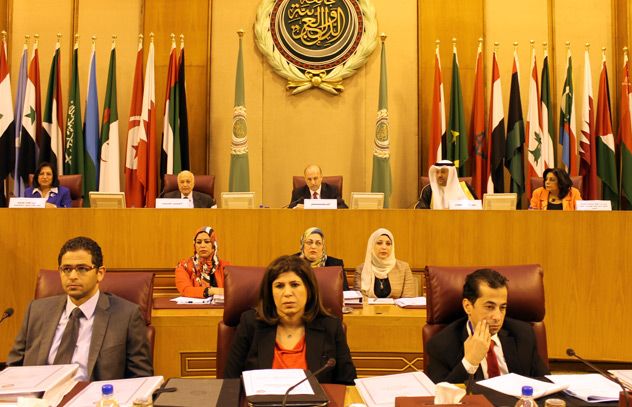
The Council of Arab Ministers of Health endorsed on 13 March the Arab AIDS Strategy (2014-2020) during its 41st Ordinary Session held at the League of Arab States.
Feature Story
The Council of Arab Ministers of Health endorses strategy to halt the HIV epidemic in Arab countries
17 March 2014
17 March 2014 17 March 2014The Council of Arab Ministers of Health endorsed on 13 March the Arab AIDS Strategy (2014-2020) during its 41st Ordinary Session held at the League of Arab States. The new Strategy is intended to guide the development of a coordinated and consensus-driven regional response to HIV.
In his opening remarks, Nabil El Araby, Secretary General of the League of Arab States, noted the importance of the landmark achievement. “I congratulate the efforts made to finalize the Arab AIDS Strategy which began with a Saudi initiative and was concluded with the support of UNAIDS, international organizations and concerned civil society organizations,” he said.
The new strategy comprises 10 goals which are aligned to the targets set in the 2011 United Nations General Assembly Political Declaration on HIV and AIDS while maintaining a broader vision for an AIDS-free generation beyond 2015. The 10 goals of the strategy include: To reduce HIV incidence among key populations at higher risk of infection by more than 50%; to eliminate new HIV infections among children; to increase HIV treatment coverage to 80%; to address stigma and discrimination; to improve AIDS financing; to address the special vulnerability of women and girls; and to review the policies around travel restrictions.
In a resolution of endorsement, the Ministers of Health requested that the League of Arab States and UNAIDS work closely to support and monitor the implementation of the strategy at country level. The League will provide seed funding to kick-start the implementation of the strategy through the organization of three high-level forums to discuss issues related to women leadership, media and religious leaders.
“Health is one of the basic and principle rights for each individual without discrimination on the basis of ethnicity, religion or political, economic or social affiliation,” said Adel Adawy, Egyptian Minister of Health and Population. “Raising the level of public health for the whole society is principle to achieving peace and security.”
UNAIDS worked closely with the League of Arab States, the Kingdom of Saudi Arabia and other member states to provide political and technical support to develop the strategy. A series of consultations, workshops and technical validation meetings were organized as well as high-level advocacy conducted at regional and global level for the endorsement of the strategy by the Council of Arab Ministers of Health.
“The endorsement of the Arab AIDS Strategy demonstrates a longstanding commitment and leadership to the AIDS response in Arab countries,” said Yamina Chakkar, UNAIDS Regional Director for the Middle East and North Africa, on behalf of UNAIDS Executive Director Michel Sidibé. “We thank the Council for making the Arab AIDS Strategy possible and for being an important ally in helping to shape how we will work towards ending the AIDS epidemic in the post-2015 era,” she added.
The rise in new HIV infections makes the Arab region home to one of the fastest growing HIV epidemics in the world. Between 2001 and 2012, the estimated number of people living with HIV in the League of Arab States member countries increased from 140 000 to 210 000. Since 2001, the number of people newly infected with HIV in the Arab countries has increased by more than 44%—from 18 000 to 26 000—and between 2001 and 2012 there was a 69% increase in AIDS-related deaths in this region.
Related
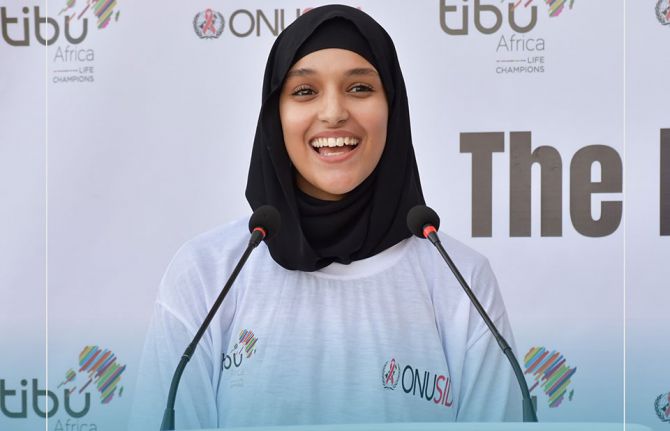

Existing discriminatory laws, policies and practices as well as negative attitudes among health practitioners are some of the main obstacles impeding access to health services for many people including people living with HIV, undocumented migrants, transgender persons, and persons with disabilities. Credit: UNAIDS/O.O’Hanlon
Feature Story
Overcoming discriminatory barriers to health services
14 March 2014
14 March 2014 14 March 2014Existing discriminatory laws, policies and practices as well as negative attitudes among health practitioners are some of the main obstacles impeding access to health services for many people.
This is one of the main conclusions coming out of a debate convened by UNAIDS on 11 March to explore how discriminatory barriers to health services affect different population groups including people living with HIV, undocumented migrants, transgender persons, and persons with disabilities.
For migrant people discrimination often starts at the point of departure, where pre-departure regulations can include mandatory testing for HIV, pregnancy and other health issues. To avoid these tests, migrants may opt for irregular channels of migration, thus becoming undocumented and unable to access health services.
For transgender persons, discrimination is embedded in the International Classification of Diseases, which considers transgender as a mental illness. In many countries, including more than 20 in Europe, transgender people are forced to go through sterilization before gender reassignment surgery in order to change their gender identity.
Speaking about the possible lack of understanding about transgender issues among the medical profession, Mauro Cabral from the Global Action for Trans Equality (GATE) stressed that, “ignorance cannot be an excuse anymore. Doctors must respect, and not judge, patients.”
Another common barrier identified was the perception among the general population in many countries that resources invested in health services are ‘wasted’ on such groups which many in society consider ‘less deserving’.
Monitoring and documenting discrimination was stressed as a strategy to generate evidence to address the problem. In this regard, the Stigma Index and Human Rights Count were highlighted as tools which have been successfully used to monitor discrimination against people living with HIV. For example, the Human Rights Count tool, revealed the practice of involuntary sterilizations of women living with HIV.
“When communities are given the space and opportunity to engage in human rights monitoring, the real obstacles of why people are not accessing health services can be identified and addressed,” said Chris Mallouris, community mobilization adviser at UNAIDS. “We must ensure that communities are at the centre of efforts to address discrimination. They must be there as equal partners,” he added.
The panel debate concluded with a sobering recognition of the long journey ahead to achieve zero discrimination. Participants recognized that action needs to be scaled up to overcome barriers to health services and that no one should be left behind if global health targets are to be achieved.