Credit: UNAIDS
Feature Story
UN General Assembly reviews progress in achieving the targets of the 2011 Political Declaration on AIDS
10 June 2013
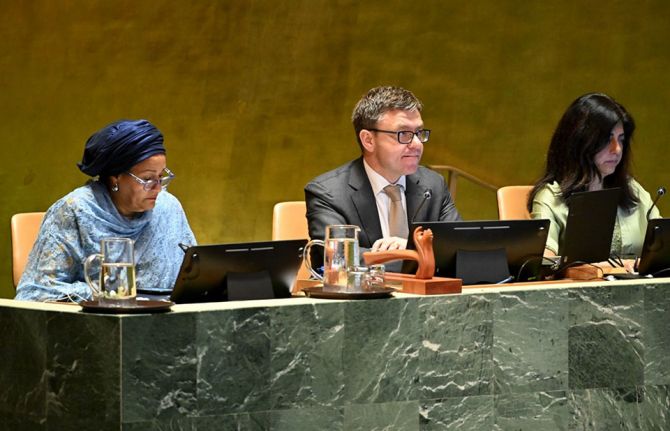
10 June 2013 10 June 2013The United Nations Secretary-General Ban Ki-moon has presented his report on HIV to the 67th United Nations General Assembly which is taking place in New York from 10-11 June 2013. The report Accelerating the AIDS response: achieving the targets of the 2011 Political Declaration takes stock of progress made in implementing the targets set out in the 2011 United Nations General Assembly Political Declaration on HIV and AIDS. The report provides an update on developments in the AIDS response, recommends key actions to accelerate progress and urges renewed commitment to achieve the agreed targets and commitments.
UNAIDS Executive Director Michel Sidibé will also participate in an interactive panel discussion complementing the General Assembly plenary meeting about AIDS and development in the lead up to and beyond 2015.
Quotes
Today’s review happens almost halfway through the implementation of the 2011 Political Declaration. I am proud of the work we have done together to turn the tide on the HIV epidemic. We are paving the way, every day, to achieve an AIDS-free generation.
I welcome the recommendation of the Secretary-General’s High-Level Panel Report to include HIV/AIDS in the post-2015 development framework. For the road ahead, to 2015 and beyond, we must uphold our commitment to universal access to HIV prevention, treatment, care and support by making sure that no one is criminalized, excluded or left behind.
Related information
Related

Feature Story
Organization of American States adopts bold resolution on HIV and human rights
07 June 2013
07 June 2013 07 June 2013The Organization of American States (OAS)—the world’s oldest regional mechanism comprising 35 independent states of the Americas—has adopted a bold new Resolution on the Promotion and Protection of Human Rights of People Vulnerable to or Living With or Affected by HIV.
Meeting at its 43rd General Assembly, delegates approved the Resolution which puts human rights, gender equality and social justice at the heart of the region’s HIV response. The new agreement emphasizes the importance of the greater involvement and participation of the most affected populations in the response to the epidemic.
In spite of progress addressing HIV in the region—treatment coverage is high, and new HIV infections have begun to decline in parts of the Caribbean—the Resolution recognizes the still significant challenges that remain to ensure equitable access to HIV services, particularly among most at risk groups as well as women and girls.
Opening the Assembly, Secretary General of the OAS, Jose Miguel Insulza noted the frequent ‘disregard’ of the rights of minorities but highlighted the critical opportunity the OAS provides "for frank, open policy dialogue on these issues in the Hemisphere".
Deeply rooted stigma and discrimination is still all too pervasive among community and religious leaders, service providers and state agents. This impedes access to services, employment, and in some cases, leads to social exclusion for people most vulnerable to HIV, including sex workers, men who have sex with men, transgender people, drug users and indigenous populations. The Resolution calls for specific measures to promote gender equality and address the needs of women, adolescents and girls, noting the strong inter-relation between gender-based violence as both a cause and consequence of HIV.
This Resolution comes at an opportune time, when global discussions on development and health are shifting, but also demonstrates that new opportunities are emerging to maintain the momentum to reach UNAIDS vision of zero discrimination, zero new HIV infections, and zero AIDS-related deaths.
UNAIDS Executive Director Michel Sidibé
As discussions continue globally around the sustainability of the AIDS response, the Resolution flags the ‘exorbitant’ cost of antiretroviral treatment in some countries and the challenge of securing generic alternatives. Furthermore, despite increases in domestic funding for the AIDS response, the Resolution notes that resources are still not being sufficiently invested in programmes that support and sustain education, behavior change and other HIV prevention strategies.
The Resolution looks at ways to strengthen collaboration with international bodies such as the Inter-American Commission on Women and the Inter-American Commission on Human Rights to advocate for greater protective laws and policies. These include the exchange of experiences and best practices, the organization of joint activities, and the coordination of efforts and capacities to attain the greatest possible impact.
OAS Member States called upon UNAIDS and the Pan American Health Organization (PAHO) to join efforts in the implementation of the Resolution as well as to provide countries with support to eliminate new HIV infections among children, to ensure access to affordable treatment, to end stigma and discrimination and to promote gender equality.
"This Resolution comes at an opportune time, when global discussions on development and health are shifting, but also demonstrates that new opportunities are emerging to maintain the momentum to reach UNAIDS vision of zero discrimination, zero new HIV infections, and zero AIDS-related deaths," said UNAIDS Executive Director Michel Sidibé.
Mr Sidibé met with Secretary General Insulza in Washington DC, prior to the OAS General Assembly where he remarked that "The OAS has been a leader in driving forth discussions around affordable medicines, and is breaking new ground in terms of addressing stigma and discrimination, and recognizing the intersection between gender-based violence and HIV".
External links
External links
Feature Story
International cricketers team up to ‘THINK WISE’ about HIV prevention
07 June 2013
07 June 2013 07 June 2013
60 children from three London schools had the chance to learn cricketing skills from the West Indies team as part of the THINK Wise initiative. 5 June, 2013 in London, England.
Credit: ICC/Getty Images
Cricketing greats from around the world have once more teamed up to promote HIV prevention and anti-stigma messages as part of the global THINK WISE campaign on AIDS. The initiative will run through the 2013 International Cricket Council’s Champions Trophy Tournament taking place from 6-23 June in England and Wales.
A partnership between the International Cricket Council (ICC), UNAIDS and UNICEF, THINK WISE uses the power of cricket and cricket players to reach out to large numbers of people—particularly young people—on AIDS issues. The partnership will be profiled at the prestigious international tournament through dedicated matches, site visits and coaching clinics with international players and other promotional activities.
“I am delighted once again that the ICC is partnering with THINK WISE to continue promoting the importance of HIV awareness,” said ICC Chief Executive, David Richardson.
Celebrating ten years of the ICC working with its UN partners on AIDS, the ICC is dedicating six of the Champions Trophy matches—including the Final—to THINK WISE. Messages on the importance of HIV prevention and the elimination of stigma towards people living with HIV are the central focus of the campaign.
I am delighted once again that the ICC is partnering with THINK WISE to continue promoting the importance of HIV awareness
David Richardson, Chief Executive, International Cricket Council
Over the years, THINK WISE has inspired many leading cricketers to join efforts to promote HIV prevention and reduce HIV-related stigma and discrimination. Current and former players who have championed the campaign include Kumar Sangakkara (Sri Lanka), Graeme Smith (South Africa), Stafanie Taylor (West Indies), Darren Sammy (West Indies), Shakib Al Hasan (Bangladesh) and Virender Sehwag (India).
“As we mark 10 years of action on AIDS through cricket, we have seen how cricket can unite billions of people across the globe. The THINK WISE global cricket AIDS partnership and the inspiring involvement of cricketing greats gives important profile and builds momentum towards changing and saving lives,” said UNAIDS Executive Director, Michel sidibé.
At THINK WISE matches, all participating teams and officials wear red ribbons as a sign of solidarity with people living with HIV. A public service announcement featuring Kumar Sangakkara and Virender Sehwag will be screened at selected tournament matches, THINK WISE messages will feature on the boundary boards and information about the campaign and HIV prevention will feature in match programmes.
During the tournament, players from England, New Zealand, South Africa and the West Indies will undertake specific AIDS awareness-raising activities with people living with HIV and young people.

Through interactions with the cricket players, the 60 children also had the chance to learn about HIV-related issues. 5 June, 2013 in London, England. Credit: ICC/Getty Images
West Indies urge children to THINK WISE
On the eve of the 2013 Champions Trophy opening, West Indies captain Dwayne Bravo and team-mates Darren Sammy and Jason Holder held a special coaching clinic at the Oval in London as part of the THINK WISE partnership activities. The trio attended the clinic alongside fielding coach Andre Coley and took part in a session delivered by UK NGO Cricket Without Boundaries.
Through interactions with the cricket players and coach, 60 children from three London schools had the chance to learn cricketing skills, while also understanding the background of THINK WISE and learning about HIV-related issues.
“It’s very important to get kids aware of HIV at an early age, just like sport, the earlier you get involved in something the quicker you learn about it. It’s good that THINK WISE is taking the initiative to educate children about HIV and I really enjoyed the experience,” said Dwayne Bravo
Jason Holder who is at his first senior ICC men’s tournament, added: “I think that THINK WISE is a very good imitative and it’s great that these three organisations, the ICC, UNAIDS and UNICEF, have come together for this tournament. Hopefully the partnership will continue to grow from strength to strength for years to come.”
The ICC Champions Trophy, featuring Australia, England, India, New Zealand, Pakistan, South Africa, Sri Lanka and West Indies, will be played over 18 days from 6 -23 June.
External links
External links


Feature Story
‘Ciao Capitano’ – Michael Ballack’s fond farewell to football
06 June 2013
06 June 2013 06 June 2013
World class footballer and UNAIDS International Goodwill Ambassador Michael Ballack played his official farewell game at the Red Bull Arena in Leipzig, Germany on 5 June.
Credit: EiB, Andreas Schulz 2013
An era in football has drawn to a close as world class footballer and UNAIDS International Goodwill Ambassador Michael Ballack played his official farewell game at the Red Bull Arena in Leipzig, Germany on 5 June. The charity event, which drew a crowd of more than 45 000 fans, was Michael Ballack’s way of thanking his devoted fans for their support throughout his career.
The proceeds of the charity game will be donated to football youth work as well HIV awareness and prevention work. Michael Ballack also acknowledged the natural flood disaster in his home region and spontaneously donated 100 000 euros to help support the re-construction.
The celebrated former German captain was joined by a host of world class stars as he pitched his ‘Michael and Friends’ team against a squad of top international players and stars. Competitors included Didier Drogba as well as Michael Essien and Andrij Schewtschenko and former Formula One World Champion Michael Schumacher. The teams were coached by Jose Mourinho and Rudi Voeller.
Michael is a captivating football player—and an inspirational leader for millions of young people around the world. Tonight is not all about Ciao Capitano–it’s about looking to the future as his journey continues with UNAIDS. His dedicated support will help us reach our goal of getting to zero new HIV infections, zero discrimination and zero AIDS-related deaths.
UNAIDS Executive Director Michel Sidibé
A mix of influential leaders from the worlds of sport, entertainment, politics and the arts also attended the match to pay tribute to Michael Ballack’s glittering career in football. Executive Director of UNAIDS and avid football fan Michel Sidibé took the opportunity to congratulate Mr Ballack on both his sterling achievements on the field and his dedication to the growing global efforts to get to an AIDS-free generation. He said, “Michael is a captivating football player—and an inspirational leader for millions of young people around the world. Tonight is not all about Ciao Capitano–it’s about looking to the future as his journey continues with UNAIDS. His dedicated support will help us reach our goal of getting to zero new HIV infections, zero discrimination and zero AIDS-related deaths.”
Michael Ballack, known for his leadership on and off the pitch, spoke emotionally to his fans, “You are the ones that make football a great game and I am forever grateful for having had the amazing privilege of sharing my career and love of the game with you."
For the past 7 years Michael Ballack has used his international reputation to convey important HIV prevention messages, empowering young people and helping save lives. He recently travelled to South Africa with the Executive Director of UNAIDS to learn more about the epidemic, visiting local projects and meeting people living with and affected by HIV. Michael Ballack will continue his work with UNAIDS and is planning to undertake more field missions in near future.
Multimedia
Related

Feature Story
Scientific breakthroughs in HIV help shape the future of AIDS research in Africa
05 June 2013
05 June 2013 05 June 2013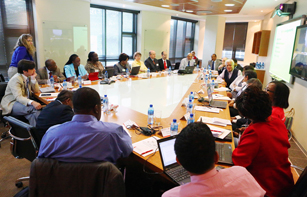
A general view of the panel during the Symposium held at the University of KwaZulu Natal School of Medicine in Durban, South Africa. Credit: UNAIDS/A.Debiky
When doctors from the University of Mississippi medical centre announced on 2 March 2013 that a baby had been ‘functionally cured’ of HIV, the world hailed the news as a historical medical breakthrough.
The baby—famously known as the ‘Mississippi baby’—was born with HIV and treated with aggressive antiretroviral drugs 30 hours after birth. Now, more than two years old, doctors confirm that the baby has not taken any medication since the age of 18 months and tests show no sign of re-active HIV (detectable viral load).
From the time that this extraordinary news was announced scientists and researchers have been busy trying to understand how the ‘Mississippi baby’ case could advance future research in preventing mother-to-child transmission of HIV.
More than 20 scientists, researchers, public health practitioners, donors, government authorities, representatives of non-government organisations and civil society came together for a two-day symposium on 3-4 June under the theme Scientific advances from ‘Mississippi baby’: Implications for public health programmes on mother-to-child transmission of HIV.
“This meeting is about giving people hope,” said UNAIDS Executive Director, Michel Sidibé. “The Mississippi miracle has to become a Durban miracle, a Bamako miracle, a miracle for all children irrespective of where they are born.”
Organised by UNAIDS and the Centre for the AIDS Programme of Research in South Africa (CAPRISA), the symposium focused on 1) whether programmes to stop new HIV infections among children need to be reformulated to promote early identification and treatment of babies at risk of HIV infection and 2) challenges associated with stopping new HIV infections among children and paediatric antiretroviral treatment.
Despite the 24% drop in new HIV infections in children since 2009, some 330 000 children around the globe were born with HIV in 2011. Most children born with HIV (more than 90%) are in sub-Saharan Africa.
Many African countries have made remarkable progress in preventing mother-to-child transmission of HIV by increasing access and integrating HIV prevention, treatment and cares services to mothers and their new-borns. AIDS-related deaths among children in the 22* priority countries of the Global Plan towards the Elimination of New HIV Infections among Children by 2015 and Keeping their Mothers Alive also reduced from 243 000 in 2009 to 203 000 in 2011
This meeting is about giving people hope. The Mississippi miracle has to become a Durban miracle, a Bamako miracle, a miracle for all children irrespective of where they are born.
UNAIDS Executive Director Michel Sidibé
However, progress in expanding access of antiretroviral therapy to children has been minimal. The percentage of children living with HIV eligible for treatment and who were receiving it in 2011 largely falls below 50% in at least 15 of the 22 priority countries—8% in Chad, 19% in Ethiopia and 29% in Malawi.
“Paediatric treatment and care lags behind; there seems to be a disconnect between investments in programmes to stop new HIV infections in children and for children in need of treatment. Even when the infants are identified they are not successfully linked to care,” said Dr Chewe Luo, UNICEF Senior Advisor on AIDS.
The ‘Mississippi baby’ case was discussed at great length highlighting the need for early infant diagnosis and initiation of treatment. “The relevance of the ‘Mississippi baby’ to the general population remains unclear and more research, including for safe and appropriate neonatal drugs needs to be done before we push for widespread change in policy,” said Dr Hanna Gay, Associate Professor at University of Mississippi, who treated the ‘Mississippi baby’. “But one thing we can be certain of is that early diagnosis and treatment saves lives.”
At the end of the two-day discussions, participants made several recommendations, including the need for early infant diagnosis, better research and improved medicines for children as well as more efficient funding mechanisms to strengthen mother and child AIDS programmes.
“What we do know is that early diagnosis of HIV and early treatment of infants and children does lead to better outcomes – regardless of the issue of a cure. We should be concerned that we are not diagnosing and treating children early enough. In South Africa only 65% of children who are in need to treatment are on treatment,” said Dr Aaron Motsoaledi, Minister of Health of South Africa.
*Angola, Botswana, Burundi, Cameroon, Chad, Côte d’Ivoire, Democratic Republic of the Congo, Ethiopia, Ghana, India, Kenya, Lesotho, Malawi, Mozambique, Namibia, Nigeria, South Africa, Swaziland, Uganda, United Republic of Tanzania, Zambia and Zimbabwe [^]

Feature Story
Eminent judges unite to address HIV, human rights and the law
05 June 2013
05 June 2013 05 June 2013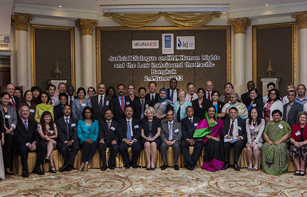
Participants at the judicial dialogue on HIV, human rights and the law. Bangkok, Thailand. 2-4 June 2013. Credit: UNAIDS
In Asia and the Pacific, almost all countries have some kind of punitive laws, policies and practices that hamper access to HIV services for people living with HIV and key populations at highest risk including people who use drugs, sex workers, men who have sex with men, and transgender people.
Faced with punitive legal environments, many people in need of HIV prevention and treatment services are not able to access them for fear of stigma, discrimination, legal reprisals and even violence.
Seeking to address these challenges, some 30 judges from the highest national courts of 16 countries in Asia and the Pacific joined to discuss the role of the judiciary in responding to HIV. They also debated about the specific actions that can be taken to create a more supportive legal and social environment for people living with and vulnerable to HIV in the region.
Convened by UNAIDS, UNDP and the International Commission of Jurists, the meeting was part of efforts to support judges become leaders in the HIV response. Participants stressed the critical role of Judges and courts in protecting people living with and affected by HIV and achieving the UNAIDS vision of ‘zero discrimination’.
30 years into the AIDS response, the need for legal environments to be aligned with the latest scientific developments on HIV and treatment was underlined. “Our authority is based on reason and evidence—this is the strongest ally we have in addressing the HIV epidemic and what we need for just and fair outcomes,” said Hon. Justice Edwin Cameron, Justice of the Constitutional Court of South Africa.
During the gathering, UNAIDS launched a new Judicial handbook on HIV, Human Rights and the Law, providing updated information on the latest scientific developments on HIV as well as key human rights and legal considerations to assist and guide judges’ HIV-related work.
Our authority is based on reason and evidence—this is the strongest ally we have in addressing the HIV epidemic and what we need for just and fair outcomes
Hon. Justice Edwin Cameron, Justice of the Constitutional Court of South Africa
Of the 38 United Nations Member States in the region, 11 impose some form of restriction on the entry, stay and residence of people living with HIV based on their HIV status; 37 criminalize some aspect of sex work; 18 criminalize same sex relations; 11 impose compulsory detention centres for people who use drugs; and 15 provide the death penalty for drug-related offences.
“The time has come for us to address all laws concerning people from marginalized sections of society. We need to re-look at legislation through the lens of the human rights guaranteed under the Constitution and ensure it is aligned to enable progress and to move with the necessary urgency,” said former Chief Justice of the Delhi High Court in India, Hon. Ajit Prakash Shah. Judge Shah was on the bench that handed down the July 2009 ruling that found India's 150-year-old statute (Section 377 of the Indian Penal Code) prohibiting homosexual acts as discriminatory and therefore a violation of fundamental rights.
Transformative jurisprudence
The striking down of Section 377 through the Delhi High Court was one of a number of protective jurisprudence examples that have had a transformative and beneficial impact on the national AIDS response and on public perception of HIV. Other examples are the progressive court decisions in Nepal, India and Bangladesh that have recognized the human rights of sex workers as defined under national Constitutions; decisions in Thailand and India that have ensured access to affordable generic medicines; and Pakistan’s inclusion of transgender people in population registration under the status of a third gender, among others.
Discussions at the Bangkok dialogue were supported by active involvement of representatives from groups of people living with HIV and key populations at highest risk, together with United Nations agencies and partners, who underlined the importance of the judiciary’s active support to the revision and removal of punitive laws in the region.
“If we don’t deal with these issues, we are not going to end AIDS,” said Mr Shiba Phurailatpam, Regional Coordinator of the Asia Pacific Network of People Living with HIV. “Judicial action can affect social views and have an impact on stigma and discrimination—it can save people’s lives,” he added.
“The law must be a shield that protects, not a sword that punishes and increases vulnerability to abuse, harassment and HIV infection,” said UNAIDS Deputy Executive Director, Management and Governance, Jan Beagle who delivered the keynote address at the meeting. “Judges can help shape social and community attitudes by stance and attitude toward people living with HIV and members of key populations,” she added.
Director of the UNDP HIV Health and Development Practice, Dr Mandeep Dhaliwal stressed that judicial leadership is an essential component of addressing inequality. “Getting the legal environment right is essential for addressing the social and structural inequalities which fuel HIV and impede health and development progress,” she said.
External links
External links

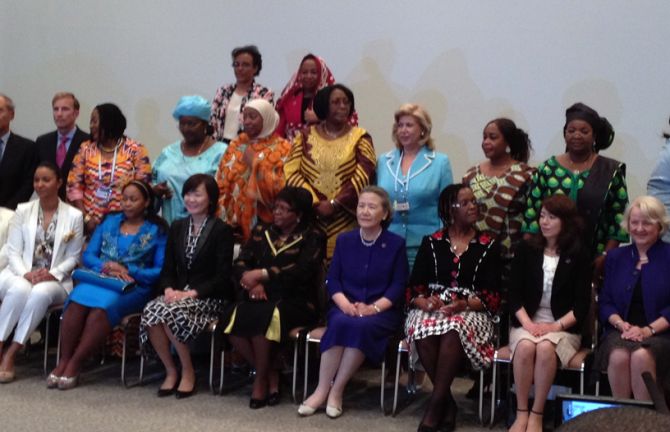
Participants at the ‘Let’s talk about AIDS: Africa and Japan’s Shared Challenges’ symposium during the TICAD V. Yokohama, Japan, from 1-3 June.
Feature Story
TICAD V: First Ladies highlight importance of continued commitment to getting to zero
04 June 2013
04 June 2013 04 June 2013First Ladies from across Africa joined the First Lady of Japan Akie Abe at a symposium entitled ‘Let’s talk about AIDS: Africa and Japan’s Shared Challenges’ during the opening day of the Fifth Tokyo Conference on Africa Development (TICAD V) held in Yokohama, Japan, from 1-3 June. The session assessed progress made and areas for intensified action on HIV. Participants underlined how continued commitment on AIDS and united responses across nations are critical to achieving the vision of zero new HIV infections, zero discrimination and zero AIDS-related deaths.
Panellists stressed the need for Japan and African nations to share experiences and build on progress together, putting at the centre of the AIDS response the respect for rights of people living with HIV and the involvement of young people.
UNAIDS Deputy Executive Director, Management and Governance, Jan Beagle highlighted progress made in Africa under the leadership of the Organization of African First Ladies against HIV/AIDS (OAFLA) and stressed the importance of investing in women and girls.
TICAD V concluded with the adoption of the Yokohama Declaration 2013 and the Yokohama Action Plan 2013-2017 that included the promotion of human security, emphasis on the empowerment of women and youth, support for African initiatives for peace and stability, and the recognition and promotion of the role of the private sector through public-private partnerships.
Quotes
I thought HIV was an issue far away from home, but then I met people including women and children living with HIV and learned that the issues were relevant also in Japan. I realized that we must tackle the epidemic together.
The African Union Roadmap on shared responsibility and global solidarity for AIDS, TB and malaria, reviewed by the recent African Union Summit meeting, is an example of political commitment at the highest level that has made such advances possible. We are still faced with challenges – not least high levels of stigma and discrimination that persist in all parts of the world – but combined efforts will yield the greatest results.
We have seen enormous progress in the last decade, thanks to African leaders including OAFLA and with the cooperation of Japan. We now have the scientific means to defeat HIV, TB and malaria.
Publications:
Publications
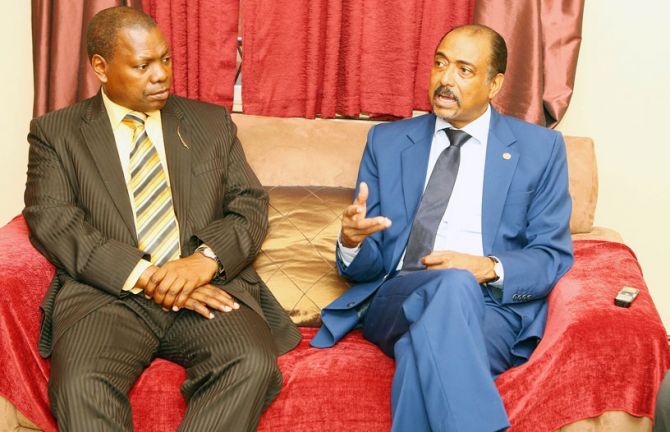
Dr Zweli Mkhize, Premier of the KwaZulu Natal province (left) and UNAIDS Executive Director Michel Sidibé. Durban,South Africa, 4 June 2013. Credit: UNAIDS/Anesh Debiky
Feature Story
Progress on HIV brings hope to the province of KwaZulu Natal
04 June 2013
04 June 2013 04 June 2013During a meeting with UNAIDS Executive Director, Michel Sidibé, the Premier of KwaZulu Natal, Dr Zweli Mkhize highlighted that progress made in the province has begun to turn around the AIDS epidemic in the South African Province which has been most affected by HIV.
KwaZulu Natal has made remarkable progress in expanding access to antiretroviral treatment as well as in reducing new HIV infections. From 2011 to the beginning of 2013 more than 300 000 men have undergone medical male circumcision decreasing their risk of HIV infection. Although it remains high, the overall HIV prevalence among 15-24 years old dropped from 31% in 2009 to 25.5% in 2011.
Mr Sidibé applauded the Premier for his personal vision and leadership in the implementation of decentralised HIV prevention, treatment and care programmes that have yielded visible results. He noted that, if current efforts are expanded, KwaZulu Natal can be on-track to reach the targets set out in the 2011 United Nations General Assembly Political Declaration on HIV/AIDS.
Despite these gains, KwaZulu Natal remains South Africa’s most affected province with an antenatal HIV prevalence of more than 40% in two of its districts and more than 1.6 million people living with HIV in 2011.
According to Mr Sidibé, if South Africa is to achieve real progress, the national AIDS response should continue with its current approach of integrating political and traditional leadership, scientific researchers and active engagement of communities.
Quotes
If KwaZulu Natal, the most affected province in South Africa, can continue to quicken the pace of progress and replicate the successes they are seeing in stopping new HIV infections in children, we can be sure that Africa will be well on the way to ending the AIDS epidemic.
We turned the tide in KwaZulu Natal. When it comes to AIDS we moved from fear, death and despair to hope and aspiration. The people we reached are the living proof of this success story.
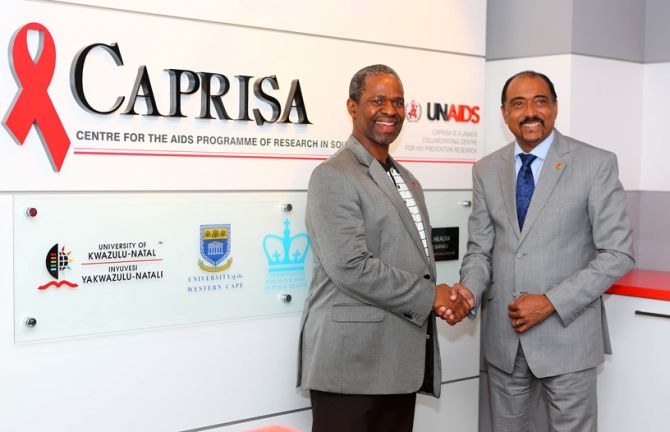
Dr Sibongiseni Dhlomo, Member of the Executive Committee for Health in KwaZulu Natal (left) and UNAIDS Executive Director Michel Sidibé met on 3 June 2013 in Durban, South Africa.
Feature Story
UNAIDS Executive Director says successes in the AIDS response should not result in complacency
03 June 2013
03 June 2013 03 June 2013UNAIDS Executive Director Michel Sidibé and Dr Sibongiseni Dhlomo, Member of the Executive Committee for Health in KwaZulu Natal met on 3 June on the side-lines of the UNAIDS/CAPRISA Symposium: Scientific advances from the ‘Mississippi baby’: Implications for public health programmes on mother to child transmission of HIV taking place in Durban, South Africa.
Mr Sidibé applauded the bold leadership that transformed the province from being the HIV epicentre in South Africa to an innovator in turning the epidemic around.
In recent years, KwaZulu Natal, through strong political commitment and effective HIV programmes, managed to ensure that more than 600 000 people in need of antiretroviral treatment had access in 2012, compared to just over 36 000 in 2005. The rate of mother-to-child transmission of HIV at six weeks declined to 2.1% in 2012 compared to 22% in 2005. The life expectancy in KwaZulu Natal has increased from 56.4 years in 2009 to 60 years in 2011, which is highly attributed to a decrease in AIDS-related deaths.
Dr Dhlomo said he was humbled by the recognition and support his province has been gaining for the successful outcomes in the AIDS response. He acknowledged that the government would need to invest more on HIV prevention services including behaviour and social change programmes. In 2012, the province spent 73% of HIV funds on treatment and care services and only 5% on preventing sexual transmission of HIV.
Quotes
Political and traditional leadership have been brought together with scientific evidence to advance progress towards the end of the AIDS epidemic. This has resulted in a significant shift in KwaZulu Natal’s AIDS response over the last few years but it is no time for complacency.
With the emphasis on truly decentralised action with all stakeholders especially the mayors in all our municipalities, I have no doubt that we are getting closer to our targets. This is everybody’s business and the public health sector cannot do it alone.
Feature Story
UNAIDS Goodwill Ambassador HRH Crown Princess of Norway calls for an end to stigma
03 June 2013
03 June 2013 03 June 2013
UNAIDS Goodwill Ambassador Her Royal Highness the Crown Princess of Norway talks to reporters at the HIV shelter in Kuala Lumpur, Malaysia. Credit: UNAIDS/A.Rahim
Addressing stigma and discrimination was underlined as critical to progress on HIV by UNAIDS Goodwill Ambassador Crown Princess Mette Marit, during a site visit to a shelter for children living with and affected by HIV in Kuala Lumpur, Malaysia.
Visiting the shelter was part of her programme at the Women Deliver Congress (28-30 May 2013), where she spoke and participated in a number of key sessions and panels. The Crown Princess stressed that addressing HIV related stigma is crucial in ensuring key populations have access to essential HIV services as well as support from society.
"Whether in Norway or Africa, or Asia, there is still so much stigma around HIV. Combating stigma is one of the more important aspects to ensure people can protect themselves and get tested,” said the Crown Princess at the WAKE shelter. The shelter is run by the Malaysian Women and Health Association (Perubuhan Wanita Dan Kesihatan) and was set up in 2001 to support children who have been abandoned due to their or their parents’ HIV status.
“One of the biggest challenges to progress on HIV is getting information to people who need it most, who are often on the margins of society and who are discriminated against. To combat stigma we need to talk more about issues that are sometimes sensitive like sexuality and sex work for example” she added.
Arriving at the home, the Crown Princess was met by children, young people and women living with HIV staying in or involved with the shelter. Children shared their experiences with the Crown Princess, guiding her around the brightly coloured shelter and pointing out artwork and decorations they had created as part of their daily activities. Women living with HIV showcased their crafts which are made available for sale at fairs and other events as part of the WAKE income generation initiative.
Whether in Norway or Africa, or Asia, there is still so much stigma around HIV. Combating stigma is one of the more important aspects to ensure people can protect themselves and get tested.
UNAIDS Goodwill Ambassador Her Royal Highness Crown Princess Mette-Marit of Norway
Children at the shelter are provided with a home, nutritious meals and support from staff and counsellors who are on hand 24 hours a day to address children's emotional and behavioural needs. Access to comprehensive health care, including psychological support and antiretroviral treatment is provided, as is access to education, school books and uniforms and opportunities for after school activities to ensure play time is integrated in the children's daily lives.
Commending the comprehensive approach adopted at the shelter for children and young people, Crown Princess Mette-Marit stressed that support and peer education is highly important for people most at risk, and that involvement of key communities in taking responses forward is critical.
The Crown Princess was joined by the Chair of the Malaysian Aids Council, Professor Dr Adeeba Kamarulzaman, and the Deputy Minister for Women, Family and Community Development, Datuk Azizah Mohd Dun. The Deputy Minister shared information with the Crown Princess about Malaysia’s AIDS response, including the significant progress made in delivering services to prevent new HIV infections among children. The coverage of such services was reported to be as high as 95% in 2012.
Dr Adeeba heralded the progress made, underlining that continued efforts are needed to ensure all people in need can access HIV services. "Our aim is to eliminate new HIV infections among children—so no babies are being born with HIV. We have the science and medicines to do that but, what is stopping us is stigma, discrimination and policies— especially against marginalized communities,” she said.
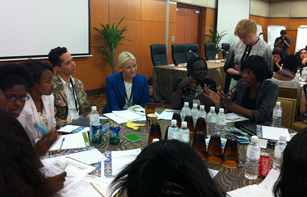
UNAIDS Goodwill Ambassador Her Royal Highness the Crown Princess of Norway discusses with youth leaders at the Women Deliver 2013 Young Leaders Forum. Credit: UNAIDS
Young people: the hope; the leaders of today
Concluding her visit to the shelter, The Norwegian Crown Princessthanked the children and young people who had come to meet her, underlining that their commitment and dedication to advancing social and development agendas were what drive her continued advocacy on HIV. “What gives me hope is the young people I meet,” she said. “Their passion and commitment, their fight, drives me.”
During her three-day programme in Kuala Lumpur, the Crown Princess met and discussed with a wide range of young people living with and affected by HIV and/or working on HIV and other health and development issues. At a session organized by UNAIDS to look at the sexual and reproductive health and rights of women living with HIV within the context of the Global Plan, the Crown Princess spontaneously invited three young delegates to take the stage and give their unique feedback to the distinguished panel about the issues most important to them for continuing the HIV response.
“I believe that if we are to turn the tide on the epidemic, we must focus our efforts and energies on young people,” said the Crown Princess. “Young people are often the most vulnerable to HIV, but they are also the best agents of change. They are not leaders of tomorrow—they are leaders of today,” she added.