Feature Story
South Africa launches campaign to reduce maternal mortality
08 May 2012
08 May 2012 08 May 2012
CARMMA aims to accelerate the implementation of activities to stem maternal and child mortality.
The distinctive cry of a new-born baby pierces the air in the labour ward and stops conversation in its tracks. "That’s what we want to hear" remarks Sister Mavimbela, who just hours ago delivered him into the world. “When a baby cries, that’s the sign of a healthy delivery,” she says with the quiet confidence of someone who knows.
Unfortunately, it is not a cry that is heard every time as South Africa struggles with a high rate of maternal and child mortality. The country has a maternal mortality ratio of 310 deaths per 100 000 live births and an under-five mortality rate of 56 deaths per 1 000 live births. To reduce this, the campaign on Accelerated Reduction of Maternal Mortality in Africa (CARMMA) was launched at Osindisweni Hospital in Ethekwini District, KwaZulu-Natal Province on Friday 4 May.
CARMMA aims to accelerate the implementation of activities to stem maternal and child mortality and meet Africa’s targets for Millennium Development Goals four and five—to reduce by three quarters the maternal mortality rate and to reduce by two thirds the child mortality rate between 1990 and 2015.
Health care workers at Osindisweni Hospital are certain about what is needed to help achieve these targets: reduce the burden of HIV. They are supported by the numbers. South African data shows that 50% of maternal deaths and 40% of under-five deaths are as a result of HIV infection.
“We didn’t experience problems like this when I started”, says Sister Phumzile Kwitshana, who has been practicing as a midwife for 24 years. “It has gotten worse because of HIV—now mothers are sick.”
Dr. Amina Kajee, a doctor in the maternity ward at Osindisweni agrees. “The last two cases of maternal deaths under my care were due to clinically advanced HIV. In one case one of the twins survived, the other didn’t. She only weighed 900 grams.”
The policy framework already exists: offer every pregnant woman HIV testing and counselling under the auspices of the national prevention of mother-to-child (PMTCT) programme. If she tests positive for HIV initiate her onto a regime of highly active anti-retroviral therapy to avoid transmitting the virus to her baby and ensure she is offered a continuum of treatment, care and support for herself and her infant.
However, one of the major obstacles to rolling out the policy successfully is that women often present for antenatal care too late in pregnancy for them to be offered the appropriate care. The overriding factor to explain this seems to be fear or lack of information, or a mixture of both.
The launch was a stark reminder of the hard work we need to do to achieve the third target of the Political Declaration on HIV/AIDS: Eliminate new HIV infections among children by 2015 and reduce maternal deaths
UNAIDS Regional Director for Eastern and Southern Africa, Professor Sheila Tlou
“Women either don’t know or don’t want to know,” is how Dr. Kagee explains it.
“Women don’t come to the clinic because they don’t want to disclose to their families or partners… Sometimes it is the attitude of health care workers with the young ones,” says Sister Kwitshana, referring to the disapproval that often meets a teenage mother, sometimes discouraging her from returning. “Some of them just hide their pregnancies until late.”
Health care workers cite other challenges—some seemingly minor administrative issues, such as the need for a dedicated ambulance on standby for maternity cases, so that women at risk can get to hospital before the crisis deepens. In resource poor settings, however, minor challenges easily become major obstacles. These are further compounded by substantial health system challenges. For example, more midwives are needed to address understaffing and they require ongoing training and values clarification.
Nevertheless, the conversation returns to the issue of women themselves. “We need to shake up the community” says Sister Kwitshana.
Community mobilization campaigns are needed to encourage women to present early for antenatal care. Communities should be the bearers of information to prevent unintended pregnancies, especially among HIV positive women and teenagers, and to reduce HIV stigma.
The launch was led by South Africa’s Minister of Health, Dr Aaron Motsoaledi and was attended by a number of dignitaries and celebrities, including the Minister of Women, Children and People with Disabilities, Ms Lulama Xingwana, Advocate Bience Gawanas, the African Union Commissioner for Social Affairs, the Premier of KwaZulu-Natal, Dr Zweli Mkhize, musical icon and UNICEF Goodwill Ambassador, Yvonne Chaka Chaka, Mrs Graça Machel and UNAIDS Regional Director of the Regional Support Team for Eastern and Southern Africa, Professor Sheila Tlou.
“The launch was a stark reminder of the hard work we need to do to achieve the third target of the Political Declaration on HIV/AIDS: Eliminate new HIV infections among children by 2015 and reduce maternal deaths,” says Professor Tlou. “One death is a death too many.”

Feature Story
United Nations Secretary-General Ban Ki-moon leads a high-level mission to India in support of the Every Woman Every Child initiative
04 May 2012
04 May 2012 04 May 2012
The UN delegation visited Cama Hospital and the Sir J.J. Hospital—two leading health facilities in the Indian state of Maharashtra that provide health services for pregnant women and children.
On 28 April, United Nations Secretary-General Ban Ki-moon led a high-level mission to Mumbai, India in support of the Every Woman Every Child initiative. During the visit, the Secretary-General commended Indian officials for the progress made in the AIDS response. Mr Ban also encouraged the Government of India to continue efforts to eliminate new paediatric HIV infections by 2015—one of the objectives of the Secretary-General’s five-year action plan.
The Every Woman Every Child initiative is a global effort that was launched in 2010 by Secretary-General Ban Ki-moon to mobilize and intensify global action to save the lives of 16 million women and children and improve the lives of millions more.
Mr Ban was joined by senior UN health officials including the Director-General of the World Health Organization Margaret Chan, the Executive Director of the UN Population Fund Babatunde Osotimehin, the Executive Director of the Joint United Nations Programme on HIV/AIDS, Michel Sidibé, the Deputy Executive Director from the UN Children's Fund, Geeta Rao Gupta and the United Nations Secretary-General’s Special Envoy for Malaria Ray Chambers.
During the visit the Secretary-General, Mrs Ban and his delegation visited Cama Hospital and the Sir J.J. Hospital—two leading health facilities in the Indian state of Maharashtra that provide health services for pregnant women and children.
Mr Ban’s mission concluded with a high level reception hosted by Millennium Development Goals advocates Mukesh Ambani and Ray Chambers, which featured interaction with some of India’s leading AIDS activists, people living with HIV, business and government officials as well as film stars and sports legends. During the reception the Mr Ban announced the appointment of Mr Prasada Rao as his new Special Envoy for HIV/AIDS in the Asia-Pacific region.
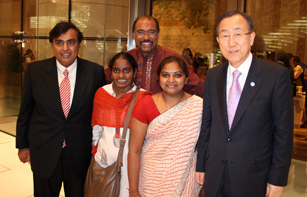
L to R: Millennium Development Goals advocate Mukesh Ambani, Kausalya from Positive women network (PWN+), UNAIDS Executive Director Michel Sidibé, Daksha Patel from Gujarat Network of People Living with HIV (GNP+) and United Nations Secretary-General Ban Ki-moon.
The UNAIDS Executive Director Michel Sidibé travelled to India’s capital New Delhi where he met with the Minister of Health and Family Welfare Shri Ghulam Nabi Azad. During their meeting, Mr Sidibé commended India for its new National AIDS Control Programme (NACP-IV) which was developed by national experts and will be funded primarily from domestic sources.
Mr Sidibé paid special attention to India’s role and contribution as a priority country in the implementation of the Global Plan towards the elimination of new HIV infections among children by 2015 and keeping their mothers alive. It is expected that the national recommendations on the elimination of new HIV infections among children in India will phase-out of single dose nevirapine in the coming months. Mr Sidibé had the opportunity to see first-hand how services to prevent mother-to-child HIV transmission are being scaled-up at the Ambedkar Hospital, one of Delhi’s largest hospitals.
A high level round table organized by the Federation of Indian Chambers of Commerce and Industry (FICCI) and UNAIDS brought together more than 50 participants including leading representatives from the Indian pharmaceutical industry and the government under the theme “India’s partnership with Africa in pharmaceuticals”. Mr Sidibé encouraged the Indian pharmaceutical industry to seize the opportunities to scale up access to HIV treatment in Africa and engage as strategic partner for the development of pharmaceutical production in Africa.
External links
Multimedia
Multimedia
Feature Story
“See to understand”: Human rights, zero discrimination and improved AIDS response
03 May 2012
03 May 2012 03 May 2012
See to understand promotes the use of red glasses to make visible the commitment to counter stigma and discrimination related to HIV.
In Guatemala, wearing a pair of red glasses has transcended from being a fashion statement to a symbol against stigma and discrimination faced by people living with HIV. UNAIDS, in partnership with the National Red Cross, launched “See to understand”, a campaign that challenges people to look at the world through red glasses for a new perspective on what it can mean to live with HIV.
Millions of people still do not know what HIV is, how it is transmitted or how to prevent it. Furthermore, a range of social prejudices result in people living with HIV being frequently subject to discrimination in the workplace and in wider society. UNAIDS Guatemala and the Guatemalan Red Cross felt it was necessary to speak about HIV in order to stop taboos and prejudices.
The new initiative aims to raise awareness about HIV, eliminate stigma and discrimination and contribute to achieving the UNAIDS vision of zero new HIV infections, zero discrimination and zero AIDS-related deaths in Guatemala.
Ver para entender (See to understand) promotes the use of red glasses to make visible the commitment to counter stigma and discrimination related to HIV. According to the campaign, wearing the glasses means prioritizing health over social and cultural norms and supporting people living with and affected by HIV. "‘To see’ means to challenge fear, ignorance, silence and myths that contribute to fuel the stigma and discrimination that jeopardize the progress made in the response to AIDS,” said Enrique Zelaya, UNAIDS Country Coordinator for Guatemala and Mexico.
Participants can support the campaign by taking a picture of themselves wearing a pair of red glasses and encourage others to do the same. So far more than 800 people have joined this initiative including national authorities and people living with HIV. Among them, Luz Lainfiesta Minister of Social Development, Claudia Samayoa Director of the National STD, HIV and AIDS Program and Otoniel Ramirez REDCA + Regional Secretary.
‘To see’ means to challenge fear, ignorance, silence and myths that contribute to fuel the stigma and discrimination that jeopardize the progress made in the response to AIDS
Enrique Zelaya, UNAIDS Country Coordinator for Guatemala and Mexico
“HIV affects us all and the response requires a comprehensive approach,” said Minister Lainfiesta. “From the Ministry of Social Development we will work to reach the goal of zero discrimination towards people living with HIV.”
The powerful message of the campaign has already expanded beyond Guatemala. During the 19th Session of the Human Rights Council held in Geneva February 2012, the United Nations High Commissioner for Human Rights, Ms Navi Pillay put on the red glasses and urged countries to protect human rights and work towards the elimination of the stigma and discrimination affecting people living with HIV.
The campaign will undertake additional activities to raise awareness about HIV-related stigma and discrimination including the broadcast of radio messages and the organization of social mobilization activities such as discussion forums, surveys and community arts competitions on HIV.
Prevailing stigma and discrimination
An estimated 65 000 people are living with HIV in the Guatemala. There are more than 20 people becoming newly infected every day amounting around 7 500 new HIV infections each year. The HIV epidemic in the country remains concentrated among key populations at higher risk such as sex workers and their clients and men who have sex with men. Discrimination against these affected populations is also very high in the country making it more difficult for them to access HIV services.
According to the first national human rights report, between 2009 – 2010 there were 313 complaints to the national attorney and civil society organizations of which 46% related to violations of the right to health and 13% to the right to life and integrity. Such violations ranged from shortages of antiretroviral medicines to lack of adequate and friendly health facilities and personnel.
The transgender organization OTRANS stressed in the report that transgender people had limited access to employment because of stigma and discrimination. OTRANS also reported cases of physical aggressions, disappearances and deaths because of gender identity. According to the organization, 13 deaths and 3 disappearances were reported from 2007 to 2011.
"Since the beginning of the epidemic, stigma and discrimination have been identified as the main obstacle to an effective HIV response,” said Cesar Núñez, UNAIDS Regional Director for Latin America. “Discrimination related to HIV is itself a violation of human rights, and, in turn, implies the violation of other rights, including the right to health, education, dignity and equality before the law," he added.
Feature Story
Thailand and neighbouring countries get together to help provide HIV treatment for thousands of migrants in need
02 May 2012
02 May 2012 02 May 2012
Many of Thailand’s more than five million migrants find themselves in situations that heighten their risk of HIV and have difficulty accessing key services such as antiretroviral therapy.
Credit: UNDP
Migration plays an integral role in Thailand’s economic development and the country hosts more than five million migrants from Cambodia, Lao People’s Democratic Republic (PDR) and Myanmar.
Many migrants however find themselves in situations that heighten their risk of HIV and have difficulty accessing key services such as antiretroviral therapy (ART). A recent regional conference, organised by the UN Development Programme (UNDP) and the Joint Initiative on Mobility and HIV/AIDS (JUNIMA) from 24-25 April explored ways of ensuring better provision of ART to this potentially vulnerable group.
Although migration is not in itself a risk factor for HIV, it can increase vulnerability, such as exploitative working conditions, which may include sexual violence; and separation from spouses/partners, families and established social and cultural norms and values.
A new study in the six provinces most affected by HIV in Thailand has shown that Cambodian migrants bear the highest burden with an HIV prevalence of 2.5%. The estimated adult prevalence in the country as a whole is 1.3%.
The Government of Thailand has taken steps to ensure that migrants have access to ART. Speaking at the conference, Dr Petchsri Sirinirund, Director of the National AIDS Management Centre at the Ministry of Health’s Department of Disease control said, “In the new national strategy for 2012-2016, we aim to provide access to quality HIV treatment and care for any person living with HIV in Thailand, regardless of their nationality.”
There is provision of antiretrovirals (ARVs) for certain categories of low skilled migrants but there are more people in need. Those who are officially registered can pay a fee for universal health coverage which includes HIV treatment and a limited number of people with temporary papers, some 2 300, receive ART through Thailand’s Global Fund project.
While we need to focus our discussion on availability of ARVs as a commodity, what also needs to be in place is a comprehensive system of medical and social care that is backed up by national and regional policy.
Promboon Panitchpakdi, Executive Director of Raks Thai Foundation, development NGO
Political commitment to providing high quality care, including antiretrovirals, is also evidenced by the establishment of a Memorandum of Understanding on Joint Action to Reduce HIV Vulnerability Associated with Population Movement. This was signed in December 2011 by the six members of the Greater Mekong Sub-region (Cambodia, Lao PDR, Myanmar, Thailand, Vietnam and the Yunnan Province of China). A Joint Plan of Action for the memorandum is being formulated.
In addition, Thai and Cambodian authorities have collaborated on a scheme which allowed Cambodian migrants to return to their home country to obtain a three month supply of ARVs.
However, many migrants are not in a position to access antiretrovirals. Each health scheme has a cost to individuals ranging from the equivalent of around 45 US dollars to 90 US dollars and there is also a long waiting list for treatment. A number of those who are unregistered never come to the attention of authorities and therefore receive no help.
The challenges of cross border navigation of different regulations, health systems, and languages, as well as the often temporary nature of migration, make it particularly challenging for migrants living with HIV to access ART along the migration continuum and to adhere to drug regimens.
Furthermore, being given ART does not only involve obtaining the drugs themselves but also ensuring access to wider HIV services like voluntary and confidential counseling and testing as an entry point to treatment.
According to Promboon Panitchpakdi, Executive Director of the Raks Thai Foundation, a development NGO, “While we need to focus our discussion on availability of ARVs as a commodity, what also needs to be in place is a comprehensive system of medical and social care that is backed up by national and regional policy.”
A number of recommendations emerged from the UNDP/JUNIMA conference. These included: examining ways to use TRIPS intellectual property and free trade agreement flexibilities to lower the cost of treatment services and increase coverage for migrants; harmonize treatment and referral protocols across countries; and ensure that in addition to treatment, migrants have better HIV services available.
Rathin Roy, Manager of UNDP Asia Pacific Regional Centre, is confident that migrants will be increasingly better served. “Thailand is a pioneer in implementing the human principle that migrants can access the same quality of HIV services and commodities that are available to citizens, and UNDP, through JUNIMA, is pleased to work in partnership with government and civil society across borders to address the challenges that will allow all migrants in need to access vital HIV treatment.”
External links
External links

Feature Story
Innovative WFP electronic voucher programme in Zimbabwe brings relief to many living with HIV
27 April 2012
27 April 2012 27 April 2012
In Harare and Bulawayo, people living with HIV receive vouchers from WFP that entitle them to a month’s supply of household food items, to be collected from one of a number of local shops.
Credit: WFP
Loveness and her three children, Robert, Susan and Julia, share a room at the back of a garage in Zimbabwe’s second city, Bulawayo. All of them are living with HIV and Loveness struggles to make ends meet and to provide the family with enough food. In the past she would often go hungry herself to ensure that her children could eat a meal, often just three spoonfuls of plain porridge each.
However, Loveness and her family are looking towards a brighter future with the help of the World Food Programme (WFP). The UN body is using an innovative intervention involving electronic vouchers to provide nutritional support to chronically ill, food insecure households, many of whom are living with HIV, in Harare and Bulawayo.
An estimated 14.3% of adults, some 1.2 million people, are living with the virus in Zimbabwe and there are around 150 000 children living with HIV.
Challenging malnutrition
Under the programme implemented by WFP through cooperating NGOs and the Ministry of Health and Child Welfare, clients visiting local clinics and hospitals found to be malnourished are referred to WFP food and voucher distribution points in their vicinity where they are given SuperCereal. This is a highly nutritious fortified blend of maize meal, soy protein and micronutrients. (Malnutrition is gauged by body mass index in adults and upper arm circumference measurement in children).
They also receive an electronic voucher to buy pre-determined food, such as oil and beans, at selected supermarkets. The e-voucher's value depends on family size and when presented with a voucher, the shop assistant contacts an electronic database to verify the ration for a month’s supply.
The cash vouchers are an alternative to in-kind food assistance and WFP uses them to tackle hunger where food is available in the market place but where most people cannot afford to buy it.
A holistic approach
For those living with HIV, such as Loveness and her family, the WFP’s nutritional support forms part of a holistic approach. One important element of the programme is to encourage beneficiaries to have a medical check up once a month at a clinic or hospital in their area. The Ministry of Health and Child Welfare works closely with the WFP and provides free antiretroviral therapy (ART) when necessary. Loveness’ children are all on such medication.
The food assistance helps me because the children get enough at each meal and the little money I’ve been spending on food I can now spend on school fees
Loveness, e-voucher recipient
Food assistance not only increases the effectiveness of ART but also helps ensure greater adherence to treatment regimens. Good nutrition is essential in protecting people living with HIV and, according to WFP, the virus, malnutrition and food insecurity are inextricably linked. When people living with HIV are malnourished the risk of death increases significantly. Although people living with HIV need more calories and nutrients than people living without the virus, they often have lower appetites and are less able to absorb nutrients.
Expanding the programme
The voucher scheme supports around 8 000 clients and their families. WFP Country Director Felix Bamezon is pleased with the success of the scheme in Harare and Bulawayo and wants others areas to reap the benefits: “WFP plans to expand the e-voucher component of the programme to other cities and towns where possible."
According to Loveness, it has made a real difference, “The food assistance helps me because the children get enough at each meal and the little money I’ve been spending on food I can now spend on school fees.”
WFP is the largest humanitarian agency fighting hunger worldwide. It feeds more than 90 million people in over 70 countries every year. In 2010, WFP supported 2.5 million beneficiaries in nearly 50 countries through its HIV and Tuberculosis (TB) programmes. This included food and nutritional support to some 500,000 people living with HIV as part of their antiretroviral therapy or TB treatment.
Related


Feature Story
Joint PEPFAR-UNAIDS mission spotlights progress and challenges in preventing new HIV infections among children in Nigeria
26 April 2012
26 April 2012 26 April 2012
Front L to R: U.S. Global AIDS Coordinator Ambassador Eric Goosby, UNAIDS Executive Director Michel Sidibé and Nigeria’s First Lady Dame Patience Jonathan.
Preventing new HIV infections among children and saving mothers’ lives were high on the agenda in a two-day mission to Nigeria by Michel Sidibé, UNAIDS Executive Director, and Ambassador Eric Goosby, the U.S. Global AIDS Coordinator. The visit occurred nearly one year after world leaders—including Nigerian President Goodluck Jonathan, Mr Sidibé and Ambassador Goosby—launched The Global Plan towards the elimination of new HIV infections among children and keeping their mothers alive.
Each year, nearly 400 000 children are born with HIV globally. Nigeria carries about one third of the global burden of new HIV infections among children. It is one of 22 priority countries of The Global Plan which, combined, account for nearly 90% of all new HIV infections among children annually.
During the mission, Ambassador Goosby and Mr Sidibé met with Nigeria’s First Lady Dame Patience Jonathan, who leads the country’s prevention of mother-to-child transmission (PMTCT) acceleration strategy, to identify bottlenecks to PMTCT scale up at both the national level and in priority states. Discussions with the First Lady centered on how to optimize and increase all available resources for PMTCT in the country.
“I will remain steady in my resolve to continue to provide the necessary leadership and support to achieve our national target of eliminating mother to child transmission of HIV in Nigeria,” said the First Lady.
The First Lady also thanked the participants of the mission for their commitment to assisting Nigeria in the critical area of health development, which is a key element of President Jonathan’s “Transformation Agenda.”
“There are no longer technical or scientific barriers preventing us from eliminating the transmission of HIV from mother to child,” said Ambassador Goosby, who heads the President’s Emergency Plan for AIDS Relief (PEPFAR). “Working together, we will address head-on the challenges to achieving elimination in Nigeria and identify the most effective way forward. Preventing new HIV infections in children is a smart investment that saves lives and gives them a healthy start in life.”
I will remain steady in my resolve to continue to provide the necessary leadership and support to achieve our national target of eliminating mother to child transmission of HIV in Nigeria
First Lady Dame Patience Jonathan of Nigeria
In meetings with leaders from private sector and civil society, including the interfaith community, Ambassador Goosby and Mr Sidibé stressed the importance of working in partnership to accelerate progress in the AIDS response. The delegation also met with members of the Nigerian National Steering Group of The Global Plan, which was launched earlier this month to accelerate and coordinate action on PMTCT by all partners in the country.
While calling for greater global solidarity in the AIDS response, Mr Sidibé also emphasized that country ownership would be essential to accelerate national action around PMTCT. “Our twin goals of zero new HIV infections among children and eliminating AIDS-related maternal deaths can only succeed if countries mobilize the required resources and political will,” he said.
According to government figures, an estimated 16% of pregnant women living with HIV in Nigeria received antiretroviral medicines to prevent mother-to-child transmission of HIV in 2011. There are approximately 3.5 million people living with HIV in Nigeria.
In May 2012, an annual Global Plan progress review will be held on the sidelines of the World Health Assembly in Geneva. Ministers of Health from the 22 priority countries identified in The Global Plan will convene to assess gains made in the first year of the plan’s implementation and to chart a course for continued progress.
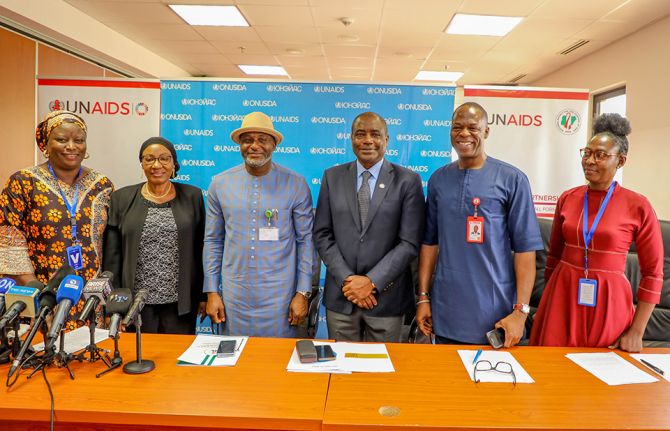

Feature Story
Nigerian governors commit to stopping new HIV infections in children
25 April 2012
25 April 2012 25 April 2012
UNAIDS Executive Director Michel Sidibé and U.S. Global AIDS Coordinator Ambassador Eric Goosby met with State governors during their visit to Nigeria. 24 April 2012.
Credit: UNAIDS/P.Ekpei
In a round-table discussion on Tuesday, high-level representatives from six Nigerian states committed to working with the Joint United Nations Programme on HIV/AIDS (UNAIDS) and the U.S. President’s Emergency Plan for AIDS Relief (PEPFAR) to eliminate new HIV infections in children. The meeting came at the start of a joint two-day mission to Abuja by UNAIDS Executive Director Mr Sidibé and Ambassador Goosby, the U.S. Global AIDS Coordinator.
The six Nigerian states represented at the discussion were among the priority states identified for urgent implementation of a national scale-up plan to eliminate new HIV infections among children.
“Even though policies are formed at the national level, only if you assume leadership can new HIV infections among infants be eliminated in your states,” said Mr Sidibé, addressing the Governors of Kano, Benue and Nasarawa States as well as the Deputy Governors of Cross River, Akwa-ibom and River States.
Nigeria carries about one third of the global burden of mother-to-child transmission of HIV. It is one of 22 priority countries of The Global Plan towards the elimination of new HIV infections among children and keeping their mothers alive—a roadmap to ending new HIV infections among children worldwide by 2015.
During the meeting, Mr Sidibé saluted Nigerian President Goodluck Jonathan for participating in the launch of The Global Plan last June at the United Nations in New York. Together with Ambassador Goosby, he suggested that a few key Nigerian states, in close collaboration with UNAIDS and PEPFAR, could step up efforts to end mother-to-child transmission of HIV.
Even though policies are formed at the national level, only if you assume leadership can new HIV infections among infants be eliminated in your states
UNAIDS Executive Director Michel Sidibé
Ambassador Goosby acknowledged the importance of the gathering. “These governors recognize the importance of addressing paediatric infections in their respective states. Their leadership will not only help Nigeria reduce the number of infants from being infected by HIV, but it will help advance the overall goals of The Global Plan,” he said.
Benue State in north-central Nigeria has an HIV prevalence of 10.6%—the highest of any state in the country. Calling himself a strong advocate for ending HIV, Benue State Governor Gabriel Suswam said that he often takes HIV tests to encourage others to go for testing.
Nasarawa State Governor, Umaru Tanko Al-Makura, said his State has an agency that supervises the care of people living with HIV and is ready to cooperate with efforts to eliminate mother-to-child HIV transmission.
The discussion ended with a call by Kano State Governor, Rabiu Kwankwaso, to create an event that would shine a spotlight on HIV and ensure that the issue came to the forefront once again in Nigeria.
During the joint mission in Nigeria, Mr Sidibé, Ambassador Goosby and other participants in the delegation—including Peter McDermott of the Children’s Investment Fund, Anil Soni of Business Leadership Council and other members of the steering group for The Global Plan—will meet with high-level government officials, business leaders, and representatives from civil society and the inter-faith community. They will also commemorate victims of last year’s bomb attack on UN House in Abuja.
Press Release
Young people present first-ever ‘crowdsourced’ recommendations for AIDS response in UN history
24 April 2012 24 April 2012New youth-led recommendations to shape UNAIDS Secretariat’s work on HIV and young people

Youth leaders presenting the UNAIDS Executive Director Michel Sidibé (center) with a set of youth-defined recommendations that will guide the UNAIDS Secretariat’s work on HIV and young people through 2015.
Credit: UNAIDS/P.Ekepei
ABUJA, 24 April 2012—Youth leaders from around the world today presented a set of youth-defined recommendations that will guide the UNAIDS Secretariat’s work on HIV and young people through 2015. The recommendations were received by UNAIDS Executive Director Michel Sidibé at an event in the Paiko community near Abuja, organized together with Nigerian youth leaders and government officials.
Based on the voices and views of more than 5000 young people from 79 countries, the recommendations resulted from CrowdOutAIDS, an innovative youth-led policy project initiated by UNAIDS. Leveraging crowdsourcing technology and new media tools, the five-month project enabled young people to fully participate in the development of strategic recommendations for the UNAIDS Secretariat’s youth agenda.
“I am so impressed by the dedication, energy and enthusiasm that young people have shown through the CrowdOutAIDS initiative,” said Mr Sidibé. “The recommendations they have presented to UNAIDS will help us mobilize a new generation of young leaders and we will work together to stop new HIV infections and AIDS-related deaths.”
Presenting the recommendations to UNAIDS, Gabriel Adeyemo, a young Nigerian activist, described CrowdOutAIDS as a ‘high level meeting’—but ‘by and for’ young people. “It brought decision-making to the grassroots, to the skilled and unskilled, learned and unlearned, rich and poor, to contribute to an issue that affects all our lives: HIV," said Adeyemo, who is also the West Africa focal point for the Global Youth Coalition on HIV/AIDS.
Globally, an estimated five million young people (15-24 years of age) are living with HIV. About 3000 young people are newly infected with HIV each day. According to recent surveys in low- and middle-income countries, only 24% of young women and 36% of young men responded correctly when asked questions on HIV prevention and transmission.
Through CrowdOutAIDS, young people proposed six key recommendations for the UNAIDS Secretariat, including:
- Strengthen young people’s skills for effective leadership at all levels of the AIDS response;
- Ensure the full participation of youth in the AIDS response at country, regional, and global levels;
- Improve young people’s access to HIV-related information;
- Diversify and strengthen strategic networks between the UNAIDS Secretariat, youth networks, and other key players;
- Increase the UNAIDS Secretariat’s outreach to both formal and informal networks of young people; and,
- Increase young people’s access to financial support.
“We have worked together, using the simplest tools—each one of us in their own corner of the world—to create spaces of exchange and draft this important document in real-time, public online sessions,” said Zahra Benyahia, a CrowdOutAIDS drafting committee member. “This is not the end. It’s the first step toward revolutionary youth leadership in the AIDS response.”
The full set of recommendations are presented in Strategy recommendations for collaborating with a new generation of leaders in the AIDS response—the first-ever “crowdsourced” AIDS-related document in UN history. The recommendations, together with an internal organizational assessment on HIV and young people, will inform the UNAIDS Secretariat’s New Generation Leadership Strategy.
Contact
UNAIDS GenevaMikaela Hildebrand
tel. +41 79 201 2124
hildebrandm@unaids.org
UNAIDS Geneva
Saira Stewart
tel. +41 79 467 2013
stewarts@unaids.org
Publications
Multimedia
Multimedia
Press centre
Download the printable version (PDF)
Feature Story
ACT UP turns 25—marking a quarter century of AIDS activism
23 April 2012
23 April 2012 23 April 2012
AIDS activists fighting for better health, equity and social justice.
Credit: ACT UP
Before there was a name for it, there was a voice. Before there was treatment, there was a movement. AIDS activism has revolutionized the way the world approaches health. In the epidemic’s 30-year history—AIDS activists have sparked the imagination and actions of millions fighting for better health, equity and social justice.
AIDS activism had its start with groups like ACT UP—the AIDS Coalition to Unleash Power. Twenty-five years ago this month, Larry Kramer was speaking from his heart in New York and galvanizing what would become the first group to use political advocacy to change the course of the AIDS epidemic.
“I spread the word that I was going to make a speech at the community centre, and an awful lot of people showed up, I'm happy to say,” said Mr Kramer in an interview in 2005. “It was amazing; it was totally amazing.”
“Larry called us together and asked us to help him take to the streets to sound the alarm that AIDS had become the largest killer of young men and women in cities like New York and the government and society was doing nothing,” said UNAIDS Civil Society Partnership Advisor Eric Sawyer. “We were charting a new path—no one had ever organized a social justice activist movement around a health issue, let alone organizing a civil disobedience on health to mirror the civil rights movement. We were both excited and a bit scared as we had no social or legal protections and were being fired from jobs, evicted from our homes and even physically attacked due to societal fear and discrimination."
There is a false belief that the AIDS epidemic is under control. While circumstances for people living with HIV are much improved—nearly 2 million people will still die of AIDS this year and AIDS activism is needed now more than ever!
UNAIDS Civil Society Partnership Advisor Eric Sawyer
One of the things ACT UP was known for was its public and confrontational style. “You do not get more with honey than you do with vinegar; you just do not,” said Mr Kramer in the documentary Age of AIDS. “If it makes them angry enough, maybe they'll say why are they angry.”
Also ground-breaking was the use of strong messages and graphics such as the Silence=Death campaign which helped break the “conspiracy of silence” around the AIDS epidemic.
Now 25 years into AIDS activism Mr Sawyer thinks the advent of effective HIV treatment has made many people complacent. “There is a false belief that the AIDS epidemic is under control,” he said. “While circumstances for people living with HIV are much improved—nearly 2 million people will still die of AIDS this year and AIDS activism is needed now more than ever!”
ACT UP will mark its anniversary with an old-style march through the streets of New York on 25 April 2012. Mr Sawyer explains that ACT UP and Occupy Wall Street will take to the streets again to demand a financial transaction tax as a way of gaining innovative sustainable financing for global health initiatives such as the AIDS response.
Today, out of the 34 million people living with HIV worldwide, about 6.6 million people in low- and –middle income countries have access to HIV treatment with nearly 8 million additional people still in need.
External links
External links
Feature Story
Landmark report on HIV among Zambia’s young people highlights challenges and charts the way forward
20 April 2012
20 April 2012 20 April 2012
A new report provides an extensive synthesis and analysis of recent data, gaps and challenges in AIDS prevention, treatment, care and support for young people in Zambia.
For Zambia’s young people the AIDS response has seen a number of important successes, with a significant 25% decline in HIV incidence over the last decade. However, according to a groundbreaking new report, the AIDS epidemic continues to have a huge effect on the country’s youth, especially young women, and much more needs to be done to achieve an HIV-free generation.
Situation Assessment of the HIV Response among Young People in Zambia provides an extensive synthesis and analysis of recent data, gaps and challenges in AIDS prevention, treatment, care and support for this key age group. It was launched at a high level meeting held from 17-18 April in Lusaka.
The event was supported by Zambia’s United Nations Joint Team in collaboration with the National HIV/AIDS/STI/TB Council (NAC), and the ministries of Health; Education; Youth and Sport; and Community Development, Mother and Child Health.
“We must reduce the number of new HIV infections among young people if we are to meet the targets set in the 2011 Political Declaration on AIDS,” said Deputy Minister of Youth and Sport Nathaniel Mubukwanu. “We are committed to continue developing high impact interventions using a combination of HIV prevention strategies to effectively respond to the epidemic,” he added.
Good progress but gaps remain
The assessment, focusing on 10 to 24 year olds, shows that HIV incidence decreased between 2001 and 2009 among young people and the proportion of young people having sex before the age of 15 has halved, from about 17% in 2000 to some 8% in 2009. There has also been a rise in the number of young people who were tested and received their HIV test results, from 7% in 2005 to 34% in 2009.
Providing young people with access to HIV testing, condoms, male circumcision and other reproductive health services, including sexuality education, will significantly contribute to Zambia achieving the UNAIDS’ vision of zero new HIV infections, zero discrimination and zero AIDS-related deaths
Helen Frary, UNAIDS Country Coordinator, Zambia
Despite these achievements, HIV prevalence among young people remains high. In 2007 prevalence among those aged 15-19, for example, was 6% for women and 4% for men.
This is attributed to a number of factors. Dr Clement Chela, NAC Director General, citing the report said these factors included, “Poor comprehensive knowledge of HIV; gender inequality, poverty and the combination of transactional and intergenerational sex, early marriage, alcohol use, peer pressure and the negative gatekeeper attitudes towards condom promotion among young people.” Data shows that only 53% of adults expressed support for condom education for HIV prevention among young people.
The report also highlights that there is no comprehensive sexuality education package for pupils in school and a high level of stigma towards young people on treatment from their peers.
Way forward
One of the key recommendations in the report for increasing protection of young people is the promotion of their meaningful involvement in HIV policy and programme design and implementation. This can be facilitated by building their capacity as change agents and service providers and encouraging them to generate demand for HIV-related services.
As Youth Representative Chipasha Mwansa contended, while hoping that her peers’ recommendations would be taken with the seriousness they deserve: “Nothing for young people without meaningful involvement of young people.”
According to the report, bottlenecks that need to be addressed in order to meet young people’s needs are those that affect access to condoms, HIV counseling and testing, male circumcision and behavior change communication among young people in and out of school. Furthermore, youth friendly services should be expanded at the health facility and community level, including those integrating HIV care and treatment and legal protection for adolescents living with the virus.
Helen Frary, UNAIDS Country Coordinator, noted that a multipronged approach was necessary. “Providing young people with access to HIV testing, condoms, male circumcision and other reproductive health services, including sexuality education, will significantly contribute to Zambia achieving the UNAIDS’ vision of zero new HIV infections, zero discrimination and zero AIDS-related deaths.”
To ensure that measurable progress is made in Zambia, the UN has pledged to work with relevant ministries and stakeholders to translate these main recommendations –and others— into a clear, costed and time-bound action plan which puts young people centre-stage.