

Feature Story
UNGASS 2008: Country progress reports
04 February 2008
04 February 2008 04 February 2008
In compliance with the Declaration of Commitment on HIV/AIDS signed by UN member states in June 2001, 122 countries have submitted their country progress reports to UNAIDS. The reports, submitted every two years, reflect the progress made by countries in their response to the AIDS epidemic.
The deadline for submission of the country progress reports for 2008 to UNAIDS was the 31st of January. These have been published on the UNAIDS web site as they were received and without any alteration.
In 2007 there have been substantial efforts in many countries to increase the engagement of civil society in national reporting processes. UNAIDS engaged the services of a consortium of civil society organizations led by the International Council of AIDS Service Organisations and the International Women's Health Coalition (ICASO and IWHC) to provide support through their regional networks to civil society organizations in national reporting. As a result, shadow reports were produced by civil society organizations which are available on the consortium’s web site.
The public sharing of the country reports enables open discussion and assessment of progress between the governments, civil society and other key stakeholders engaged in the national AIDS responses.
“The 2008 UNGASS reporting process is a dramatic step forward in international and country level collaborations and it is the most coordinated effort to date. It is also very exciting that civil society has become part of the process in so many countries," said Dr Deborah Rugg, Chief Monitoring and Evaluation Division, UNAIDS.
The 2008 reports mark an important time point in assessing progress towards the Universal Access to HIV prevention, treatment, care and support, and the targets set in the 2001 Declaration of Commitment. Countries were requested to report on 25 core indicators ranging from AIDS spending and Government AIDS policies to the number of people receiving anti-retroviral drugs or the percentage of most-at-risk populations reached by HIV prevention programmes.
UNAIDS will now prepare a compilation report based on the reports received which will assess the state of the global AIDS epidemic in preparation for the United Nations High-level meeting on AIDS that will take place in June in New York.
The country progress reports will also be used to inform the 2008 UNAIDS report on the global AIDS epidemic that will be launched at the upcoming International AIDS conference in Mexico.
UNGASS 2008: Country progress reports
Related
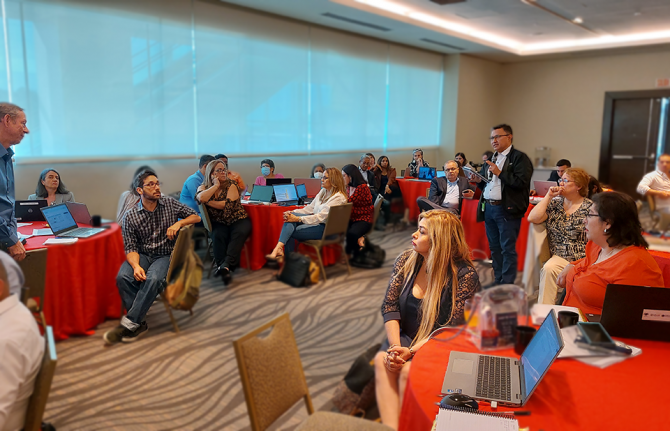
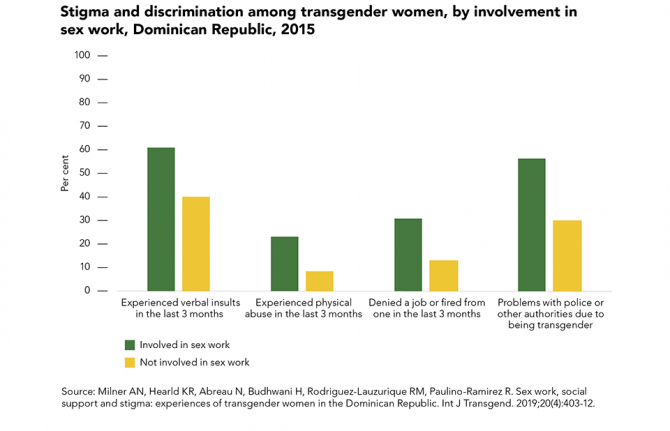 Transgender sex workers face frequent abuse
29 March 2022
 Many key populations avoid health services
21 February 2022
Feature Story
African First Ladies meet on AIDS
04 February 2008
04 February 2008 04 February 2008
In her address to the Assembly, UNAIDS
Deputy Executive Director Mrs. Deborah
Landey commended the organization for
its success in bringing women’s issues to
the forefront, particularly the focus on
preventing mother to child transmission
of HIV.
The Organisation of African First Ladies against HIV and AIDS (OAFLA), held their 5th Extra Ordinary General Assembly in Addis Ababa from 1-2 February. More than 30 first ladies (or their high level representatives) attended the assembly which was held in parallel with the African Union Summit.
The First Lady of Ethiopia and Vice President of OAFLA, Madam Azeb Mesfin, (also hosting meeting) gave the opening remarks, followed by the First Lady of Zambia and Acting OAFLA President Maureen Mwanawasa, who urged her peers to reflect on the successes of the organization whilst planning carefully for future activities.
In her address to the Assembly, UNAIDS Deputy Executive Director Mrs. Deborah Landey commended the organization for its success in bringing women’s issues to the forefront, particularly the focus on preventing mother to child transmission of HIV. Ms. Landey stressed that significant progress had been achieved in Africa over the last decade both in terms of providing anti-retroviral treatment and in reducing HIV prevalence.
The Deputy Executive Director of UNAIDS also encouraged the First Ladies to continue their campaigns to mobilise action on preventing new infections which still remains a major challenge. “HIV prevention is the key. It is a highly complex issue. But this can be no excuse for inaction. We still have a long, long way to go to make HIV prevention truly effective,” said Ms Landey.
Elizabeth Mataka, UN Special Envoy in
Africa, urged OAFLA members and leaders
at all levels to take collective responsibility
in the fight against AIDS.
Elizabeth Mataka, UN Special Envoy in Africa, urged OAFLA members and leaders at all levels to take collective responsibility in the fight against AIDS. “Each of us here today has considerable influence and we have a duty and a responsibility to lend our support, advocacy and leadership to build on the extraordinary response that has so far been mobilised.”
The UN special envoy also encouraged the organisation to seek support from major funding organisations such as the Global Fund to Fight AIDS, Tuberculosis and Malaria. The Global Fund Board is now requesting countries to take particular note of the vulnerabilities of women and girls as they put forward their proposals for Round 8 funding and beyond.
African First Ladies meet on AIDS
Related links:
Feature Story
Getting support for HIV and mental health in Africa
02 February 2008
02 February 2008 02 February 2008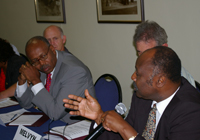
Frank Njenga, President of the African
Association of Psychiatrists and Allied
Professions presents alongside Joseph
Mbatia Director of Mental Health, Ministry
of Health, Tanzania.
Research shows that 89% of AIDS related home based care givers in the North West Province and Mpumalanga in South Africa were depressed or showed signs of depression. The research was presented at the recent World Federation for Mental Health expert forum convened in Cape Town, South Africa, on 29-31 January 2008.
The study conducted by the South African Depression and Anxiety Group and Wits University South Africa was one of several examples of the growing need for increased access to mental health care for people infected and affected by HIV.
"It is clear from our grassroots partners and members that there is demonstrated need for strengthened mental health services addressing stress management, social support and self-esteem among people living with and affected by HIV”, said the Secretary General of the World Federation for Mental Health, Preston Garrison. “Caregivers in particular, experience high levels of stress and their role can take a substantial mental health and physical toll as they care for the physical, emotional and economic needs of their family members,” he added.
World Health Organization consultant Melvyn Freeman referenced a study in Zambia that showed 85% of pregnant women diagnosed HIV positive had episodes of major depression and many had suicidal thoughts. Another study revealed an increase in depression and suicide among AIDS orphans in East and Southern Africa.
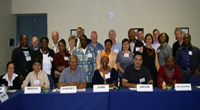
World Federation for Mental Health forum
brought together 23 leaders from different
specialties within the AIDS and mental
health fields, to explore mental health
needs for all aspects of the AIDS response.
The forum, supported by the Ford Foundation brought together 23 leaders from different specialties within the AIDS and mental health fields, to explore mental health needs for all aspects of the AIDS response. Particular attention was given to the needs of care givers, people living with HIV and vulnerable children - groups identified as often experiencing the most significant mental health challenges as a result of AIDS.
The Cape Town forum was convened in part thanks to the advocacy of national level organizations such as the Zimbabwe National Association for Mental Health which has continually pushed to raise awareness of the need for increased mental health support services for caregivers of people living with AIDS and for children who are orphaned when their parents die of AIDS.
In a key note presentation at the meeting Frank Njenga, President of the African Association of Psychiatrists and Allied Professions, offered an overview of the status of mental health in Africa emphasizing how the trauma of AIDS experienced by individuals, families and communities has significantly increased the need for an urgent scale-up of comprehensive mental health services that work in collaboration with national and local AIDS programmes.
A series of roundtable discussions explored gaps in mental health that need to be addressed in order to optimize the well-being of people infected or affected by HIV in Africa. Among the issues considered was the need to better understand how mental health problems increase the vulnerability of individuals to HIV infection and the need to train health care workers in order to reduce the mental health and HIV related stigma.
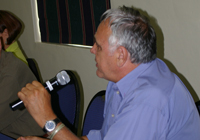
Julian Sturgeon, National Manager of the
Treatment Action Campaign , highlighted
the work of the organization's treatment
literacy programme designed to ensure
optimum adherence to treatment among
people living wtih HIV.
It was also highlighted by the participants that any new intervention should seek to support the greater empowerment of people with mental health problems to respond to their own HIV needs.
Furthermore, participants also underlined the need for a greater standardization of mental health and well being programmes to strengthen the many community based initiatives already focused on psycho-social support.
"The relationship between HIV, mental health and the pursuit of well-being is multi-layered and offers many opportunities for strengthening, scale-up and increased collaboration,” said Andy Seale, UNAIDS Senior Advocacy Adviser, East and Southern Africa Region. “Many aspects of HIV-related mental health needs have been addressed at the community level for years. However, local needs - particularly of people living with HIV and those with an increased care burden - are often inadequately addressed and programmes remain under resourced and could benefit from increased international support and advocacy,” he added.
In conclusion, it was agreed to move forward in mobilizing an Africa-wide initiative to address the complex and multiple interactions between mental health and AIDS through a focus on community-level mobilization.
The initiative will seek to mobilize further interest at the African Psychiatric Conference to be held in Ghana in April 2008, compile an online directory of joint HIV and mental health resources, develop a series of policy papers and information packs for key workers, and convene a partners' conference in early 2009 exploring the mental health consequences of AIDS for people living with HIV, their families, caregivers and communities.
Feature Story
HIV positive leaders meet in Monaco
25 January 2008
25 January 2008 25 January 2008
UNAIDS Special Representative Her
Serene Highness Princess Stephanie of
Monaco during the opening of the HIV+
Monaco meeting that takes place from
24-26 January in Monaco.
Photo credit: UNAIDS/G.Luci
UNAIDS Special Representative Her Serene Highness Princess Stephanie of Monaco has convened a meeting of HIV positive leaders in her home town of Monaco. The meeting, entitled ‘HIV+ Monaco’ which is taking place from 24-26 January has been organized in collaboration with The Government of Monaco, UNAIDS, Fight AIDS Monaco and The Living with HIV Partnership.
Key leaders from networks of people living with HIV met to reflect on how they can improve knowledge and information exchange on key issues, as well as improve collaboration among groups of people living with HIV at country, regional and global levels.
"The HIV+ Monaco Conference is an important opportunity for people living with HIV to develop their advocacy agenda," said Kate Thomson, UNAIDS' Acting Chief of Civil Society Partnerships. "The meeting will be critical in ensuring that the voices of women and men from all over the world have the possibility to shape the advocacy agenda as an essential component of the global AIDS response."
The outcomes of the conference will then feed into the International ‘Living with HIV Leadership Summit’ due to take place in Mexico on 31 July to 1 August 2008 (LIVING 2008) ahead of the 2008 International AIDS Conference. “We are proud that the HIV+ Monaco Conference offers HIV positive leaders the opportunity to meet and discuss key issues affecting their lives in preparation for the Mexico Summit,” said UNAIDS Special Representative HSH Princess Stephanie of Monaco.
The HIV+ Monaco meeting will be followed by a 6-month global e-consultation to further develop thinking around issues which have been identified and gather evidence of best practice and lessons learnt for discussion at LIVING 2008.
"The road to LIVING 2008: Positive Leadership Summit begins in Monaco," said Kevin Moody from the Global Network of People living with HIV (GNP+) representing the LIVING with HIV Partnership. "The participants at the HIV+ Monaco Conference are leaders with years of experience who are committed to improving and coordinating their advocacy work through an extended consultative process that will reignite the passion within the people living with HIV movement by setting the advocacy agenda for the next couple of years."
HIV positive leaders meet in Monaco


Feature Story
Business Coalitions: a joint response to AIDS
24 January 2008
24 January 2008 24 January 2008
The World Economic Forums’ initiative for health the ‘Global Health Initiative’, supported by UNAIDS, has released the first report on Business Coalitions at the World Economic Forum’s annual meeting in Davos. The report is an in-depth study of the activities of Business Coalitions and will help define how they can better support the private sector in responding to AIDS.
Business Coalitions on AIDS have emerged as an effective platform for the private sector response to the epidemic. AIDS has already claimed the lives of 25 million in the global workforce and remains a serious threat to business.
Although some companies are already effectively addressing AIDS in the workplace, others despite being aware of the risks to their business, simply do not know how or where to start mitigating risks.Business Coalitions have emerged to fill this gap and provide the private sector with the tools and processes it needs to effectively address AIDS in the workplace.
Business Coalitions act as a voice for the private sector, often through representation on national AIDS committees and by interacting with other key stakeholders. They support the business response to AIDS through advocacy and the design, development and implementation of workplace programmes by providing the necessary materials, tools and training.
"UNAIDS has supported the development of a number of national business coalitions on HIV in regions heavily impacted by the epidemic,” said Peter Piot, Executive Director, UNAIDS. “Business coalitions are a valued and respected partner in the AIDS response. Thanks to their growing influence, more companies are engaging in activities to tackle AIDS. But such companies remain in the minority. I hope this report will help encourage others to get involved.”
To date, four regional Business Coalitions and 47 national Business Coalitions have been established with a further 10 national Business Coalitions scheduled for launch in 2008-2009. Collectively, these coalitions have already reached over one million organisations with AIDS workplace policies and programmes.
Coalitions have formed partnerships with key stakeholders at national, regional and international levels. In addition to the private sector, these include international donors, other regional and national Business Coalitions, governments and civil society groups. These relationships are critical in delivering a coordinated response to the epidemic.
The regional coalitions serve as a platform for national coalitions to come together, share experiences, exchange expertise and find solutions to some of the more complex challenges, common to the region. UNAIDS is currently working with over 30 regional and national business coalitions, helping to support the private sector response to AIDS.
Business Coalitions Tackling AIDS: A Worldwide Review , January 2008 presents the current Business Coalition landscape and suggests next steps for all stakeholders to build on the global momentum and success with engaging the private sector.
The report was developed by the GHI in partnership with the World Bank, UNAIDS and Deutsche Gesellschaft für Technische Zusammenarbeit (GTZ) and with the support of the Corporate Council of Africa (CCA) and the PharmAccess Foundation.
Business Coalitions: a joint response to AIDS
Media information:
Related links:
Global Health Initiative
World Economic Forum
Feature stories:
Business and the AIDS response
Publications:

Feature Story
UNAIDS Executive Director meets Mexican delegation
22 January 2008
22 January 2008 22 January 2008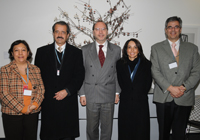
L to R: Dulce Valle Álvarez, Advisor at the
Mexican Permanent mission in Geneva,
Dr José Ángel Córdova Villalobos, Minister
of Health, UNAIDS Executive Director, Dr
Peter Piot, Dr María de los Ángeles
Fromow, Head of the Social Participation
unit and Dr Mauricio Hernández,
Undersecretary of Prevention and
Promotion of Health.
Photo credit: UNIADS/O.O'Hanlon
The Mexican Minister of Health, Dr José Ángel Córdova Villalobos, made a recent visit to UNAIDS headquarters in Geneva to meet with Exective Director Dr Peter Piot to discuss plans for the upcoming International AIDS Conference taking place in Mexico City from 3-8 August 2008.
The meeting follows on from Dr Piot's visit to Mexico last month where he joined government and civil society representatives in commemorating World AIDS Day in the Mexican town of Leon. During his visit to the country he also stopped off in Mexico City to discuss the initial preparations for the conference with senior officials.
Whilst in Geneva, the Mexican delegation expressed their interest in collaborating with UNAIDS to organize two high-level thematic meetings during the International AIDS Conference. The first will invite First Ladies from the Latin American and Caribbean regions to discuss the feminization of the epidemic in the region with the First Lady of Mexico, Margarita Zavala de Calderón; the other will invite regional Ministers of Health and Education to look at specific AIDS-related issues pertinent to these sectors in the Latin America region. The Mexican delegation requested the assistance of UNAIDS in developing the content and focus of these meetings.
UNAIDS Executive Director meets Mexican delegatio
Related Links:
XVII International AIDS Conference 2008
Related stories:
President focuses on AIDS in Mexico (05 December 2007)
Feature Story
Business and the AIDS response
22 January 2008
22 January 2008 22 January 2008
More and more businesses are introducing
HIV prevention programmes to educate
their staff about HIV.
UNAIDS works closely with the private sector and recognises the significant contribution the business community makes to the global response to the AIDS epidemic. This week, world business leaders will come together at the World Economic Forum in Davos to discuss global priorities for 2008––including the business community’s contribution to the AIDS response.
In every region of the world, today’s most successful businesses are an integral part of the societies around them and more and more private sector leaders are recognising that the well being and security of the communities they serve are essential to their shared futures.
AIDS has had a profound impact on the business community. The global labour force has lost 28 million people to AIDS––which in the most affected countries has taken a direct toll on markets, investments, services and education.
Unlike most other health crises, HIV largely strikes people of working age, around nine out of ten people living with HIV today are in their most productive years.
AIDS reduces the supply of labour, increasing operational costs, reducing productivity, slowing economic growth and threatening the livelihoods of both workers and employers.
But businesses are fighting back. With the realisation that the workplace is one of the most effective environments to promote AIDS awareness and support people living with HIV, businesses around the world are investing in the AIDS response.
“The business community understands that their reach, expertise, skills and resources can make a real difference to the AIDS response––helping to keep both their workforce and their businesses healthy,” said Dr Peter Piot, Executive Director of UNAIDS.
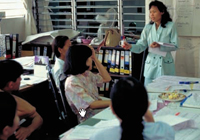
HIV programmes introduced into the
workplace are playing an important role in
reducing stigma around the disease and
supporting people in accessing essential
HIV services.
More and more businesses are introducing HIV prevention programmes to educate their staff about HIV. These vital programmes are giving employees the tools they need to protect themselves and their families from HIV.
Studies show that two out of three people living with HIV go to work, and for many the fear of losing their jobs or being shunned by colleagues prevents them from disclosing their HIV status––denying them access to vital treatment and support services. HIV programmes introduced into the workplace are playing an important role in reducing stigma around the disease and supporting people in accessing essential HIV services.
The business community are also looking outside their own walls to make a difference. Companies are using their knowledge and expertise, resources and networks to build capacity in the AIDS response, promote behavioural change, mobilise private and public funds and share best practices.
The role of the business community is proving central to the response to the epidemic and UNAIDS will continue to work with business of all sizes and sectors to further strengthen the AIDS response.
UNAIDS is currently working with partners from the travel & tourism, telecommunication, sports, mines, PR/advertisement, finance, media, pharmaceuticals, oil & petroleum and automobile industries. UNAIDS also works closely with over 30 regional and national business coalitions.
Links:
Read more about UNAIDS and private sector partnerships
Business and the AIDS response
Related
Feature Story
Civil society’s role in joint reviews of AIDS responses
18 January 2008
18 January 2008 18 January 2008Country experiences of joint reviews of national AIDS responses were discussed and analyzed at a consultation organized by UNAIDS which took place in Geneva on 15 – 16 January 2008.
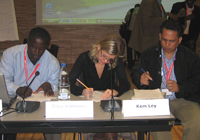
L to R: Daniel Motsatsing, Executive
Secretary BONASO (Botswana), Olga
Varetska, Head M & E, International
HIV/AIDS Alliance (Ukraine) and Kem Ley
from the HIV/AIDS Coordinating
Committee (Cambodia).
The meeting was part of a process to develop guidance for National AIDS Councils and their partners at country level to help plan and execute joint reviews of national AIDS programmes.
Joint Reviews are essential to identify gaps, harmonize resources and align activities of the multiple players involved in the national AIDS response, underlining the commitment to partnership and coordination by all stakeholders.
Participants included representatives of national AIDS coordinating authorities, civil society, UNAIDS regional and country offices, UNAIDS Cosponsors and bilaterals.
Civil society contribution to the national AIDS responses and their involvement in the joint reviews was one of the major topics analyzed at the consultation. Civil society participants coming from the Botswana Network of AIDS Service Organizations (BONASO), the Cambodia HIV / AIDS Coordination Committee (HACC) and Alliance Ukraine brought reports of the scope of their contribution in their respective national AIDS response joint review.
Civil society representatives underlined that the main challenges they encountered during the joint review in their countries were the unequal or lack of representation of key populations in the process and the absence of appropriate instruments to feed back the review results to the field level and to civil society.
During the consultation, participants emphasized the key roles of civil society in the joint review, not only as provider of first-hand data as programme implementers but also as provider of technical expertise related to the review.
“Civil society organizations are not only at the heart of service delivery but also key to reviewing and appraising national AIDS responses ’’ stated Andy Seale, Chief of the UNAIDS Civil Society Partnerships Team.
Finally, it was stressed that the main contribution of the civil society, as representatives of the communities and acting as external actors, has been to bring a key element of independent oversight and a strong sense of accountability to the whole process of national AIDS programmes joint review.
Civil society’s role in joint reviews of AIDS res
Feature story:
Feature Story
2008 High-Level Meeting on AIDS
15 January 2008
15 January 2008 15 January 2008The 2008 high-level meeting on AIDS will take place at the United Nations headquarters in New York on 10 - 11 June. It will review progress made in implementing the 2001 Declaration of Commitment on HIV/AIDS and the 2006 Political Declaration on HIV/AIDS.
Ahead of this high-level meeting, United Nations Secretary General Ban Ki-moon will submit a comprehensive and analytical report for consideration by Member States. The SG’s Report will be based on national reports that Member States were requested to submit to UNAIDS by 31 January 2008.
The organizational arrangements for the high-level meeting are outlined in a resolution adopted by the General Assembly on 19 December 2007. Detailed information about the plenary meetings, the thematic panel discussions, and the informal interactive civil society hearing will be provided in due course.
The high-level meeting will provide an important forum for various stakeholders, including government representatives and accredited civil society participants. Discussions are expected to focus on the progress made, challenges remaining and sustainable ways to overcome them.
Civil society engagement in the 2008 high-level meeting on AIDS
UNAIDS has been working closely with the Office of the President of the General Assembly (OPGA), the Non-Governmental Liaison Service (NGLS) and the Civil Society Support Mechanism (CSSM) to support civil society engagement in the high-level meeting and in the country level reporting processes on AIDS. The CSSM is a coalition led by the International Council of AIDS Service Organizations (ICASO) and the International Women’s Health Coalition (IWHC).
On-line civil society application form
The on-line application form was officially launched on Wednesday, 23 January 2008. It includes background information on the high-level meeting and Civil Society Hearing, as well as two different forms: a registration form for those organizations in consultative status with ECOSOC; and an accreditation form for non-ECOSOC accredited organizations wishing to attend the high-level meeting.
Civil Society Task Force
A Civil Society Task Force is currently being set up, in cooperation with the Civil Society Support Mechanism, to support UNAIDS and the OPGA in key decisions relating to the attendance and participation of civil society organizations and the private sector in the high-level meeting.
2008 High-Level Meeting on AIDS
Related links:
Feature Story
Strengthening partnership: UNAIDS and the International HIV/AIDS Alliance
11 January 2008
11 January 2008 11 January 2008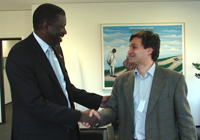
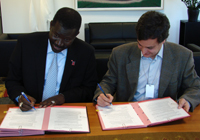
UNAIDS Director of Partnerships and
External Relations, Elhadj As Sy (L) and
Alvaro Bermejo, Executive Director of the
International HIV/AIDS Alliance (R) during
the signing of the collaboration
agreement. Geneva, 11 January 2008.
Working towards the global efforts to reach universal access to HIV prevention, treatment, care and support services for all those in need, UNAIDS has renewed its collaboration with the International HIV/AIDS Alliance.
The first agreement, which ran from 2004 to 2007, enabled strong civil society mobilisation for HIV prevention intensification, focusing particularly on empowering women to lead the AIDS response and underlining the key role of civil society in national AIDS responses.
“This is a strategic collaboration which is critical to securing greater impact, paving the way towards universal access,” said UNAIDS Director of Partnerships and External Relations, Elhadj As Sy at the signing of the renewed agreement.
The renewed partnership will focus on strengthening civil society responses to AIDS and aims to achieve the following objectives:
- Promoting direct involvement and leadership of civil society responses to HIV.– including people living with HIV and key populations.
- Promoting human rights-based responses to HIV
- Mobilising country-level public, private and civil society partnerships.
- Promoting evidence informed policy and good practice and the use of strategic information.
- Building capacity to track, monitor and evaluate country responses within a single, agreed national framework.
- Facilitating increased access to HIV prevention, treatment, care and support services.
- Facilitating access to technical and financial resources at country level.
- Facilitating and supporting the involvement of civil society and people living with HIV in planning, implementation and evaluation of national HIV strategies.
The renewed partnership will focus on
strengthening civil society responses to
AIDS.
The Alliance is a global partnership of nationally-based organisations working to support community action on HIV. These national partners help local community groups and other NGOs to take action on AIDS, and are supported by technical expertise, policy work and fundraising facilitated by the UK-based international secretariat and across the Alliance, in regional programmes and representative offices in the USA and Brussels. The Alliance also works on a range of international activities such as support for South–South cooperation, operations research, knowledge sharing, training and good practice development, as well policy analysis and advocacy.
“We are delighted with this renewed partnership that will scale up our community empowerment objectives and our joint impact on the HIV epidemic. The Alliance is committed to bring all its leverage in this partnership as part of its contribution towards universal access” said Alvaro Bermejo, the Executive Director of the Alliance.