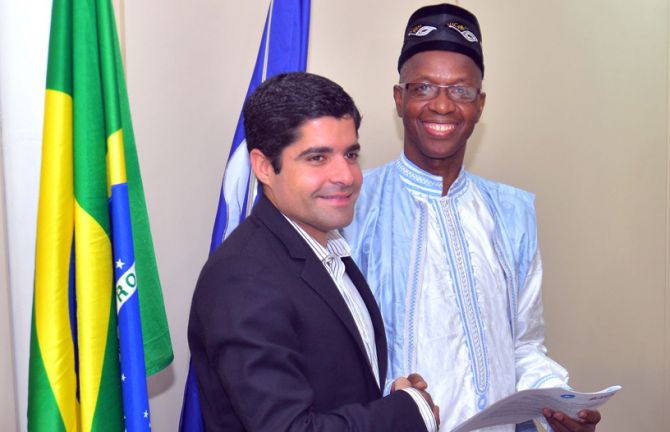
The signing ceremony took place in the headquarters of the Municipality of Salvador at Praça Municipal ToMÉ de Souza in the presence of Mr Antonio Carlos Magalhães Neto, Mayor of Salvador; and Dr Djibril Diallo, who represented the UNAIDS Executive Director Michel Sidibé and César A. Núñez, UNAIDS Regional Director in Latin America.
Feature Story
UNAIDS and Municipality of Salvador in the State of Bahia sign an agreement to promote HIV prevention campaign
01 August 2013
01 August 2013 01 August 2013The Municipality of Salvador in the State of Bahia today signed a Memorandum of Understanding (MoU) with the Joint United Nations Programme on HIV/AIDS (UNAIDS) in which both organizations agreed to work jointly to raise awareness of HIV and mobilize the worlds of sport and culture to promote UNAIDS Protect the Goal campaign.
The main objective of the MoU is to establish a technical development cooperation framework in support of UNAIDS vision of “Getting to Zero” in the State of Bahia and carry out advocacy activities in support of UNAIDS “Protect the Goal” campaign, a brand new initiative that highlights the power of protection and fosters HIV prevention and treatment particularly among young people in advance of the 2014 FIFA World Cup in Brazil.
Globally, an estimated 4.6 million young people (15-24 years of age) are living with HIV. About 2 300 young people are infected with HIV each day. Many young people living with HIV, who are eligible for treatment lack access or do not know their HIV status. In Latin America, the situation among youth is of particular concern given that less than 30 per cent of those aged 15-24 years correctly identify how to prevent sexual transmission of HIV, and condom use in this age group remains low, while only 30 per cent of women aged 20 to 24 report using condoms during last sexual activity.
In Brazil, HIV and AIDS estimates for 2011 were as follows: New infections (all ages): 18,000 [11,000 - 26,000]; Number of people living with HIV: 490,000 [430,000 - 570,000]; Percentage of people living with HIV (aged 15 - 24); Adults aged 15 to 49 prevalence rate: 0.30% [0.30% - 0.40%]; Adults aged 15 and up living with HIV: 470,000 [410,000 - 550,000]; Women aged 15 and up living with HIV: 200,000 [170,000 - 230,000]; Deaths due to AIDS: 15,000 [12,000 - 20,000]; and Orphans due to AIDS aged 0 to 17: 78,000 [48,000 - 110,000].
Quotes
We applaud the signing of this cooperation agreement that aims to strengthen local capacities and harmonize programmes with other UN agencies.
We are appreciative of the efforts of the Municipality of Bahia to leverage the convening power of sport and culture to support the Protect the Goal campaign. We look forward to joint efforts with local officials for the successful outcome of the promotion of the campaign.
The signing of the MoU here today emphasizes the commitment of Brazil and society at large to get to zero new HIV infections, zero discrimination and zero AIDS-related deaths.

Feature Story
Building momentum to stop new HIV infections among children and keep their mothers alive
02 August 2013
02 August 2013 02 August 2013
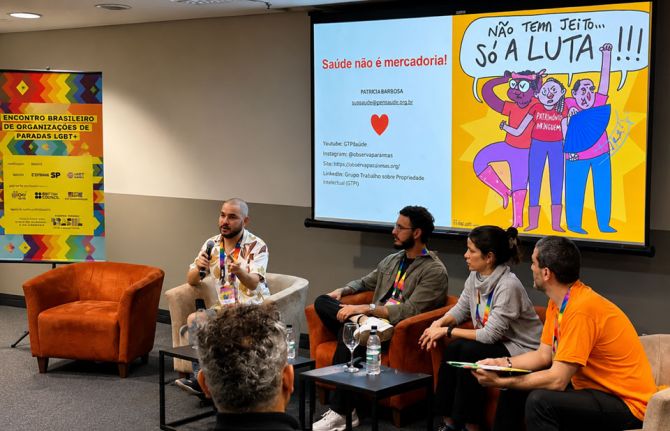
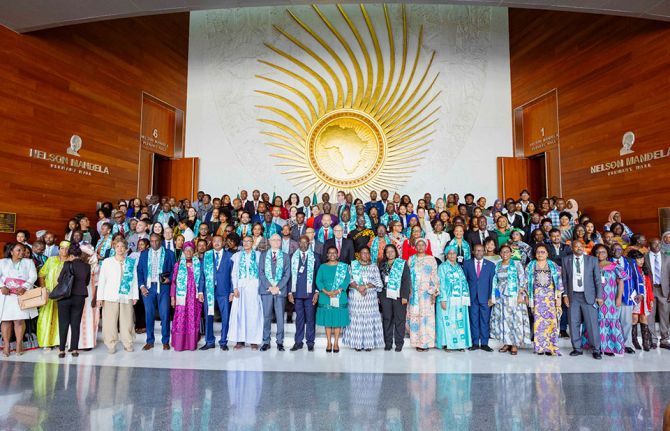
The African Union international conference on maternal, newborn and child health is being held in Johannesburg, South Africa from 1 to 3 August. Credit: UNAIDS
In 2012, more than 200 000 children were newly infected with HIV among the 21 countries in sub-Saharan Africa where almost 90% of the world’s HIV transmissions to children occur. While this was a 38% decline from 2009, it still means that nearly 600 children were newly infected each day.
As part of on-going efforts to improve the health of women and children across Africa, the African Union recently convened an international conference on maternal, newborn and child health in Johannesburg, South Africa. The conference, which runs from 1 to 3 August, addresses a number of important issues including service delivery and quality of service, access to medicines, family planning and task shifting. It also looks specifically at the impact of HIV on women and children and how to ensure increased access to essential HIV services.
“As leaders we have the power to ensure that no woman dies giving life. We also have the power to ensure that no child dies from an avoidable cause,” said the President of South Africa, Jacob Zuma during the opening ceremony of the conference.
Stopping new HIV infections among children and ensuring their mothers have access to HIV services including treatment for their own health is a top priority for UNAIDS. In 2011, UNAIDS and PEPFAR spearheaded a new initiative which has been embraced by the global community. The Global Plan to eliminate new HIV infections among children and keeping their mothers alive (Global Plan) has set the ambitious goal for 2015 of reducing new HIV infections among children by 90% and reducing AIDS-related maternal and paediatric mortality by 50%.
As leaders we have the power to ensure that no woman dies giving life. We also have the power to ensure that no child dies from an avoidable cause.
Jacob Zuma, President of South Africa
To highlight the urgent need to scale up progress, UNAIDS held a special session at the conference to build on momentum around the Global Plan and address bottlenecks in the African countries where most new HIV infections among children occur. During the session UNAIDS reported that while seven countries have shown a rapid decline in new HIV infections (50% or more decline between 2009 and 2012), six others are showing signs of stagnation (less than 30% decline), and the remaining seven show moderate performance (30-49% decline).
“We need to reflect on how we shift the paradigm of how we are working today. The paradigm is a disease approach, but we need a holistic approach. We cannot afford to have women coming in to the facility and being addressed for TB on one day; HIV on another day... We need to consider her as a woman – a whole human being – who needs holistic support,” said UNAIDS Executive Director, Mr Michel Sidibé.
The African Union is a strong supporter of the Global Plan and has actively advocated for increased efforts to expand access to HIV services for women and children.
“The focus on maternal, newborn and child health is not expenditure, it is an investment. It is an investment in our common humanity and our common survival… We can do it, we must do it. We have no choice,” said African Union Chairperson, Dr Nkosazana Dlamini Zuma.
Speeches
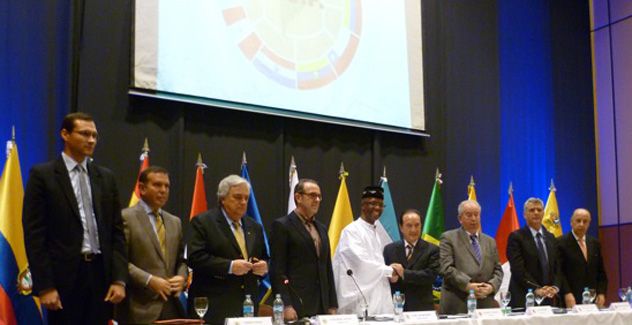
On Mr Figueredo's left: Julio Grondona, President of the Argentine Football Association and FIFA Vicepresident; Ángel María Villar, President of the Royal Spanish Football Federation; Marco Polo del Nero, President of São Paulo State Football Federation. On Dr. Diallo's right: Alberto Stella, UCC for Argentina, Uruguay, Paraguay and Chile; Juan Ángel Napout, President of Paraguay Football Association; José Luis Meiszner, CONMEBOL Secretary General; and Hubert Lisowski, Consultant. Credit: CONMEBOL
Feature Story
UNAIDS and the South American Football Confederation sign memorandum of understanding to advance HIV prevention
01 August 2013
01 August 2013 01 August 2013The South American Football Confederation (CONMEBOL) and the Joint United Nations Programme on HIV/AIDS (UNAIDS) today signed a Memorandum of Understanding (MoU) in order to combine efforts to promote UNAIDS' Protect the Goal campaign and raise awareness about HIV/AIDS, particularly among the youth. The signing ceremony took place on the occasion of the special session of South America's soccer governing body in the presence of CONMEBOL President Eugenio Figueredo and Dr Djibril Diallo, on behalf of UNAIDS Executive Director Michel Sidibé.
The main objectives of the MoU are to carry out joint advocacy and communication activities in competitions organized by CONMEBOL —one of the Fédération Internationale de Football Association's (FIFA) six continental confederations— in support of the "Protect the Goal" campaign, a brand new initiative within the framework of UNAIDS' sport for global advocacy that was launched at the 2013 Orange Africa Cup of Nations in South Africa.
Globally, an estimated 4.6 million young people (15-24 years of age) are living with HIV. About 2300 young people are infected with HIV each day.
Quotes
We are pleased to work alongside UNAIDS to improve HIV education and facilitate access to HIV prevention, care, treatment and counselling services. Through this innovative campaign we plan to reach a broad spectrum of audiences in our region, particularly young people.
The campaign we are launching today with CONMEBOL aims at reaching zero new HIV infections and ensure that no baby is born with HIV. We will work closely together in the lead-up to the upcoming 2014 World Cup in Brazil.
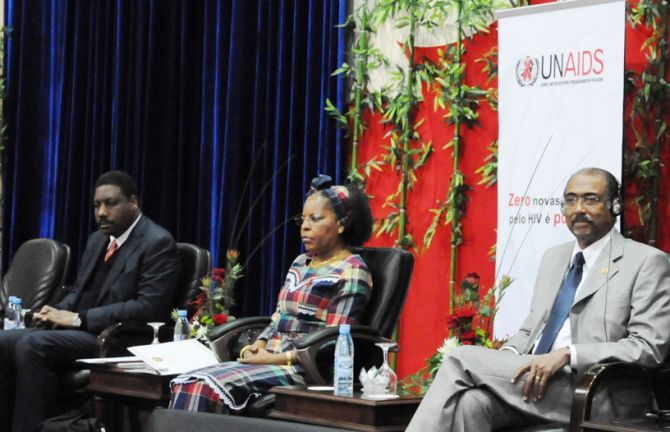
Left to right: Alexandre Lourenço Jaime Manguele, Minister of Health, Mozambique; Dr Maria Dia Luz Guebuza, First Lady of Mozambique; and Michel Sidibé, UNAIDS Executive Director. Maputo, Mozambique, 31 July 2013.
Feature Story
First Lady of Mozambique appointed as Patron of the Global Plan
31 July 2013
31 July 2013 31 July 2013The Executive Director of UNAIDS, Michel Sidibé, has appointed the First Lady of Mozambique as a Patron of the Global Plan towards the elimination of new HIV infections among children by 2015 and keeping their mothers alive.
A long-standing champion of the response to HIV, Maria Dia Luz Guebuza has advocated for zero new HIV infections among children for a number of years. In 2012, at the 32nd Summit of Heads of State and Government of the Southern Africa Development Community (SADC) she was instrumental in convening a powerful meeting of First Ladies. During the meeting the 15 First Ladies developed the ‘Maputo Declaration on the Elimination of Mother-to-Child Transmission of HIV’ which Dr Guebuza presented to heads of State who officially adopted the declaration at the Summit.
As a Patron of the Global Plan, Dr Guebuza will highlight the need to expand both HIV prevention and treatment services to women and children not only in Mozambique but across the region, which has been most affected by the AIDS epidemic.
The Global Plan is focusing particular efforts on these 22 countries to achieve two main targets for 2015: a 90% reduction in the number of children newly infected with HIV and a 50% reduction in the number of AIDS-related maternal deaths.
Mozambique is one of the Global Plan’s 22 priority countries and according to the latest progress report Mozambique has made major strides in providing HIV prevention and treatment services for women and children. The number of women receiving antiretroviral therapy to prevent transmission to their children increased from just 38% in 2009 to 86% in 2012 (under 2010 guidelines). Subsequently the number of new infections among children fell in the same time period from 26 000 to 14 000.
The Global Plan towards elimination of new HIV infections among children by 2015 and keeping their mothers alive is an initiative which was launched in 2011 by UNAIDS and the United States Presidents Emergency Plan for AIDS Relief (PEPFAR) at the UN General Assembly High Level Meeting on AIDS.
Quotes
It is an honour and complex mission to accept this role in the name of Mozambican women and children. I am convinced we can make substantial success by 2015.
The role of Patron of the Global Plan is a huge responsibility. As First Lady, as a woman, as a mother—your role is so important. You are giving your voice and your name to women without a voice. We count on you to help ensure women will stay healthy and all babies will be born free from HIV in Mozambique by 2015.
I reiterate the full support of the Mozambique government to reach the goals of the Global Plan.
It is time for a political commitment to reduce stigma. It is time for Mozambique to go even further. If we join our forces, we can reach the elimination of mother-to-child transmission.
Related


From left to right: CONCACAF General Secretary, Enrique Sanz; UNAIDS Senior Adviser, Dr. Djibril Diallo; Panamanian Football Federation President, Pedro Chaluja; CONCACAF President, Jeffrey Webb; U.S. Soccer Federation President, Sunil Gulati, together with the United States and Panama National Football Teams during the 2013 CONCACAF Gold Cup Tournament final at Chicago's Soldier Field on July 28 in front of an announced crowd of 57 920 fans. Credit: CONCACAF Public Affairs
Feature Story
HIV prevention campaign: going for gold
31 July 2013
31 July 2013 31 July 2013The 2013 Confederation of North, Central American and Caribbean Association Football (CONCACAF) Gold Cup soccer tournament is promoting the HIV prevention campaign “Protect the Goal” of UNAIDS. On 28 July during the final game of the tournament in Chicago, IL, USA the captains of the national football teams from the United States and Panama pledged to raise awareness of HIV in the football community.
The “Protect the Goal” banner was displayed prominently on the pitch prior to the game, in front of about 58 000 fans. Damarcus Beasley, the captain of the U.S. team and Roman Torres, the captain of the Panamanian team, read a statement calling on players, football fans and young people to support the campaign.
CONCACAF has also promoted the “Protect the Goal” campaign during games taking place earlier this month in Los Angeles, CA, Harrison, NJ and Portland, OR. In April 2013, UNAIDS and CONCACAF signed an agreement in which both organizations agreed to team up to raise awareness about HIV, particularly among the youth.
Globally, an estimated 4.6 million young people (15-24 years of age) are living with HIV. About 2300 young people are infected with HIV each day.
Quotes
We are extremely happy to continue to support UNAIDS in its efforts to roll out the Protect the Goal campaign and the presidents of the national football teams have embraced the campaign message and are speaking out on HIV prevention in their countries.
We are honoured to have Dr Webb as a strong advocate for UNAIDS vision of Getting to Zero and leadership from CONCACAF will be key as we gear up to the 2014 FIFA World Cup in Brazil.
Related
Feature Story
Addressing the challenges facing young people in South Africa
29 July 2013
29 July 2013 29 July 2013
(From left to right) UN Messenger of Peace Charlize Theron, South African President Jacob Zuma, and UNAIDS Executive Director Michel Sidibé. Credit: UNAIDS
The challenges facing young people in South Africa were the focus of a dynamic meeting between South African President Jacob Zuma, UN Messenger of Peace Charlize Theron and the Executive Director of UNAIDS Michel Sidibé. Prominent issues in the discussions included the vulnerability of young women and girls to HIV in South Africa, the need for Africa to become more self-sufficient in producing antiretroviral medicines and the remarkable progress South Africa has made in responding to HIV recent years.
President Zuma said, “We came from a difficult time. We had all the plans but the manner in which we interfaced with the world was very difficult. I want to thanks UNAIDS, specifically Michel Sidibe, who has been a pillar of strength in supporting our country on HIV. During this very short time we have changed the life expectancy of our people due to his support and guidance."
The importance of reaching young people with HIV services was also stressed together with the need to integrate health care into education and youth programmes. The example of South Africa’s Integrated School Health Programme, which aims to reach school children with primary health care services and life orientation skills, was highlighted as a positive way forward in improving the health of young South Africans.
It’s time to end AIDS. It’s time for zero preventable deaths due to AIDS, zero tolerance for violence and new infections among young women.
UNAIDS Executive Director Michel Sidibé
“It’s time to end AIDS,” said Mr Sidibé. “It’s time for zero preventable deaths due to AIDS, zero tolerance for violence and new infections among young women.”
A recent study revealed that young women between the ages of 15 and 24 are three times more likely to become infected with HIV than young men in the same age group. HIV prevalence is also much higher among women (23%) in South Africa than in men (13%).
Ms Theron spoke passionately about some of the issues facing young people in South Africa that she has seen and heard through the work of her non-profit organization the Charlize Theron Africa Outreach Project.
“I can promise that we will continue to support you to keep yourselves and your peers safe from HIV,” said Ms Theron.
Ms Theron and Mr Sidibé also met with Friends for Life, a non-profit organization located in Alexandra township in Johannesburg. Friends for Life is a community-based HIV prevention, care and support organization which works closely with young people.
“The visit was such a great opportunity for us to share our ideas and concerns as young people,” said Thulani Tshefuta, a representative of the South African National AIDS Council’s youth sector. “We hope that through speaking about the situation of youth in South Africa and continuing to serve as advocates, we see a change in our communities and in the lives of young people living with HIV.”
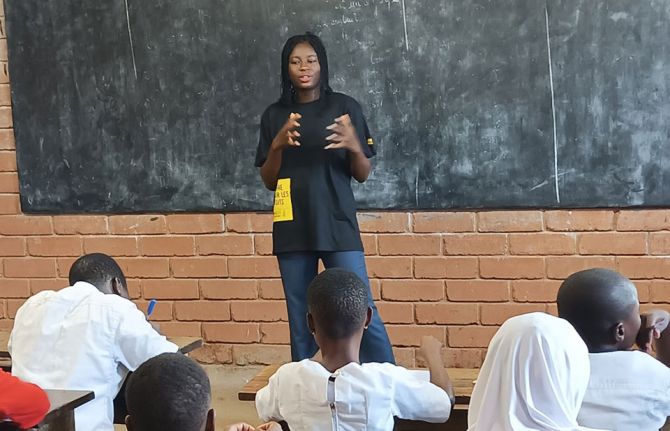
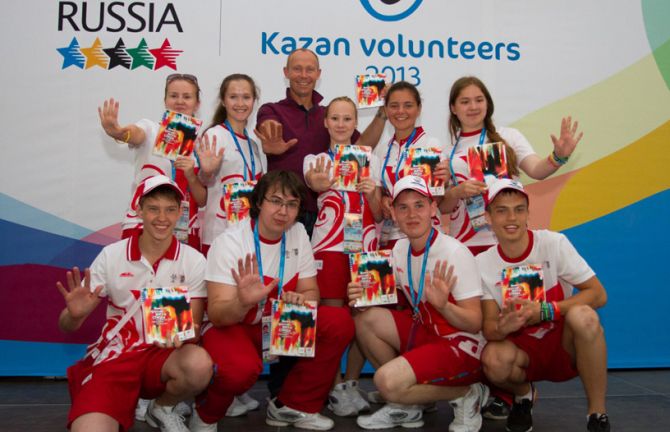
Volunteers received the toolkit “Together for HIV and AIDS prevention” autographed by Russian sport shooter Vasily Mosin, Bronze Olympic Champion, London-2012. Credit: UNAIDS
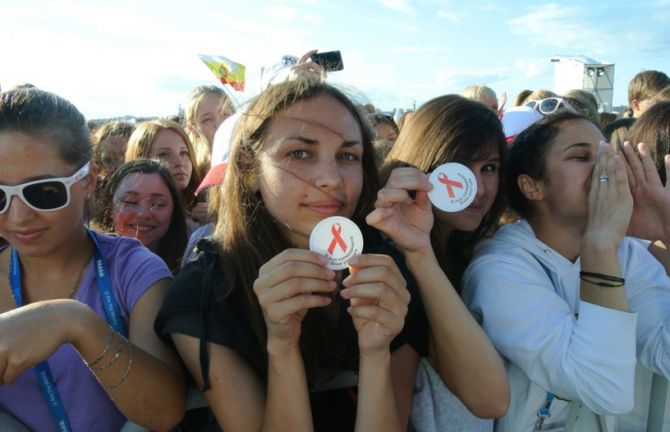
Participants of the 2013 Summer Universiade showing their red ribbons in support of people living with HIV. Credit: UNAIDS
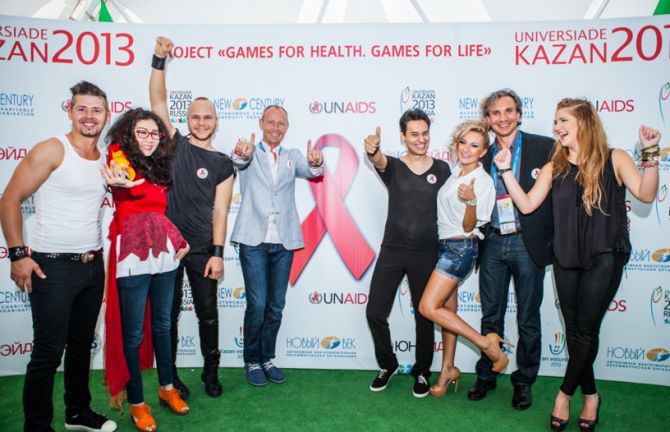
"Games for Health. Games for life" was supported by Russian Olympic Champions —volleyball player Yekaterina Gamova; sport shooter Vasily Mosin; and water polo player Irek Zinnurov— and the Regional Youth Red Ribbon Team, a group of young famous singers from Eastern Europe and Central Asia including Julia Lasker and Dilyara Vagapova (Russia); Teo (Belarus), Kanykei (Kyrgyzstan); Dara (Moldova); Vlad Darwin (Ukraine); and Jassur Mirsagatov (Uzbekistan). Credit : UNAIDS
Feature Story
Summer World University Games in Russia raise HIV awareness among young athletes and volunteers
26 July 2013
26 July 2013 26 July 2013Kazan, Russian Federation was the host of the 27th Summer Universiade — World University Games. The event attracted 11 000 young athletes from more than 160 nations competing in 27 sports from artistic gymnastics to wrestling.
With this backdrop an HIV prevention project called Games for Health. Games for Life was launched. Around the world about 2300 people aged 15-24 become infected with HIV every day and many of the young people living with HIV are unaware of their HIV status. In the region where the Games took place (Eastern Europe and Central Asia) the number of people living with HIV has almost tripled since 2000.
As part of the launch of Games for Health. Games for Life, 35 000 HIV prevention hand-outs were distributed to participants and volunteers. And some 8000 volunteers participated in information sessions about HIV where they discussed issues such reducing stigma and discrimination and promoting the rights of people living with HIV.
The results of this HIV prevention initiative were presented to the next Universiade organizing committee and will be shared with the organizers of major upcoming sporting events including the Sochi 2014 Winter Olympics and the 2018 FIFA World Cup.
Quotes
Universiade is an event where young athletes and volunteers can combine their efforts to make our world a better place. Make your contribution to such a noble matter, as preventing the spread of HIV.
Only with participation of young people as active force we can stop the HIV epidemic in the region and contribute to reaching the goals of Zero new HIV infections and Zero discrimination.
It is as simple as that - take care of yourselves, your loved ones and support people who need your support.
Related

Panel moderator Petra Lantz, Director of the UNDP Geneva Representation Office; flanked by Flavia Pansieri, Deputy High Commissioner for Human Rights; and Jan Beagle, UNAIDS Deputy Executive Director, Management and Governance. Geneva, 25 July 2013.
Feature Story
Gender equality and empowerment of women and girls essential in getting to zero
26 July 2013
26 July 2013 26 July 2013The particular impact that HIV has on women and girls was discussed during a panel discussion organised in conjunction with the 55th Session of Committee on the Elimination of Discrimination against Women (CEDAW). Broad ranging discussion took place during the event on how gender inequality, poverty, harmful cultural practices, and unequal power relations exacerbates their vulnerability to HIV infection.
Also underscored was the important, if not central, role of human rights and creating an enabling environment for women and girls. Participants agreed that countries must do more to ensure women and girls have access to comprehensive sexual and reproductive health and HIV services.
The keynote speech was given by Jan Beagle, Deputy Executive Director, Management and Governance, UNAIDS who said the Committee could help to ensure that governments make HIV services available and accessible to all women and girls including sex workers, women who inject drugs and transwomen. Looking to the post-2015 agenda, she stressed the importance of leveraging synergies across movements to advance sexual and reproductive health (SRH) and rights, gender equality and the empowerment of women and girls.
The panellists agreed that all barriers hampering women’s access to sexual and reproductive health services must be removed, and they called on State Parties to CEDAW to make the necessary investments to facilitate access to SRH services. They also encouraged State Parties to enhance their reporting on human rights issues as it relates to women and HIV and to better use CEDAW to advance the rights of women and women living with HIV in particular.
Quotes
For UNAIDS, the integration of human rights in the AIDS response is non-negotiable. Ending new HIV infections and AIDS-related deaths will not be possible without attention to the social and legal contexts in which people live. Reaching zero discrimination will not be possible if people do not have access to justice.
The most effective response to HIV is the global empowerment of women. The CEDAW Convention should be the basis for this empowerment, namely through women’s equal access to employment and their full participation in economic and social life.
Gender discrimination is at the heart of the greater vulnerability that women experience. When women do not have a strong social and political role, when their access to education is unequal, we realize that the risk of HIV infection is so much higher.
Speeches
Speeches
Press Release
New report shows that a healthier Africa will further boost economic growth on the continent
15 July 2013 15 July 2013ABUJA, Nigeria, 15 July 2013—A report launched today at the Special Summit of the African Union on HIV/AIDS, Tuberculosis and Malaria highlights increased, targeted health spending as an essential foundation to greater economic growth and development in Africa. The report, Abuja +12: Shaping the future of health in Africa, published by the African Union (AU) and the Joint United Nations Programme on HIV/AIDS (UNAIDS), reviews progress made since the AU’s 2001 Abuja Declaration—in which leaders pledged to mobilize domestic and international resources for health and remove barriers to the AIDS response—highlights remaining gaps, and prioritizes next steps.
“Africa’s health and our prosperity are inextricably linked. 2001 was a turning point for Africa as African countries committed to take greater responsibility for the health and wellbeing of their citizens,” said Dr Mustapha Sidiki Kaloko, AU Commissioner for Social Affairs. “Since then, we have invested greater resources and efforts to address AIDS, TB and malaria which has produced exceptional results. We urge all AU member states to commemorate Abuja+12 with a renewed commitment to prioritize health and achieve their commitments and targets by 2015.”
The new report highlights five main recommendations for a healthier Africa: unifying leadership, generating innovative financing, making smarter investments in health, strengthening human resources and ensuring no one is left behind. Together, these recommendations aim to leverage health as a force for economic growth and social progress across Africa.
The report also highlights recent successes in the HIV, TB and malaria responses in Africa, including substantial reductions in the number of new HIV and TB infections and deaths from malaria. There is now much broader access to antiretroviral and TB medications and use of malaria control strategies such as insecticide-treated bed nets and indoor residual spraying are becoming more widespread.
“Twelve years ago, African leaders pledged to unite in addressing the health crises which were devastating the continent—and succeeded in making historic progress,” said Michel Sidibé, Executive Director of UNAIDS. “A renewed and bold commitment here in Abuja is essential as drawing from experiences in the AIDS response, we know that smart investments will save lives, create jobs, reinvigorate communities and further boost economic growth in Africa.”
The report cites a number of approaches pioneered as part of the AIDS response that can help improve returns on health investments. These include using investment frameworks to prioritize spending on the most cost-effective interventions; focusing efforts on people most in need; and reducing front-line health care costs by shifting tasks, where appropriate, from physicians to nurses, community health workers or other health practitioners. On strengthening health governance in Africa, the report notes that the principles that have been fundamental to the success of the AIDS response can be leveraged for the post-2015 agenda to advance coordination, innovation and commitment.
A central element of the 2001 Abuja Declaration was the commitment to allocate at least 15% of public expenditures to health by 2015. Over the last five years, health spending in Africa has risen by about 10% annually. However, spending is still nowhere near where it needs to be—just six AU member states (Liberia, Madagascar, Malawi, Rwanda, Togo, and Zambia) have achieved the 15% Abuja target, and an additional US$ 31 billion is required to close the funding gap.
Contact
UNAIDS AbujaJeanne Seck
tel. +221 77 56 50 235
seckj@unaids.org
UNAIDS Geneva
Sophie Barton-Knott
tel. +41 22 791 1697
bartonknotts@unaids.org
Publications
Publications
Press centre
Download the printable version (PDF)
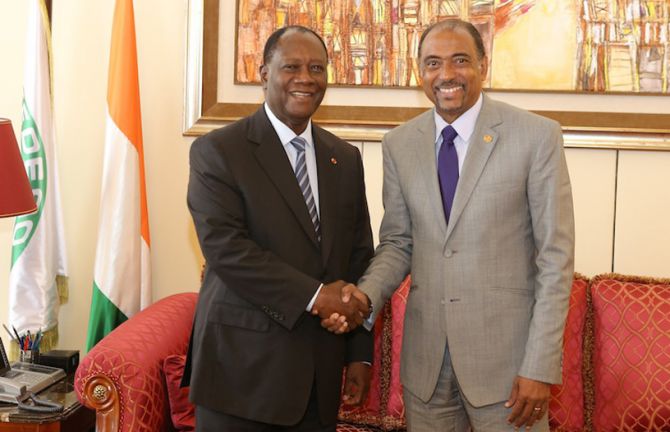
The President of Côte d’Ivoire Alassane Ouattara (left) met with UNAIDS Executive Director Michel Sidibé, on the side-lines of the 39th conference of Francophone parliamentarians, which took place in Abidjan from 9 to 12 of July 2013.
Feature Story
Côte d’Ivoire President commits to stopping new HIV infections among children
13 July 2013
13 July 2013 13 July 2013The President of Côte d’Ivoire Alassane Ouattara said his country is committed to stopping new HIV infections among children in a meeting with UNAIDS Executive Director Michel Sidibé, on the side-lines of the 39th conference of Francophone parliamentarians, which took place in Abidjan from 9 to 12 of July. Mr Sidibé also asked the President to lead the region and the continent on innovative financing in the HIV response,
During his one-day official visit to Côte d’Ivoire, Mr Sidibé also met with the country’s President of the National Assembly, Guillaume Kigbafori Soro, and pushed for a more inclusive society in Côte d’Ivoire. There is draft legislation pending in Parliament which aims to improve living conditions for people living with HIV.
Quotes
Côte d’Ivoire has made a lot of progress in the past 12 months and if access to HIV treatment for pregnant women living with HIV continues to be scaled up, the country can become a model for the Francophone region in stopping new HIV infections among children.