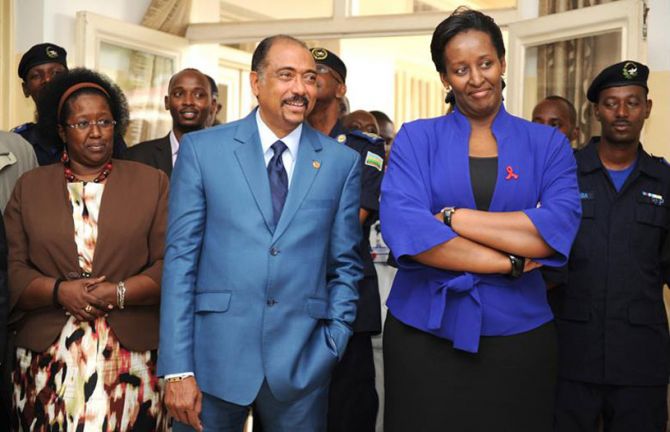
UNAIDS Executive Director Michel Sidibé visited the Isange One Stop Centre located in Kacyiru Police Hospital in Kigali, Rwanda to see services provided for survivors of gender-based violence and child abuse. While at the hospital, Mr Sidibé learnt about the Prevention of Mother-to-Child Transmission Family Package Programme which was initiated by the First Lady of Rwanda and supported by Imbuto Foundation in collaboration with UN agencies.
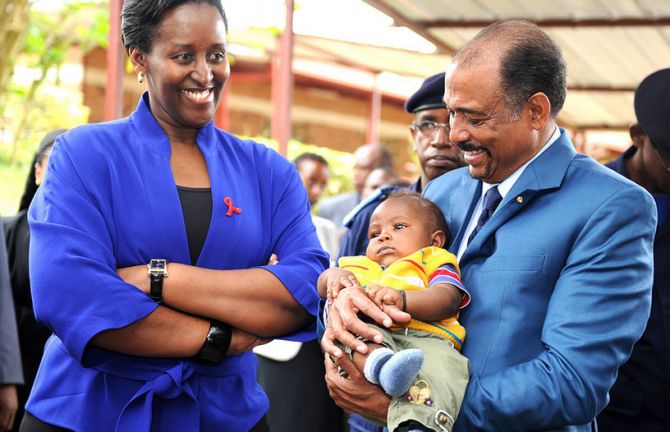
UNAIDS Executive Director Michel Sidibé visited the Isange One Stop Centre located in Kacyiru Police Hospital in Kigali, Rwanda to see services provided for survivors of gender-based violence and child abuse. While at the hospital, Mr Sidibé learnt about the Prevention of Mother-to-Child Transmission Family Package Programme which was initiated by the First Lady of Rwanda and supported by Imbuto Foundation in collaboration with UN agencies.
Feature Story
UNAIDS Executive Director says Rwanda is moving from AIDS to sustainable health
06 May 2013
06 May 2013 06 May 2013UNAIDS Executive Director Michel Sidibé commended the government of Rwanda for its leadership in the national AIDS response. The country has made significant progress in its HIV response and is on track to meet national and global HIV related goals.
Mr Sidibé began his two-day official visit to the country on 6 May by meeting Jeanette Kagame, First Lady of Rwanda in the country’s capital, Kigali. During this meeting the First Lady discussed the success and challenges that the Imbuto Foundation, an organization she created in 2007, faces in its HIV programming.
Mr Sidibé congratulated the First Lady for her personal commitment towards empowering women and girls.
Mr Sidibé also visited the Isange One Stop Centre located in Kacyiru Police Hospital to see services provided for survivors of gender based violence and child abuse. While at the hospital, Mr Sidibé also learnt about the Prevention of Mother to Child Transmission Family Package Programme which was initiated by the First Lady and supported by Imbuto Foundation in collaboration with UN agencies.
Quotes
We need to innovate. Our success is exciting, yet very fragile. This is where the Development partners can come in and support our work.
Thank you for your commitment. Due to your efforts, Rwanda is moving from AIDS to sustainable health. Rwanda is showing impact by not only increasing coverage on ART to 91% but also reducing deaths by 70%.
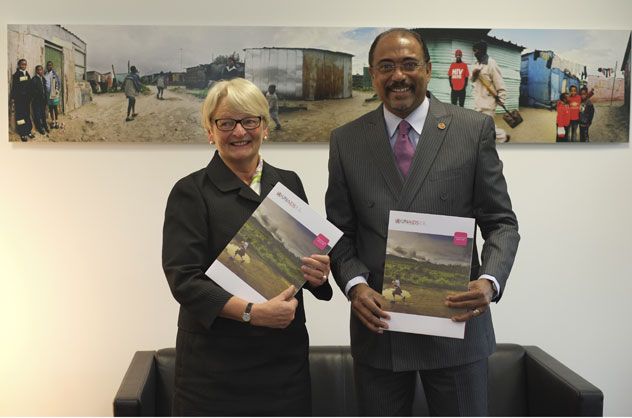
Archive photo of Minister for Development Cooperation and Humanitarian Affairs of Luxemburg, Marie-Josée Jacobs and UNAIDS Executive Director Michel Sidibé during the signing of the cooperation agreement on 22 May 2012. Geneva.
Credit: UNAIDS/A. Obeid
Feature Story
Minister for Development Cooperation and Humanitarian Affairs of Luxemburg steps down
03 May 2013
03 May 2013 03 May 2013The Minister for Development Cooperation and Humanitarian Affairs of Luxemburg, Marie-Josée Jacobs stepped down this week after close to four years in the position and after eighteen years as Minister for Family Affairs and social inclusion. During that time, the collaboration between Luxemburg and UNAIDS was considerably strengthened especially regarding issues such as the protection of human rights in the context of HIV, addressing the needs and rights of women and supporting national strategic planning to advance AIDS programmes in countries.
Ms Jacobs demonstrated her personal engagement at numerous high-level UN fora and meetings on AIDS and recognized the importance of UNAIDS’ strategic leadership. In 2012, Luxembourg and UNAIDS signed a memorandum of understanding to foster joint action and bolster the global response to HIV.
Since the creation of UNAIDS, Luxembourg has been one of the Joint Programme’s most important partners. Among UNAIDS’ top 10 donors, the Grand-Duchy is providing regular funding for activities essential to an effective response to HIV, in particular addressing gender equality and the needs of women and girls, stopping new HIV infections among children and strengthening national AIDS responses at country level.
Quotes
Ms Jacobs has shown strong commitment to the global AIDS response and in particularly towards the elimination of stigma and discrimination and the protection of the most vulnerable groups. UNAIDS looks forward to continuing this partnership with Luxemburg towards our shared vision of zero new HIV infections, zero discrimination and zero AIDS-related deaths.
Luxembourg appreciates the added-value of UNAIDS in terms of its global political guidance and its contribution to broader social transformations. These are the changes required to further build on the successes of the MDGs while moving into the Post-2015 development framework.
Related
Feature Story
Pacific nations seek solutions to laws and policies that block access to HIV services
02 May 2013
02 May 2013 02 May 2013
The President of Fiji, His Excellency Ratu Epeli Nailatikau (centre) joined delegates from Fiji, Kiribati, Papua New Guinea, Samoa, Solomon Islands, Tuvalu and Vanuatu to review laws and policies which impact on HIV and health programming initiatives. Credit: UNAIDS
For activist and community leader Kapul Robert* from Papua New Guinea (PNG) accessing HIV services is a constant challenge. “Papua New Guinea has a law that says sodomy is illegal and this law is contributing to the high-levels of stigma existing in society for both men who have sex with men (MSM) and transgender people.”
Almost all Pacific nations—and many countries across Asia-Pacific— have examples of laws and practices that criminalize people living with HIV or people most at risk of infection such as MSM, sex workers, transgender people, migrants and prisoners. Such punitive laws and policies sustain violence and discrimination and contribute to significant obstacles to access HIV-related services.
According to Mr Robert, who identifies as MSM, the general population of PNG would never be able to say they had sex with another man as they would immediately feel discriminated against. “It’s hard to talk about it,” he said. “If people are referred to government run rural clinics they just don’t go back because they are afraid to be judged. So they don’t receive their HIV test results or their medication,” he explains. “People don’t feel free under the law to identify themselves as MSM or transgender,” he added.
Responding to such challenges, leaders from government, health, legal and community sectors of seven Pacific Island nations—Fiji, Kiribati, Papua New Guinea, Samoa, Solomon Islands, Tuvalu and Vanuatu—came together for a consultation in Nadi, Fiji at the end of April. The objective was to identify concrete country-level actions needed to address punitive laws, law enforcement practices and weak access to justice to ensure greater access to HIV services.
“Pacific Island Countries have a history of leadership in the response to HIV, and have played a crucial role in building momentum for progress towards shared goals,” said the President of Fiji, His Excellency Ratu Epeli Nailatikau. “But we have less than 1 000 days left until the deadline for achieving HIV targets. This is an opportunity for us to identify key aspects of the legal environment that are hindering access to HIV services and to map out a time-bound action plan to address them.”
“If the laws were changed the number of HIV cases among MSM would reduce. People would feel less discriminated against and be able to access HIV testing and antiretroviral treatment.”
Activist and community leader Kapul Robert
Through the consultation, examples of progress in a number of Pacific countries—including Fiji, New Zealand, and Australia, where a variety of punitive laws have been revised or lifted were heralded as exemplary for the region. Moving towards replication in other Pacific nations, actions identified in the country plans ranged from supporting the progress of HIV bills through Parliament to awareness-raising with the judiciary and law enforcement authorities on key legal and human rights issues.
“This is the first legal review of its kind in the Asia Pacific region,” said Director of UNAIDS Asia Pacific Steven Kraus. “We’ve seen nations coming together for meaningful community dialogue and peer exchange to identify priority actions. This leadership and solid inclusive strategy puts the Pacific in prime position on the route to ending the AIDS epidemic,” he added.
The developed action plans will be implemented at the country level, supported through partnership with the Secretariat of the Pacific Community RRRT (Regional Rights Resource Team), UNAIDS, UNDP, ILO and other regional partners.
For Kapul Robert, enhanced attention to legal reform and law enforcement within the context of the HIV response is strongly welcomed. “If the laws were changed the number of HIV cases among MSM would reduce. People would feel less discriminated against and be able to access HIV testing and antiretroviral treatment.”
*Name has been changed to protect the identity of the interviewee.
Feature Story
New survey on HIV education: Progression, regression or stagnation?
30 April 2013
30 April 2013 30 April 2013
The IATT report on the global education sector’s HIV response shows mixed results with progress in some fields and stagnation in others.
There is room for optimism in the overall progress of the global education sector’s response to HIV, says a new in-depth study of 39 countries around the world. However, a worrying degree of stagnation in some areas still exists and much more needs to be done if the sector is to fulfil its critical role in helping to intensify HIV prevention.
The report, 2011-2012 Education Sector HIV and AIDS Global Progress Survey: Progression, Regression or Stagnation? was commissioned by the UNAIDS Inter-Agency Task Team (IATT) on Education and compares results from a similar comparative study in 2004. It finds that now almost all countries have an education sector HIV policy, that an increasing number of teachers are trained to share knowledge about the epidemic and that it occupies more space in the curriculum, taught through life-skills education.
But policy development in theory does not necessarily translate into implementation in practice. The extent to which HIV is addressed is still marginal. Despite noted improvements, many more teachers need to be trained and knowledge about the virus remains low.
Recent research in a range of countries shows that less than half of young people have comprehensive and correct knowledge about HIV. This matters a great deal, the report contends, as education is the foundation for the success of all HIV programming. High quality information and the space to explore key issues such as sex and relationships are seen as fundamentally necessary for comprehensive AIDS education.
Young people can use their knowledge to make informed choices about how to protect themselves and others from HIV. In addition, the very fact of being educated in itself reduces vulnerability to the virus, especially for girls, as it promotes self-esteem, assertiveness and economic independence.
Education is a protective factor for HIV infection and it contributes to a global citizenry that can address stigma and discrimination. Education, therefore, plays a central role in the AIDS response.
UNESCO Global Coordinator for HIV and AIDS, Soo-Hyang Choi
According to UNESCO Global Coordinator for AIDS Soo-Hyang Choi, “Education is a protective factor for HIV infection and it contributes to a global citizenry that can address stigma and discrimination. Education, therefore, plays a central role in the AIDS response.”
Room for improvement
The IATT report gives a salient example of what is happening on the ground and where improvements can be made in a long term study in Southern and Eastern Africa. The research found that on average two thirds of grade six students (between 13 and 14 years of age) across 11 countries did not have even minimal understanding of HIV required to preserve and promote their health. Knowledge levels ranged from 19% in Lesotho to 70% in Tanzania.
However, 99% of their teachers did in fact have this knowledge but did not impart it to their students. The study concluded that teachers were uncomfortable sharing such information or felt that it went beyond their remit. They were also given limited training in the topic—by government experts, UN agencies or civil society organizations—both before they started teaching and once they were actually on the job.
Scott Pulizzi, Coordinator of UNAIDS IATT on Education, maintains that this must change, “Every learner needs a qualified teacher who is mandated and supported by the school administration and the community to teach skills-based sexuality education, including HIV. Without systemic change in the education sector, teachers will not be able help their learners acquire the knowledge and develop the skills to reduce their vulnerability to the virus.”
Progression, Regression or Stagnation? recommends a detailed action plan to ensure that learners get a potentially life-saving HIV education. Steps include:
- Establishing high-level political will for a comprehensive AIDS response in education;
- Developing a country-appropriate management system to coordinate and implement existing policy and plans;
- Supporting sector-wide teacher training on HIV;
- Ensuring that curricula and accurate teaching materials are age-appropriate, gender-sensitive, life skills-based and available in all schools for all learners; and
- Engaging parents and the community in implementation.
The report emphasizes that an AIDS-free generation is within reach. And it concludes by stressing that, “The objectives of Getting to Zero: zero new HIV infections, zero discrimination and zero AIDS-related deaths are possible and it starts with education.”
The IATT is convened by UNESCO and includes other UNAIDS Cosponsors, bilateral agencies and civil society organisations
Related

Feature Story
Women’s issues must remain central to sustainable development
29 April 2013
29 April 2013 29 April 2013
A high-level task force for ICPD presenting the paper Policy Recommendations for ICPD Beyond 2014: Sexual and Reproductive Health and Rights for All. 25 April 2013, New York. Credit: Elsa M. Ruiz
In 1994 at the International Conference on Population Development (ICPD) in Cairo, 179 countries adopted a landmark 20-year Programme of Action, placing gender equality and women’s empowerment and reproductive rights at the center of population and sustainable development.
Last week, in a review of progress which took place in New York, a high-level task force strongly urged governments and the international community to take much bolder action in order to meet the commitments.
In a paper Policy Recommendations for ICPD Beyond 2014: Sexual and Reproductive Health and Rights for All, the task force outline specific steps to ensure that the commitments made become central components not only of next year’s conference, but also the post-2015 and sustainable development goals agenda. The task force is also calling for increased accountability mechanisms to ensure concerted action by governments to achieve these goals.
While we are encouraged by the achievements of ICPD implementation, the challenge is that too many people around the world are still denied their sexual and reproductive health and rights
Former President of Finland and co-chair of the High-Level Task Force for the ICPD, Tarja Halonen
Co-chaired by former Presidents Joaquim Chissano of Mozambique and Tarja Halonen of Finland, the task force is comprised of 26 eminent government, civil society, and private sector leaders. Its mission is to galvanize political will and advance a forward-looking agenda for the ICPD Programme of Action that fulfills sexual and reproductive health and rights of all people.
“While we are encouraged by the achievements of ICPD implementation, the challenge is that too many people around the world are still denied their sexual and reproductive health and rights,” said Former President Halonen. “These are fundamental freedoms and human rights that lie at the very core of human dignity.”
The global panel of experts highlighted four main recommendations for government action:
- Respecting, protecting and fulfilling sexual and reproductive rights for all through public education and legal and policy reforms
- Achieving universal access to quality, comprehensive and integrated sexual and reproductive health information, education and services
- Ensuring universal access to comprehensive sexuality education for all young people
- Eliminating violence against women and girls and securing universal access to critical services for all victims/survivors of gender-based violence
Within those four areas are recommendations for specific actions on a range of issues including; ending unsafe abortion, ending acts of violence against women and girls; and ensuring equality under the law regardless of sexual orientation or gender identity, HIV or other status.

UNAIDS Deputy Executive Director, Management and Governance, Jan Beagle participating at the launch of the policy recommendations. Credit: Elsa M. Ruiz
All four key recommendations are highly relevant for UNAIDS and the global AIDS response. The HIV epidemic continues to disproportionately affect young women and girls, with infection rates twice as high as young men. Every minute a young woman is newly infected with HIV. Globally, AIDS is the leading cause of death in women of reproductive age.
UNAIDS Deputy Executive Director, Management and Governance, Jan Beagle, stressed that sexual and reproductive health and rights for women and girls, gender equality and the elimination of violence against women are central to the work of UNAIDS in achieving the targets of the 2011 United Nations General Assembly Political Declaration on HIV/AIDS.
“To achieve our objective of inclusive development rooted in equality and social justice, we need to leverage synergies across movements, bringing together the capacity and innovation of the AIDS response with movements to advance sexual and reproductive health and rights, gender equality and the empowerment of women and young people,” said Ms Beagle.
The panelists at the launch were: Luis Ubiñas, President of the Ford Foundation; H.E. Tarja Halonen Former President of Finland, and Co-Chair of the High-Level Task Force for the ICPD; H.E. Joaquim Chissano Former President of Mozambique, and Co-Chair of the High-Level Task Force for the ICPD; Dr. Babatunde Osotimehin, Executive Director, United Nations Population Fund; Ishita Chaudhry, CEO & Founder of The YP Foundation, and Member of the High-Level Task Force for the ICPD; Her Royal Highness Crown Princess Mary of Denmark, and Member of the High-Level Task Force for the ICPD; H.E. Joy Phumaphi, Former Minister of Health of Botswana & Member of the Global Leaders Council for Reproductive Health.
External links
External links
Feature Story
Climbing against gender-based violence: A quest for dignity, equality and justice
25 April 2013
25 April 2013 25 April 2013
At the summit of Mt Brandberg, the climbers joined the MYWORLD initiative and casted their vote to ‘end AIDS and gender-based violence’. Credit: UNAIDS
Mountain climbing for most is a sign of strength, courage, achievement and perhaps a sense of freedom. For the 25 men and women who summited Mountain Brandberg in Namibia from 18-21 April, their drive was solidarity against gender-based violence (GBV).
Led by young people, gender activists, women affected by GBV, representatives of non-government organisations, artists, poets, and radio personalities completed the climb to increase public awareness on GBV and advocate for behaviour change in Namibia.
“With the increasing number of gender-based violence cases in Namibia it was important to bring young people together to discuss possible solutions while having fun,” said fashion designer, Hem Matsi who organized the climb.
In Namibia, 40% of females have experienced physical violence compared to 28% of their male counterparts, according to a 2009 study on Knowledge, Attitudes and Practices (KAP) conducted by the Ministry of Gender Equality and Child Welfare. The 2011 National Crime Statistics showed that the Namibian police recorded 1085 reported cases of rape and 277 attempted rape in the same year.
“Gender-based violence is a national problem and each one of us within the Namibian society should take part in the fight against GBV,” said Rosalia Nghidinwa, Minister of Gender Equality and Child Welfare during the official expedition send-off hosted by the Ministry.
Stopping gender-based violence and ensuring gender equity will go a long way to help us end the AIDS epidemic
Henk Van Renterghem, UNAIDS Country Coordinator in Namibia
Traditional social norms such as child marriage and gender inequality in Namibia are thought to create an enabling environment for various forms of GBV, including intimate partner violence and domestic violence.
Furthermore, there seems to be a high tolerance embedded in the society when it comes to men beating their wives or partners. What goes on behind closed doors is regarded as a family matter, and not the business of neighbours, friends, or the authorities.
The Government of Namibia has put in place various legislative measures including the ‘Combating of Domestic Violence Act of 2003’ to address GBV in the country. However, lack of effective implementation of laws and policies constrain women and girls from having total protection of their basic human rights.
“In Namibia, there is disparity between the protective measures provided in the legislation and the reality on the ground,” said Rachel Coomer of the Legal Assistance Centre. “The response to gender-based violence is under resourced with too many systemic failures that leave the victims without the protections they need.”
GBV is considered to be a main factor in the HIV epidemic as it significantly decreases a woman’s ability to protect herself from HIV infection. HIV infection in turn can increase risk of violence and abuse as women living with HIV are often blamed for bringing the virus into the family—which can lead to abuse and even killings.
“Stopping gender-based violence and ensuring gender equity will go a long way to help us end the AIDS epidemic,” said Henk Van Renterghem, UNAIDS Country Coordinator in Namibia, who participated in the hike co-sponsored by UNAIDS. “The voice and energy of young people, artists and the media are critical to make a difference in the lives of many women and girls.”
At the summit of Mt Brandberg, the climbers joined the MYWORLD initiative and casted their vote to ‘end AIDS and gender-based violence’. By doing so, the climbers identified these as priorities to shape the next global development goals after 2015.

25 men and women climbed to Mountain Brandberg in Namibia from 18-21 April to advocate against gender-based violence (GBV). Credit UNAIDS
For many participants, the climb was not only an epic adventure but also a real blood, sweat and tears experience of hiking up steep slopes with temperatures soaring to more than 30c degrees. “It was the hardest physical and mental challenge that I ever had to overcome. What kept me going was knowing that many people go through worse pain every day with little or no hope for solution. We need to do more to fight GBV - men should respect the women of their community,” said 22-year-old student Taleni Matheus.
The group of young Namibians chose not only the highest mountain but also a place of great symbolic value to get their voices heard on the importance of stopping GBV. Brandberg is not just the highest mountain in Namibia at 2 606 m of elevation but also a mythical place of great natural and cultural importance—a spiritual site of great significance to the San (Bushman) tribes with hundreds of rock art sites and paintings.
External links
External links
Related

Feature Story
Australia ups leadership role in the global AIDS response
24 April 2013
24 April 2013 24 April 2013
L to R: UNAIDS Deputy Executive Director of Programme, Dr Luiz Loures, Minister of Health for Victoria State the Hon. David Davis MP, and Prof Sharon R Lewin, Director, Infectious Diseases Unit, Alfred Hospital and CoChair AIDS Conference Melbourne, during the launch of the new logo for the 20th International AIDS Conference taking place in Melbourne, Australia in July 2014.
Stepping up its leadership role in the response to AIDS, Australia is the new Vice-Chair of the Programme Coordinating Board of the Joint United Nations Programme on AIDS. The country has also kicked off the countdown to the next International AIDS conference to be held in Melbourne in July 2014.
As part of the kick off to Melbourne 2014, a new logo was presented. Speaking at the presentation, the Minister of Health for Victoria State the Hon. David Davis MP said he expected AIDS 2014 to be momentous, “The conference represents a generational opportunity for our State to lead and learn from, a collaborative, global dialogue on HIV.”
The logo was designed by 22 year-old Tanzanian artist Yohana Longinus Haule, who won an international competition to create the new logo. It features two pairs of abstract footprints in the shapes of the AIDS red ribbon to represent steps forward in the challenge to HIV both for individuals dealing with the virus and for the entire global response.
As Australia prepares to host the International AIDS Conference next year, UNAIDS looks forward to a continued close collaboration as we collectively strive for results expanding access to treatment and stopping new HIV infections.
UNAIDS Deputy Executive Director of Programme Dr Luiz Loures
In hosting AIDS 2014, Australia is demonstrating its leading role in the AIDS response. The country is especially known for its research and programmes for key populations, such as men who have sex with men—who make up some two thirds of new HIV infections in a national prevalence of 0.2%.
UNAIDS Deputy Executive Director of Programme, Dr Luiz Loures, attended the presentation and praised the country’s guiding role, “As Australia prepares to host the International AIDS Conference next year, UNAIDS looks forward to a continued close collaboration as we collectively strive for results expanding access to treatment and stopping new HIV infections.”
As part of this close collaboration, Dr Loures led a senior UNAIDS delegation in a series of high-level meetings to discuss, among other issues, the successes and challenges specific to the AIDS epidemic in Asia and the Pacific. The UNAIDS delegation met with AusAID, the government’s overseas aid programme and with the Department of Health and Ageing (DoHA), the organizers of the AIDS 2014 conference and regional agencies.
The Asia-Pacific region is heavily affected by HIV with nearly 5 million people living with the virus in South, South-East and East Asia in 2011, and some 53 000 in Oceania. There has been mixed progress in key aspects of the response. Whereas most areas have seen declines in new HIV infections and AIDS-related deaths both have increased in East Asia. Across the region treatment coverage is also variable with a high of 69% in Oceania and a low of 18% in East Asia.
External links
External links
Partners
Feature Story
Call for urgent scale up of access to treatment
23 April 2013
23 April 2013 23 April 2013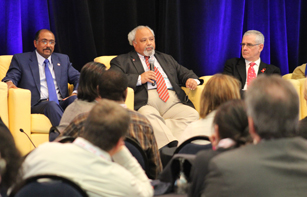
L to R: UNAIDS Executive Director, Michel Sidibé, United States Global AIDS Coordinator, Ambassador Eric Goosby and chair of the International HIV Treatment as Prevention Workshop, Julio Montaner. Credit: British Columbia Centre for Excellence in HIV/AIDS.
Vancouver, 1996: Researchers electrify the International AIDS Conference with news of a stunning scientific breakthrough. Using a combination of medicines, they have been able to reduce the amount of virus in the blood of people living with HIV to virtually undetectable levels. In what became known as the “Lazarus Effect,” people once near death were suddenly well again and able to live normal, healthy lives.
This discovery transformed the course of the AIDS response forever and more than 8 million people around the world today have access to the lifesaving treatment.
This week, HIV experts are once again gathering in Vancouver. This time to discuss another important scientific breakthrough—recent research showing that HIV treatment not only protects the health of people living with HIV, it also dramatically reduces the likelihood of transmitting the virus to others.
On the opening day of the conference the Executive Director of UNAIDS Michel Sidibé, together with the United States Global AIDS Coordinator Eric Goosby, led roundtable discussions on the theme ‘What will it take to end AIDS?’
“If we have the evidence that antiretroviral therapy can help someone living with HIV to stay alive and protect their sexual partners from infection by up to 96%, then we have a moral obligation to make it available,” said Mr Sidibé. “Providing HIV treatment as soon as possible is ethically and morally correct, economically and programmatically feasible and consistent with what we have learnt about clinical best practice over the last decade.”
If we have the evidence that antiretroviral therapy can help someone living with HIV to stay alive and protect their sexual partners from infection by up to 96%, then we have a moral obligation to make it available.
UNAIDS Executive Director Michel Sidibé
Mr Sidibé was referring to results announced in May 2011 by the United States National Institutes of Health which showed that if an HIV-positive person adheres to an effective antiretroviral therapy regimen, the risk of transmitting the virus to their uninfected sexual partner can be reduced by 96%.
The Prime Minister of St Kitts and Nevis Denzil Douglas made a bold statement on the potential impact of combination HIV prevention. He said, “Using treatment as prevention in combination with other prevention interventions can end AIDS in the Caribbean countries.”
Malawi, a country which has been severely affected by HIV, radically scaled up its response to HIV in recent years resulting in a 73% drop in the rate of new HIV infections since 2001. Talking about the impact of antiretroviral therapy on her country’s epidemic, the Minister of Health of Malawi, Catherine Hara said, “In part due to the rapid treatment expansion, HIV infections in Malawi have decreased to 46,000 per year and annual deaths are going down and are now less than 50,000 per year whereas before the number of deaths was nearly 100,000.” She also added “My country pioneered Option B+* in antenatal care services for women and the number of pregnant women living with HIV that are accessing treatment increased by over 700%.”

The Prime Minister of St Kitts and Nevis Denzil Douglas speaking at the Vancouver conference. Credit: British Columbia Centre for Excellence in HIV/AIDS.
Emphasizing the need to start treatment early Marvelous Muchenje, of Women’s Health in Women’s Hands said, “Many people associate starting treatment with illness or even death—we need to change that conception as starting treatment earlier prevents illness, death and HIV transmission.”
Wrapping up the session, chair of the International HIV Treatment as Prevention Workshop, Julio Montaner, stressed the need to turn evidence into action. "We know enough about the science for treatment as prevention. It is now time to act."
The Workshop will continue until Thursday 25 April as researchers, implementers and policy makers involved in treatment as prevention continue to share data, protocols and findings, and foster an open collaborative environment regarding research into treatment as prevention. They will be looking to identify areas of potential synergy and possible gaps, where further targeted research efforts may be needed.
*Option B+ is an option that gives women living with HIV the possibility of starting lifelong antiretroviral therapy immediately for their own health as well as to protect their children.
Feature Story
Africa Health Forum 2013: Finance and Capacity for Results
22 April 2013
22 April 2013 22 April 2013
Credit: UNAIDS
Big questions were raised about getting the best results in health and development at the World Bank’s Africa Development Forum 2013. The event brought together Ministers of Finance and Health from some 30 African countries to explore effective and creative ways to ensure the future health of the continent.
With the umbrella theme finance and capacity for results, the aim of the forum was to identify concrete strategies to ensure that investments in health produce sustainable results on a large scale. Also sought, were new ways to finance and build institutional capacity so that African countries can design, implement and evaluate health investments.
“We need more money for health and more health for money in Africa,” said the host Makhtar Diop, Vice President of the World Bank Group, Africa Region in his opening remarks. “This landmark conference aims to jointly decide on concrete actions for countries and show partners how to further invest in health and sustainable growth in Africa,” he added.
Urgent change needed
Several key characteristics of the continent’s health systems need to be urgently addressed, according to the participants. For instance, the average per capita health spending in Africa was seen as low. However, it is higher than in many South Asian countries where health outcomes are considered generally better. Therefore, Africa would not only need more health financing but also, it would need to spend what it has more effectively.
We have a unique opportunity to recommit ourselves to universal access to health that is critical for short, medium and long term growth, ending poverty and building shared prosperity.
President of The World Bank Group Dr Jim Yong Kim
In addition, out-of-pocket expenses for accessing health services were also defined as extremely high, constituting about one third of all health expenditure in sub-Saharan Africa and more than 60% in several countries like Cameroon and Sierra Leone. Such personal spending may contribute to increase poverty and decrease the use of medical services.
Many African countries are still heavily dependent on external resources to finance their health sector. For some, as much as 40% comes from this stream and in 26 of 33 countries in sub-Saharan Africa, donor support accounts for more than half of HIV investments. Participants defined this dependency as a serious sustainability issue requiring more self-sufficiency and building of domestic capacity with self-financing as the ultimate goal.
Speaking about sustainable financing, the Minister of Finance of Nigeria Hon. Ngozi Okonjo-Iweala stated that, “It is not only the volume of financing that matters but how that really responds to the need of the poor,” said Minister Okonjo-Iweala. “In a country deciding on how to best respond to those needs, political will and leadership are key.
In Africa, a shift from investments that focus on inputs and processes to those that focus on results and systemic changes is already underway. Health sector reforms and efficiency improvement initiatives, results-based financing (RBF), and public-private partnerships in many countries have resulted in rapid scaling up of service coverage and improved efficiency in how resources are used for health.
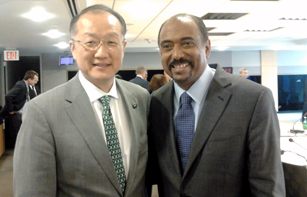
President of The World Bank Group Dr Jim Yong Kim (left) and UNAIDS Executive Director Michel Sidibé.
The RBF approach at the facility level, pioneered in Rwanda, has resulted in a substantial increase in coverage of high-impact activities such as immunization, family planning, the distribution of mosquito nets, and skilled attendance at delivery. Today, more than 20 sub-Saharan African countries are piloting some form of RBF. Development partners are also trying out this mechanism at the country level. For example, the new World Bank financing instrument known as Program-For-Results (PforR) will now be used in Ethiopia to link disbursement directly with achieving national programme results. Many sub-Saharan African countries have also established social safety nets. Through these initiatives, people with limited or no resources may have improved access to basic health services, among other services, so that they do not have to skip necessary care or endure financial hardship related to it.
The AIDS response: a new paradigm
In charting the way forward Michel Sidibé highlighted the role of the AIDS response in pioneering a new paradigm of sustainable development, shared responsibility and global health solidarity. He stressed that, despite the progress made in reducing new HIV infections in Africa, more funding, both donor and domestic, and more strategic use of that funding for greatest impact were necessary.
“Our world is shifting and we have to think about long-term financing for results,” said UNAIDS Executive Director Mr Sidibé. “Our objectives are to help countries revisit their programmes and find new mechanisms for investments in health and social development. In the AIDS response, we are seeing a major shift with the domestic investments surpassing those of the donors. We also need to maximize external aid and value for money,” he added.
Participants at the forum committed to building on African countries’ successful initiatives and experiences showing promise such as national health financing strategies, efficiency improvement programmes, results-based financing and introducing safety nets for the poor.
Closing the conference, the President of The World Bank Group Dr Jim Yong Kim said, “We need to help countries to get innovative systems for health to lift the burden. We have a unique opportunity to recommit ourselves to universal access to health that is critical for short, medium and long term growth, ending poverty and building shared prosperity.”
Related
Feature Story
When art and politics intersect
22 April 2013
22 April 2013 22 April 2013
Credit: UNAIDS
If artist Keith Haring were still alive he might have joined the anti-homophobia demonstrations taking place in Paris during the opening weekend of a new retrospective of his art.
More than 20 years after his death, a new exhibit still packs a big political punch. Entitled “The political Line” the show opened at the Musée d’Art Moderne de la Ville de Paris and at the Cent Quatre community centre on 19 April 2013.
One of the most influential artists of his time, Mr Haring was known for his political messages. His art focused on communicating difficult issues such as social justice and individual freedom.
Even the title “The political Line”—is a play on words—honouring both his political narrative and his emphasis on line drawings. The exhibit is also making a political statement by showing in two very different Paris neighbourhoods.
The fact that much of his art was painted and shown in public spaces means that people have to interact with issues like violence, AIDS and homophobia. His art is as relevant today as it was when he painted them and he continues to influence a new generation of activism through art.
Annemarie Hou, UNAIDS Director of Communications
“One is in the 16th, which is a very rich quarter, in a museum and one show here at the Cent Quatre in the 19th,” said Bettina Bauerfeind a guide for the Cent Quatre community center, at the heart of an urban renewal area. “This is an exceptional exhibition because it brings together people—he wanted to offer his artwork to everybody.”
“The fact that much of his art was painted and shown in public spaces means that people have to interact with issues like violence, AIDS and homophobia,” said Annemarie Hou, UNAIDS Director of Communications. “His art is as relevant today as it was when he painted them and he continues to influence a new generation of activism through art.”
Diagnosed with HIV in 1998, the artist set up a foundation dedicated to AIDS and children’s issues. In honour of World AIDS Day in 2008, UNAIDS received two Keith Haring sculptures on loan from the foundation for the UNAIDS “Art for AIDS” collection.
The Paris retrospective follows a timeline of Mr Haring’s political messages—featuring more than 250 works of art. The exhibit runs until 18 August 2013.