Feature Story
High-Level Taskforce for women, girls and HIV calls for accelerated efforts to protect the rights and wellbeing of young women and girls in South Africa
31 October 2012
31 October 2012 31 October 2012
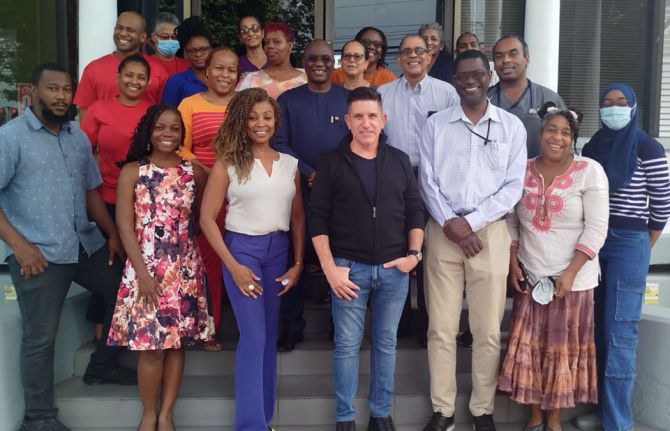
The members of the High-Level Taskforce for Women, Girls, Gender Equality and HIV for Eastern and Southern Africa during their recent visit to South Africa
The High-Level Taskforce for Women, Girls, Gender Equality and HIV for Eastern and Southern Africa concluded a week-long political advocacy mission to South Africa calling for renewed commitment and leadership to protect the health and rights of young women and girls in the country.
South Africa’s Department of Women, Children and People with Disabilities invited the Taskforce to advocate with the country’s leadership around the critical issues facing women and girls today including teenage pregnancy, gender based-violence, transmission of HIV from mother-to-child, and sex work.
“The work done by the Taskforce will help us identify gaps and challenges which will enable us to develop more effective intervention programmes,” said the Deputy Minister of the Department of Women, Children and People with Disabilities, Ms Hendrietta Bopane-Zulu.
The members of the Taskforce met with South Africa’s high-level government officials, representatives of international and civil society organisations, parliamentarians and other stakeholders working on the HIV response. The delegation also held discussion with networks of women living with HIV and lesbian, gay, bisexual transgender, and intersex (LGBTI) communities.
High teenage pregnancy
Despite South Africa’s progress in the AIDS response, women and girls remain disproportionately affected by the epidemic. According to the 2008 Human Sciences Research Council (HSRC) household survey, HIV prevalence was more than four times higher in women aged 20–24 (21.1%) than in men in the same age group (5.1%).
We have all the necessary policies in place but our biggest challenge is changing societal attitudes
South Africa’s Deputy President Kgalema Motlanthe
Social determinants such as poverty, inequalities, gender based violence, and limited access to sexual and reproductive health information together with a lack of adolescent friendly health services make teenage girls vulnerable to unintended pregnancy and HIV infection. Data from the National Strategic Plan on HIV, TB and STIs, 2012–2016 shows that 39% of 15–19-year-old girls have been pregnant at least once and 49% of adolescent mothers are pregnant again in the subsequent 24 months. It also reveals that one in five pregnant adolescents is HIV-positive.
“We are doing everything possible to end teenage pregnancies, which are primarily caused by older men taking advantage of young girls,” said South Africa’s Deputy President Kgalema Motlanthe. “We have all the necessary policies in place but our biggest challenge is changing societal attitudes,” added Dr Motlanthe.
The Taskforce team engaged with the King Goodwill Zwelithini of KwaZulu-Natal Province regarding traditional and social norms, such as intergenerational sex and multiple and concurrent partnerships that contribute towards the issue of teenage pregnancy. "We should not only focus on youth programmes,” said King Zwelithini. “We must also educate parents at home because some parents find it hard to talk to their children. It is not easy but we should speak the truth, because the love of truth is the spirit of men," he added.
“Prevention of unintended pregnancies and HIV infection in young girls must be a major priority for South Africa’s leadership”, said Professor Sheila Tlou, Regional Director of UNAIDS and a member of the Taskforce. “Keeping girls in school is critical to reduce new HIV infections among girls and help them to reach their potential.”
Stopping new HIV infections among children
The elimination of new HIV infection among children and keeping their mothers alive was also present during the discussions that the Taskforce members had with South Africa’s Minister of Health, Dr Aaron Motsoaledi. South Africa has seen a decrease in mother-to-child transmission of HIV from 3.5% in 2010 to 2.7% in 2011 and is well on its way to meet the target set in the 2011 Political Declaration on HIV/AIDS of virtual elimination by 2015.

Minister of Gender, Children and Social Development in Kenya and member of the Taskforce, Naomi Shaban (left) with South Africa’s Deputy President Kgalema Motlanthe.
While acknowledging the drop in new HIV infections among children, the Minister of Gender, Children and Social Development in Kenya, Dr Naomi Shaban—who led the Taskforce delegation—stressed that more needs to be done to keep mothers alive. “We need to redouble our efforts to save babies but also, we need to ensure that the mothers are there to care for their children,” said Dr Shaban.
In order to address the high rates of maternal mortality in South Africa—310/100 000 live births—earlier this year, the National Department of Health, spearheaded by the Minister of Health, Dr Motsoaledi, launched the Campaign for Accelerated Reduction of Maternal Mortality in Africa (CARMMA) in South Africa.
Some of the key elements of CARMMA is to strengthen women’s access to comprehensive sexual and reproductive health services, especially family planning to prevent new HIV infections and unintended pregnancies, strengthen the health system to provide human resources for maternal and child health and to intensify the management of HIV-positive mothers.
The High-Level Taskforce for Women, Girls, Gender Equality and HIV in Eastern and Southern Africa, which comprises ministers, National AIDS Council (NAC) directors, four regional UN directors, civil society and women living with HIV, was officially launched in December 2011 at the 16th International Conference on AIDS and STIs in Africa (ICASA). It aims to engage in high-level political advocacy in support of accelerated country actions and monitoring the implementation of the draft Windhoek Declaration for Women, Girls, Gender Equality and HIV.
Feature Story
Namibia’s City of Windhoek collaborates to strengthen HIV response
30 October 2012
30 October 2012 30 October 2012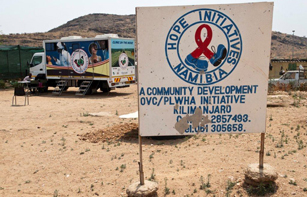
The Mister Sister Mobile clinic parked outside the office of Hope Initiative SA—a community-based organization that provides care and support services for orphans and vulnerable children in the informal settlements around Windhoek.
Credit: UNAIDS/T.Figuera
Similar to many other countries, Namibia’s population has been shifting towards towns and cities in search of better opportunities and hoping for a more prosperous life. Urbanization has led to the growth of informal settlements surrounding major cities and towns making it difficult to reach residents with critical health services.
Namibia’s capital City of Windhoek—whose population grew by 38% between 2001 and 2011—has partnered with UNAIDS, UNDP and PharmAccess Foundation to strengthen its overall health and HIV response with innovative options such as mobile clinics.
“The City of Windhoek is committed to delivering efficient and effective municipal health services to all Windhoek residents, in particular underserved populations,” said the Chief of Health Services for the City of Windhoek, Mary-Anne Kahitu. “Through our strategic partnerships—such as with the Ministry of Health and Social Services, PharmAccess Foundation and other key stakeholders—we will endeavor to promote increased access to quality health and HIV services in informal settlements,” she added.
During a period of 18 months, the joint project "Strengthening city responses to HIV/AIDS" explored the city’s urban HIV epidemic and response. Findings included a household survey showing that HIV incidence and prevalence appeared to be higher in the north-western area of Windhoek, which is primarily characterized by informal settlements and low-income formal housing. The study highlighted that these areas had limited access to adequate HIV prevention and treatment services—such as antiretroviral treatment, HIV counselling and testing and services to stop mother-to-child transmission of HIV.
Mobile health services
The findings of the study prompted collaborative action between PharmAccess Foundation, the City of Windhoek and the Ministry of Health and Social Services to provide mobile health services. Twice a month, a mobile clinic visits the informal settlements. Supported through the PharmAccess’ Mister Sister Mobile clinic project, the Ministry provides all medicines for the operation of the clinic free of charge.
The City of Windhoek is committed to delivering efficient and effective municipal health services to all Windhoek residents, in particular underserved populations
Chief of Health Services for the City of Windhoek, Mary-Anne Kahitu
The first mobile clinic was parked outside the office of Hope Initiative SA (HISA), a small community-based organization that provides care and support services for orphans and vulnerable children in the informal settlements around Windhoek.
“It is very important to have a mobile clinic in informal settlements because without it, children and vulnerable people would definitely not have access to medical help,” said Patricia Sola, Founder of Hope Initiative. “Our nearest clinic is more than an hour walk away, not to mention the cost of being seen by a doctor.” For HISA, the clinic also brings an opportunity to give information to patients on access to social grants and birth registration.
The primary health care services provided the same kind of services the Ministry offers in its health care facilities. These include family planning advice and supplies, routine immunizations, child growth monitoring, screening for TB symptoms and referral, diagnosis and treatment of routine communicable disease, HIV testing, and referral and follow up on chronic diseases.
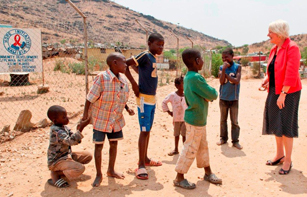
UNAIDS Deputy Executive Director, Management and Governance, Jan Beagle chats with a group of children during her recent visit to Namibia.
Credit: UNAIDS/T.Figuera
In August 2012, PharmAccess began expanding its operations into the rural and remote areas of Khomas and Omaheke regions with two additional mobile clinics. “PharmAccess Namibia is very proud to provide primary health care services to the people who need it most in Windhoek’s poorest informal settlements,” said Ingrid De Beer, Managing Director of Pharm Access in Namibia. “Our partnership with the Ministry of Health and Social Services, supported by Mister Sister Partners and the City of Windhoek, has made this possible. In the coming months, we look forward to collecting the evidence required to inform local policies on primary health service provision in the informal settlements of greater Windhoek,” she added.
In a recent visit to Namibia, UNAIDS Deputy Executive Director, Management and Governance, Jan Beagle, along with representatives of partner organisations involved in the project, commended the City of Windhoek and the Ministry of Health and Social Services for its leadership and commitment to strengthening the city's response to HIV.
Ms Beagle highlighted the excellent partnership between the community, civil society and government to meet the health needs of vulnerable populations in informal settlements around Windhoek and emphasized that “such innovative initiatives should be scaled up and replicated across the country.”
External links
External links
Feature Story
Goodwill Ambassador Hong Myung-bo praises Thailand’s HIV efforts
29 October 2012
29 October 2012 29 October 2012
UNAIDS Goodwill Ambassador Mr Myung-Bo Hong (second from left) was accompanied on the visit to Thailand by his two sons: 12-year-old Jeongmin (left) and 14-year-old Seongmin, standing next to UNAIDS Executive Director Michel Sidibé. Credit: UNAIDS
South Korean football star Hong Myung-bo—a UNAIDS International Goodwill Ambassador—described his HIV fact-finding visit to Thailand this week as an “eye-opening experience” and a great learning opportunity.
“I’ve been able to see first-hand the tremendous work that UNAIDS and its partners are doing in Thailand and across Asia,” said Mr Hong, who played for South Korea’s national football team in four consecutive World Cups (1990-2002) and is currently Korea’s Olympic Football Team coach.
“A football match lasts 90 minutes and even if you are leading in the first half, you can still lose the match,” said Mr Hong, adding, “We cannot afford to drop the ball” in terms of HIV awareness.
During his five-day mission, Mr Hong visited community organizations and met with members of key affected populations in the national HIV epidemic, including female sex workers at the Empower Foundation—a national non-governmental organization that protects the rights of female sex workers.
Mr Hong pledged to share impressions and highlights from the visit on his return to South Korea with key stakeholders and to underline the importance of shared responsibility and continued funding for the AIDS response. While connecting with UNAIDS Executive Director Michel Sidibé in Bangkok, he shared his plan to arrange a charity football match in December to raise money for AIDS-related projects in the region.
The power of sport is impressive and can be an agent for change, especially for young people. Mr Hong is a compelling voice to empower young people to protect themselves from HIV—to address stigma and discrimination against people living with and affected by HIV.
UNAIDS Executive Director Michel Sidibé
“The power of sport is impressive and can be an agent for change, especially for young people,” said Mr Sidibé, who was in Thailand as part of a three-country official mission in South-East Asia. “Mr. Hong is a compelling voice to empower young people to protect themselves from HIV—to address stigma and discrimination against people living with and affected by HIV.”
During his visit to Thailand, Mr Hong took part in a football training session for coaches organized by Thailand’s National Olympic Committee and the Physical Education Institute.
Mr Hong was accompanied on the visit to Thailand by his two sons, 14-year-old Seongmin Hong and Jeongmin, aged 12. While meeting with Mr Sidibé, Seongmin presented the Executive Director with a US$ 3000 donation, which he had raised at an art exhibit for AIDS.
Mr Sidibé applauded the young man’s initiative: “You have made a very powerful gesture. Efforts like yours show that we can be inclusive, tolerant, open and compassionate—that we can all work together to stop HIV.”
Multimedia

Feature Story
Myanmar commits to reaching zero new HIV infections in children by 2015
29 October 2012
29 October 2012 29 October 2012
Myanmar’s Minister of Health Professor Dr Pe Thet Khin and UNAIDS Executive Director Michel Sidibé.
Myanmar’s Minister of Health, Professor Dr. Pe Thet Khin, says his ministry is committed to working towards the elimination of new HIV infections among children by 2015 and keeping their mothers healthy to raise them. Minister Pe Thet Khin jointly announced this commitment with UNAIDS Executive Director Michel Sidibé in a meeting on 27 October in Mandalay.
“The Ministry of Health believes that by 2015 children in Myanmar can be born free of HIV and their mothers can remain healthy to raise them,” said Minister Pe Thet Khin. “This plan is realistic, achievable and supported by evidence. Preventing new HIV infections among children is a smart investment that saves lives and helps to give children a healthy start in life. This will be achieved through scaling up testing services and providing drugs that are simple and safe to all pregnant women who need them.”
With treatment from early in pregnancy through the breastfeeding period, the risk of transmitting HIV from a mother living with HIV to her child can be less than 5%. Myanmar’s National AIDS Programme has been gradually scaling up its HIV prevention services for pregnant women. In 2011, 84% of the estimated 3700 pregnant women living with HIV received antiretroviral prophylaxis to prevent transmission of HIV to their babies. However, less than a third of pregnant women are currently tested for HIV. Myanmar health authorities plan to decentralize HIV testing services to reach more pregnant women.
The Ministry of Health believes that by 2015 children in Myanmar can be born free of HIV and their mothers can remain healthy to raise them
Myanmar’s Minister of Health, Professor Dr Pe Thet Khin
“I congratulate Myanmar on its commitment to reach an AIDS-free generation by 2015,” said UNAIDS Executive Director Michel Sidibé. “I am sure if resources are made available to Myanmar, the country will reach its ambitious goal and I call on donors to support the Ministry of Health.”
Mr Sidibé and Minister Pe Thet Khin called on international donors and other partners to work with Myanmar’s Ministry of Health to maintain the achievements made so far and to expand HIV prevention and treatment services for key affected populations.
The two leaders also spoke about country ownership and sustainability of health programs. The health system in Myanmar is undergoing reform. Mr Sidibé suggested applying the “three ones” principle for health: one costed national health plan; one national health sector coordination mechanism; and one national monitoring and evaluation system that all development partners follow.
Multimedia
Feature Story
Myanmar overcomes major challenges to push forward its response to HIV
26 October 2012
26 October 2012 26 October 2012
UNAIDS Executive Director Michel Sidibé (left) met with Vice-President of Myanmar Dr Sai Mauk Kham on 26 October in Nay Pyi Taw. Credit: UNAIDS
The Vice-President of Myanmar, Dr Sai Mauk Kham, reconfirmed his government’s commitment to effective HIV programming during a meeting with UNAIDS Executive Director Michel Sidibé. The two leaders met in Nay Pyi Taw, the country’s capital, where they discussed the progress made by Myanmar in its AIDS response despite the enormous challenges faced by the country.
Vice-President Sai Mauk Kham highlighted that Myanmar is struggling with twin challenges—human resources capacity and funding. “Myanmar’s main obstacle is funding. We need US$ 340 million dollars for our response to HIV. Right now we have reached 50% of our target. We have to continue our efforts,” said Dr Sai Mauk Kham.
Unlike other low- and middle-income countries in Asia, Myanmar has received little international support during the past two decades. However, the country has still managed to make some progress in its national AIDS response. Around 216 000 people were living with HIV in Myanmar in 2011 with an HIV prevalence among the adult population estimated at 0.53%. Health authorities estimated that 8 500 new HIV infections occurred in 2011—a drop from 11 000 in 2008 and an estimated 32% of people living with HIV in need of treatment were accessing it, compared to just 12% in 2008.
Myanmar’s main obstacle is funding. We need US$ 340 million dollars for our response to HIV. Right now we have reached 50% of our target. We have to continue our efforts
Vice-President of Myanmar, Dr Sai Mauk Kham
“This is a transformative moment in Myanmar. Despite difficult times, Myanmar is managing to deliver results,” said Mr Sidibé. “UNAIDS will support Myanmar’s efforts to seize this window of opportunity and expand HIV programmes to make significant returns on investments.”
Since reform and political change have occurred in Myanmar, international donors are investing more in the country’s AIDS response. At the same time, the country is increasing its domestic budget for HIV. This month, the government announced that for the first time ever, Myanmar will dedicate funds to acquire antiretroviral drugs. The Ministry of Health is planning to spend its own resources on HIV treatment which will be distributed through the state health system.
Reforming laws
Mr Sidibé also met with Myanmar’s Attorney General Dr Tun Shin and called on his support to reform existing punitive laws which often date back to colonial times. Existing laws criminalizing same-sex sexual activities between consenting adults, sex work and drug use are hampering the AIDS response in the country.
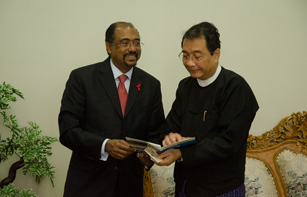
UNAIDS Executive Director Michel Sidibé; and Myanmar’s Attorney General Dr Tun Shin. Credit: UNAIDS
“Our goal is universal access to HIV services but we face universal obstacles,” said Mr Sidibé. “Anything we can do to remove obstacles will be very supportive of the AIDS response. We will not reach zero discrimination without reforming laws,” he added.
Dr Shin explained that amending or drafting laws is a two-step process in Myanmar, with ministries in charge of initiating the legal reform in their area. Once the ministries have drafted the laws they come to his office for vetting and processing. Dr Shin said that it is important for the people of Myanmar and the international community to see that the government is serious about change through the reform of its laws. He assured Mr Sidibé that the Office of the Attorney General would support the efforts of UNAIDS in this area.
Multimedia
Feature Story
Benin’s Head of State calls for shared responsibility in the national AIDS response
26 October 2012
26 October 2012 26 October 2012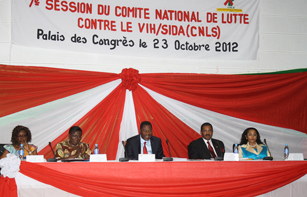
L to R: Dr Sonia Boni, Executice Secretary, National AIDS Committee; Professor Kindé Gazard, Minister of Health; H.E. President Boni Yayi, President of the Republic of Benin; Dr Mamadou Diallo, UNAIDS Director, Regional Support Team for West and Central Africa; Ms Nardos Bekele-Thomas, United Nations Resident Coordinator.
At an extraordinary session of Benin’s National AIDS Committee on 23 October, President Boni Yayi called for a series of measures to accelerate progress in the country’s AIDS response. Held at the Palais des Congrès in Cotonou, the session was attended by more than 350 participants, including ministers, ambassadors and representatives from the private sector, civil society, networks of people living with HIV, and United Nations agencies.
According to government estimates, about 60 000 adults and children are living with HIV in Benin. Over the past decade, Benin has succeeded in reducing national HIV prevalence—from 4.1% in 2001 to 1.2% in 2012. Eight out of ten people living with HIV now have access to antiretroviral treatment and one in two HIV-positive pregnant women have access to services that prevent new HIV infections in children.
To build on these gains, Benin’s President called for improved governance in the AIDS response. He announced that he would rapidly undertake a national audit of the country’s AIDS structures—including the National AIDS Committee (NAC), the Global Fund Country Coordinating Mechanism (CCM) and the national AIDS Control Programme (NACP)—and said that the NAC’s Executive Secretariat, previously under the authority of the Minister of Health, would be placed under his direct leadership.
President Yayi pledged to address the recurrent issue of HIV drug stock-outs by simplifying procurement procedures and adopting special custom regulations for antiretroviral medicines. He said he would focus national efforts on achieving the twin goals of universal coverage to HIV treatment and the elimination of mother-to-child transmission of HIV by 2015.
Though Benin has increased its AIDS budget in recent years, more than 75% of national AIDS investments are funded through external sources. In the spirit of shared responsibility, President Yayi pledged to increase the national HIV budget from US$ 1.2 million to US$ 3.2 million. A new airfare tax earmarked for the national AIDS response was also highlighted.
This is a true example of shared responsibility in action, which is advocated by the UNAIDS Executive Director
Ambassador of France, Jean-Paul Monchau
Donors attending the meeting congratulated Benin’s Head of State on these measures. “This is a true example of shared responsibility in action, which is advocated by the UNAIDS Executive Director,” said the Ambassador of France, Jean-Paul Monchau.
The meeting in Cotonou offered a platform for dialogue between all AIDS stakeholders around the implementation of the African Union’s Roadmap on Shared Responsibility and Global Solidarity for AIDS, Tuberculosis and Malaria.
Launched in July 2012, the Roadmap offers a set of long-term sustainable strategies to finance and provide access to HIV treatment, prevention and other health services in Africa. In his capacity as Chair of the African Union, President Yayi presented the Roadmap to African leaders at a September 2012 high level side event of the UN General Assembly.
Feature Story
Nobel Peace Prize winner Aung San Suu Kyi calls for zero discrimination of people living with HIV
26 October 2012
26 October 2012 26 October 2012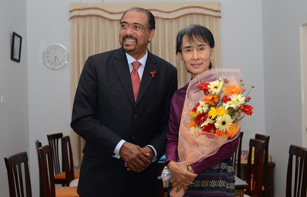
UNAIDS Executive Director Michel Sidibé, and Nobel peace prize winner and Member of Parliament Aung San Suu Kyi. Credit: UNAIDS
Nobel peace prize winner and Member of Parliament Aung San Suu Kyi calls on her fellow citizens and people around the globe to eliminate stigma and discrimination, which people living with HIV often face. On Friday, the leader of the National League for Democracy welcomed UNAIDS Executive Director, Michel Sidibé to her residence in Nay Pyi Taw, the capital of Myanmar. The two leaders spoke at length about how to overcome stigma and discrimination of all marginalized groups.
Mr Sidibé thanked Aung San Suu Kyi for her leadership on AIDS since the beginning of the epidemic in Myanmar as well as her global statements against stigma and discrimination, such as at the World AIDS Conference in Washington D.C., earlier this year. In their discussion, Mr Sidibé asked why she spoke out strongly and early on the issue of AIDS when there were so many important issues for her to consider. Aung San Suu Kyi responded that similar to other issues that she is closely focused on “addressing AIDS requires openness and compassion. Responding to AIDS can be seen as a contribution to positive human relations.”
Currently there are slightly over 30% of people living with HIV eligible for treatment who are receiving treatment in Myanmar. Mr Sidibé said, “Myanmar has the potential to quickly scale-up and reach 85% coverage of those in need of ARVs. We are in a race against time to get resources and save many lives. But, the final mile will not be easy.” Aung San Suu Kyi agreed, “Our country is trying to run the last mile. That last mile is the most difficult. If we collapse then we don’t get to our goal and the possibility of collapse is greatest during the last mile – you don’t get second wins.”
Addressing AIDS requires openness and compassion. Responding to AIDS can be seen as a contribution to positive human relations.
Nobel peace prize winner and Member of Parliament Aung San Suu Kyi
There are an estimated 216,000 people living with HIV and HIV prevalence is estimated at 0.53% for adults. Myanmar has an epidemic concentrated mainly in the following groups: sex workers and their clients, drug users and men who have sex with men and their sexual partners. As in many other countries key affected populations in Myanmar face stigma and discrimination which hamper their access to prevention. A person living with HIV who also comes from a key affected population often struggles under a heavy double dose of stigma, which prevents their access to care, treatment and support.
Aung San Suu Kyi said that social fear and stigma often stop people from getting an HIV test and knowing their status early, which hampers their access to early HIV treatment. Aung San Suu Kyi has been a strong champion of the AIDS movement. She has publically embraced people living with HIV as a sign of her efforts to counter stigma and discrimination. Earlier this year at a major international AIDS conference in Washington DC, USA, she delivered a message via video link, supporting people living with HIV.
Mr Sidibé thanked her for her support and hoped that her example would inspire other community leaders in Myanmar and around the world to speak out against stigma and discrimination.
Multimedia
Feature Story
United Nations Deputy Secretary-General visits UNAIDS
25 October 2012
25 October 2012 25 October 2012
L to R: UNAIDS Deputy Executive Director, Programme, Paul De Lay; UNAIDS Deputy Executive Director, Management and Governance, Jan Beagle; UN Deputy Secretary-General, Jan Eliasson; UN Secretary-General’s Special Adviser on the Post-2015 Development Agenda, Amina Mohammed; Political and Public Affairs Director, Luiz Loures; Executive Office Director, Tim Martineau. Credit: UNAIDS
UNAIDS welcomed the visit from the United Nations Deputy Secretary-General, Jan Eliasson to its headquarters in Geneva on 25 October. Accompanied by the United Nations Secretary-General’s Special Adviser on the Post-2015 Development Agenda, Ms Amina Mohammed, Mr Eliasson discussed with the UNAIDS Deputy Executive Directors and the Director of Political and Public Affairs the need to address peace and security, development, human rights and the rule of law, in an integrated way.
During the meeting, Mr Eliasson commended the ‘horizontal’ approach pursued by UNAIDS in bringing together different actors and interests around a common thematic agenda. He stressed the need for the United Nations system to work more coherently, and noted that “such an approach can inform the future direction for UN reform and delivering as one.” Such approaches will be crucial in the implementation of a post-2015 development agenda.

Feature Story
Indonesia to push for social inclusiveness as a global development goal
24 October 2012
24 October 2012 24 October 2012
UNAIDS Executive Director Michel Sidibé met with the Head of the President’s Delivery Unit for Development Monitoring and Oversight, Kuntoro Mangkusubroto in Jakarta on 24 October 2012.
Credit: UNAIDS/E.Wray
Countries pledged to reach eight Millennium Development Goals (MDG) by 2015, including reversing the AIDS epidemic. Much progress has been made in reaching these goals. However, there is recognition that the world will still need to focus on these goals beyond 2015. Therefore, the United Nations Secretary General Ban Ki-moon has appointed Indonesia, along with the United Kingdom and Liberia, to co-chair a High-Level panel tasked with setting future development priorities beyond 2015.
Indonesia’s Head of the President’s Delivery Unit for Development Monitoring and Oversight and advisor to Indonesia’s President on the post 2015 development agenda, Kuntoro Mangkusubroto committed to not only maintaining but expanding key global development goals during a meeting with UNAIDS Executive Director Michel Sidibé in Jakarta on Wednesday.
“I would like to congratulate Indonesia for leading the work to develop the post 2015 development agenda,” said Mr Sidibé. “This shows trust in Indonesia, not only as a country that is influencing the agenda in Asia but in the world. This exercise is a unique opportunity to really bring the debate around creating an inclusive society and redistribution of opportunity to the world table.”
We are not going to close the MDG chapter and open a new book. We think MDGs are good and we need to maintain them, but we also want new social issues like social inclusiveness to be addressed
Head of the President’s Delivery Unit for Development Monitoring and Oversight, Kuntoro Mangkusubroto
Mr Kuntoro agreed that the current MDGs had greatly contributed to the world’s development. “We are not going to close the MDG chapter and open a new book. We think MDGs are good and we need to maintain them, but we also want new social issues like social inclusiveness to be addressed,” said Mr Kuntoro.
Dialogue with civil society
After meeting with the President’s advisor, Mr Sidibé had a dialogue with civil society organizations representing people living with HIV and key affected populations in Indonesia. The discussion, moderated by Professor Irwanto and held at the AIDS research centre of the Atma Jaya University in Jakarta, reviewed current HIV policies and their implementation, as well as to hear the concerns of civil society on how HIV should be addressed in the post 2015 development agenda.
Professor Irwanto reminded the gathering about the important role played by civil society in the AIDS response. “The problem is that, right now, we feel that civil society is getting less and less attention. We hope that the role of civil society is not only maintained but strengthened because the achievements so far could not have been reached without civil society,” said Professor Irwanto.
Civil society participants discussed a wide variety of concerns including ensuring that civil society is given the opportunity to contribute to the development of national guidelines on HIV, the need to ensure antiretroviral therapy is made accessible to everyone needing treatment and how to support women living and affected by HIV.

UNAIDS Executive Director Michel Sidibé participating in a dialogue with civil society organizations representing people living with HIV and key affected populations in Indonesia. 24 October 2012.
Credit: UNAIDS/E.Wray
“Many of you have been helping us to frame the HIV response in a different way. You have changed the dynamic of social mobilization,” said Mr Sidibé. “Let us work together. I am asking you to help us to ensure that AIDS remains high on the development agenda. Let us not miss the opportunity to bring to shape the debate on the post 2015 development agenda,” he added.
Indonesia spearheaded a movement among countries in the Association of Southeast Asian Nations (ASEAN) to reach the global vision of zero new HIV infections, zero discrimination and zero AIDS-related deaths through the ASEAN Cities Getting to Zero initiative. The move is part of an effort to strengthen collaboration between countries in the region to control the epidemic. Jakarta was chosen as one of three Indonesian cities participating in the programme.
Mr Sidibé visited Jakarta’s model community health centre, located in the city’s Tambora district, which is participating in the ASEAN Cities Getting to Zero project. The centre provides comprehensive HIV services, including voluntary counselling and testing, prevention of mother-to-child transmission, HIV treatment care and support, as well as methadone treatment for people who use drugs.
Multimedia

Feature Story
HIV-positive Kami and United Nations Secretary-General Ban Ki-Moon promote women and children’s health
23 October 2012
23 October 2012 23 October 2012
United Nations Secretary-General Ban Ki-Moon and Kami
Kami, a muppet from Takalani Sesame (South Africa's Sesame Street), who is openly living with HIV, joined the United Nations Secretary-General Ban Ki-Moon in promoting children’s health. During a public service announcement Kami and Mr Ban talk about what they do to stay healthy including washing their hands before they eat, drinking plenty of clean water and exercising.
The video was produced by the Sesame Workshop, the non-profit organization behind Sesame Street around the world, as part of its commitment to the United Nations Secretary-General’s Every Woman Every Child movement to mobilize and intensify global action to improve the health of women and children around the world.
“I am deeply grateful to Sesame Workshop for lending its creativity, passion and global popularity to Every Woman Every Child, which is working to save millions of lives,” said Ban Ki-moon. “I am proud to partner with Kami and her friends, who can advance the global health agenda around the world in ways I never could. I hope others will join our global movement for the health of every woman and every child.”
I am proud to partner with Kami and her friends, who can advance the global health agenda around the world in ways I never could. I hope others will join our global movement for the health of every woman and every child
United Nations Secretary-General Ban Ki-Moon
Through this collaboration, Sesame Workshop aims to improve the lives of millions of women and children by uniquely harnessing the power of educational media and the Sesame Street Muppets to promote health awareness, knowledge and positive behavior change.
Every Woman Every Child is an unprecedented global movement, spearheaded by Mr Ban, to mobilize and intensify global action to improve the health of women and children around the world. Working with a wide range of partners, the initiative aims to save the lives of 16 million women and children and improve the lives of millions more.