Press Statement
UNAIDS commends United States’ commitment to achieving an AIDS-free generation
29 November 2012 29 November 2012UNAIDS welcomes new plan and calls for leveraging the unprecedented alignment of global priorities in the AIDS response

Credit: UNAIDS/Y.Gripas
GENEVA, 29 November 2012—The Joint United Nations Programme on HIV/AIDS (UNAIDS) welcomes the unveiling of the President's Emergency Plan for AIDS Relief (PEPFAR) Blueprint: Creating an AIDS-free Generation, by United States Secretary of State Hillary Rodham Clinton. The Blueprint builds on the remarkable results that have been achieved to date and sets a bold course for the future. The new US plan of action focuses on four critical pillars: saving lives, smart investments, shared responsibility and driving results with science.
A new consensus for action has emerged in the AIDS response. Chairperson of the African Union Commission Dr Nkosazana Dlamini Zuma attended the launch of the Blueprint and voiced her support for the US efforts. In July this year, the African Union Commission, in strong collaboration with UNAIDS adopted a new Roadmap on shared responsibility and global solidarity for AIDS, TB and Malaria response in Africa, a further example of the strong global commitment to prioritizing HIV.
"Never in the history of the AIDS response have we been so aligned in our priorities, our mutual respect and in our shared motivation for results," said Michel Sidibé, Executive Director of UNAIDS. "We must commit to immediately bring countries and resources together—to close the capacity gap between where we are today and where we must be tomorrow.”

Credit: UNAIDS/Y.Gripas
To get to an AIDS-free generation faster, smarter and better, UNAIDS and stakeholders will help ensure that technical assistance capacity is strengthened in countries, with a focus on finding practical solutions to specific country-level obstacles.
Building on the theme of shared responsibility in the Blueprint, UNAIDS is calling for a new partnership paradigm focused on: One country ownership plan, one smart investment plan and one mutual accountability plan.
There are 1000 days to reach the Millennium Development Goals and the 2015 targets of the UN Political Declaration on HIV/AIDS that include eliminating new HIV infections among children and keeping their mothers alive.
“Today we have the political will and the science, now we must build the capacity to reach everyone in need of HIV services,” said Mr Sidibé. “To do this it is essential that the AIDS response is fully funded and that the resource gap is closed.”
Watch video of the event:
Contact
UNAIDS GenevaSophie Barton-Knott
tel. +41 22 791 1697
bartonknotts@unaids.org
UNAIDS Washington
Annemarie Hou
tel. +41 79 500 2123
houa@unaids.org
Speeches
Press centre
Download the printable version (PDF)
Feature Story
The International Labour Organization launches “Getting to Zero at Work” campaign
29 November 2012
29 November 2012 29 November 2012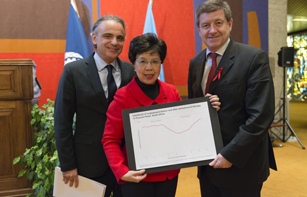
L to R: Luiz Loures, UNAIDS Director of Political and Public Affairs; Margaret Chan, WHO Director-general; and Guy Ryder, ILO Director-General, holding a chart during the launch of the campaign showing that the likelihood of employment for people living with HIV increases with access to HIV treatment. Geneva, Switzerland
The International Labour Organization (ILO), together with UNAIDS and the World Health Organization, launched on 27 November the “Getting to Zero at Work” campaign to promote the rights of people living with HIV in the workplace. The initiative recognizes the vital role that the world of work plays in the response to AIDS.
“The United Nations is leading by example through its own workplace policies,” said ILO Director-General, Guy Ryder. “Today, we must all together, governments, employers’ and workers’ organizations and other stakeholders, recommit to protecting the human rights of people living with HIV so that they may enjoy the right to work free from discrimination.”
More than 30 million people living with HIV who are of working age still face a high level of discrimination, according to the ILO. This prevents or limits their access to jobs as well as HIV services. Recent evidence shows that providing access to HIV prevention and treatment increases productivity and bring back people to work.
Today, we must all together, governments, employers’ and workers’ organizations and other stakeholders, recommit to protecting the human rights of people living with HIV so that they may enjoy the right to work free from discrimination
ILO Director-General, Guy Ryder
“Zero AIDS-related deaths and zero new HIV infections are realistic goals. The most challenging objective is zero discrimination,” said Luiz Loures, UNAIDS Director of Political and Public Affairs. “The ILO’s efforts to get to zero discrimination at Work are critical for an effective response to AIDS. The workplace is the most effective place to protect the human rights of workers and ensure a safe and supportive environment for people living with and affected by HIV.”
Margaret Chan, WHO Director-general, highlighted the important role that health workers play standing on the frontline of the AIDS response: “If countries are to achieve universal access to HIV services, one of their first steps must be to ensure that all health workers have access to effective and affordable HIV prevention, treatment and care."
The “Getting to zero at work” campaign aims to promote the ILO Recommendation No.200, the first international labour standard on HIV and AIDS in the world of work adopted in 2010. The ILO standard provides sound guidance on addressing HIV through the promotion of human rights, job security and enhancing access to HIV prevention, treatment, care and support services from a workplace perspective.
Publications
Related
Feature Story
Kenya launches campaign to stop new HIV infections among children by 2015 and keep their mothers alive
28 November 2012
28 November 2012 28 November 2012
Dr Francis Kimani, Director of Medical Services, Maya Harper, UNAIDS Country Coordinator, Robert Godec, United States Ambassador to Kenya and Hon Beth Mugo, Minister for Public Health and Sanitation of Kenya.
A national campaign to stop new HIV infections among children by 2015 and keep their mothers alive was announced on 16 November by the Kenyan Minister for Public Health and Sanitation Beth Mugo. The new initiative is part of a commitment made by Kenya at the 2011 United Nations General Assembly High Level Meeting on AIDS in New York, and marks an important milestone in the national AIDS programme in Kenya.
HIV is the leading cause of all deaths in the country and contributes to 20% of maternal deaths and 7% of all deaths in children aged five years or less. An estimated 13 000 children became newly infected with HIV in 2011. Kenya is one of the 22 countries listed as riorities under the Global Plan—which provides the foundation for country-led movements towards the elimination of new HIV infections among children and keeping their mothers alive.
The new campaign aims to mobilize citizens, especially women of reproductive age, to access HIV prevention services. The Government of Kenya has committed to improve the quality of HIV services available by providing all HIV-positive pregnant women with life-long antiretroviral therapy (ART) even after delivery (a strategy known as Option B+).
Ms Mugo acknowledged the multiple benefits of providing HIV-positive pregnant women with life-long ART, which include preventing HIV transmission to their children and improving the overall health of HIV-positive mothers. Ms Mugo noted, however, that the implementation of this approach will be gradual and will require a strengthened health system. “Let us not focus solely on HIV services, but adopt an integrated service and multi-sectoral approach to keep our mothers and children alive,” she said.
Placing women at the centre
Women living with HIV have been central to the campaign through the Kenya Mentor Mothers programme, through which HIV-positive mothers provide advice and encourage other pregnant women to access HIV services.
Mercy, an HIV-positive mother of three, works as a mentor mother in the new programme. She herself benefited from accessing HIV services to prevent HIV transmission to her children and stressed that stigma initially made it difficult for her to access HIV prevention, treatment and care services. She highlighted that stigma and discrimination are continuous barriers to HIV services and must be addressed in order for the campaign to be successful.
“I was lucky to have had access to health services. My baby is negative because of the information, services and support I received from the health facility,” said Mercy. “Today I serve my community as a mentor mother where I support HIV positive pregnant women and encourage them to adhere to treatment and exclusive breastfeeding.”
The role of men is also taken into account in the new campaign. “Maternal and Child health has been complicated and slowed by HIV. Worse still, maternal and child health is affected by the poor male involvement,” said the Director of Medical Services, Dr Francis Kimani. He called on men to fully participate in ensuring that their children and their children's mothers are healthy, and encouraged men to find out their HIV status and to always accompany their partners to visits to antenatal clinics.
Let us not focus solely on HIV services, but adopt an integrated service and multi-sectoral approach to keep our mothers and children alive
Kenyan Minister for Public Health and Sanitation Beth Mugo
UNAIDS Country Coordinator Maya Harper noted that services for the prevention of mother to child transmission of HIV are a key entry point to providing HIV services to the entire family. “This campaign is an excellent opportunity to catalyze a new movement for family planning, reproductive health and rights in the country,” she said.
The event also saw the launch of the National Strategic Framework to guide the implementation of the campaign for the year 2012 – 2015 in addition to the National Communication Strategy for the elimination of new HIV infections among children and the National Guidelines for peer education to prevent mother-to-child HIV transmission.
Related

Feature Story
New momentum in the Arab AIDS response opens doors for change
27 November 2012
27 November 2012 27 November 2012
UNAIDS Deputy Executive Director, Management and Governance, Jan Beagle and Dr Ziad Memish, Deputy Minister for Public Health, Kingdom of Saudi Arabia.
The Arab region is breaking new ground in its actions on HIV and AIDS. “The increasing number of HIV infections and AIDS-related deaths indicate the importance of developing a clear roadmap for the Arab region with achievable goals” said Dr. Ziad Memish, Deputy Minister for Public Health of the Kingdom of Saudi Arabia. He pledged the commitment of Saudi Arabia to continue its leadership in the development of the Arab AIDS Initiative, launched by the Arab Ministers of Health in October 2011, to scale up the HIV response at regional and national levels to achieve the targets set in the 2011 United Nations Political Declaration on HIV/AIDS.
At a meeting convened by the Kingdom of Saudi Arabia, under the auspices of the League of Arab States and supported by UNAIDS, governmental and non-governmental representatives recognized the need for urgent action as MENA is one of only two regions where the epidemic continues to grow. While overall numbers may be relatively low, estimates from the UNAIDS Global Report released in November 2012 indicate an increase in new HIV infections and AIDS-related deaths in MENA region. Since 2001 the number of people newly infected with HIV has increased by more than 35%, with a significant increase in AIDS-related deaths. The report also shows that despite a doubling of the number of people accessing HIV treatment in the region between 2009 and 2011, coverage of HIV treatment remains very low, at 15%.
Participants agreed that the guiding principles for the development of the Arab AIDS Strategy should include; evidence based and rights based; people centered; multi-sectoral; integrated; and gender and youth sensitive. The strategy should recognize and leverage the diversity of HIV situations and responses in the region.
AIDS is not only a health issue, but a social and developmental issue that demands a coordinated evidence-based response
Dr Laila Negm, Director of the Health and Humanitarian Aid Department, League of Arab States
“AIDS is not only a health issue, but a social and developmental issue that demands a coordinated evidence-based response” said Dr. Laila Negm, Director of the Health and Humanitarian Aid Department, League of Arab States. She emphasised the need for political mobilisation to address prevention, treatment, and stigma and discrimination and said that the region would count on the continued support of UNAIDS to move the Strategy forward.
“There is a window of opportunity for the region to demonstrate that it can be among the first to end AIDS, and leverage the AIDS response for broader health, human rights and development outcomes” said Ms. Jan Beagle, Deputy Executive Director of UNAIDS.
Fact sheets
Related
Feature Story
UNAIDS International Goodwill Ambassador Toumani Diabaté continues to play against stigma and discrimination
16 November 2012
16 November 2012 16 November 2012
UNAIDS International Goodwill Ambassador Diabaté and Executive Director Michel Sidibé at UNAIDS headquarters in Geneva, 16 November 2012. Credit: UNAIDS
UNAIDS International Goodwill Ambassador Toumani Diabaté visited the UNAIDS headquarters in Geneva on 16 November where he met with UNAIDS Executive Director Michel Sidibé to take stock on the current state of the AIDS epidemic.
Mr Diabaté, a worldwide-acclaimed musician from Mali and GRAMMY award winner, plays the kora, a harp-like instrument unique to West Africa, which he has brought to audiences around the world. He has used his influence as a well-respected public figure to advocate for the elimination of stigma and discrimination towards people living with HIV, which is a key component of the UNAIDS vision of Getting to Zero.
“Toumani is not just a voice, not just an artist,” said Mr Sidibé. “He grew up in a place where it was not worth being a famous musician if you could not change things with your music.”
UNAIDS.org took this opportunity to interview Mr Diabaté about his role in the AIDS response.
As a well-known musician, you use your influence to back a lot of important social causes. Why did you choose to focus on AIDS in particular?
I have seen a lot in my life, especially how stigma and discrimination can affect people and societies negatively. People living with and affected by HIV are often not treated with the respect they deserve. I want to help stop AIDS-related stigma and discrimination by speaking to my audience about the facts of HIV. By knowing the facts, people can be empowered to make informed choices and help support people living with HIV.
Music connects people and builds bridges between cultures, and through it we have an opportunity to touch souls and express feelings
UNAIDS International Goodwill Ambassador Toumani Diabaté
What would you like to contribute to the global response to AIDS?
I hope that, with my humble voice, I can help reach a greater audience and make people act as well as listen. I want them to take the AIDS issue seriously and get involved. Together we can make a difference.
Why do you think your music is such an effective tool in spreading HIV awareness messages in Mali and overseas?
Music connects people and builds bridges between cultures, and through it we have an opportunity to touch souls and express feelings. I hope that my audience will listen to and understand my message about stopping stigma and discrimination associated with AIDS.
What do you think needs to change in West Africa and globally for the UNAIDS vision of zero new HIV infections, zero AIDS-related deaths and zero discrimination to become a reality?
It is about shared responsibility: everybody needs to get involved, and I would like to see increased involvement of governments and the private sector, while remembering that people affected have to be at the center of the AIDS response and included in the decision-making processes. We can all contribute to making a difference and getting to zero.
Feature Story
UNFPA report focuses on rights-based approach to family planning
14 November 2012
14 November 2012 14 November 2012
The 2012 State of World Population report focuses on the need for more policy and programmatic action to ensure that all people have access to family planning.
Credit: UNFPA
The United Nations Population Fund (UNFPA) has launched its 2012 State of World Population report entitled “By Choice, Not by Chance”. The new publication places renewed focus on the need for more policy and programmatic action to ensure that all people can equally access family planning services—which is critical to individuals’ abilities to exercise their reproductive rights.
This rights-based approach, the report says, might be the premise for the global sustainable development framework that would succeed the 2015 Millennium Development Goals (MDGs).
By enabling individuals to choose the number and spacing of their children, family planning has allowed women, and their children, to live healthier, longer lives. However, not everyone can yet plan their sexual and reproductive life. The report highlights that a staggering 222 million women of childbearing age in developing countries still do not have access to modern contraceptives. This places them at higher risk of HIV. Women and girls of reproductive age are the hardest hit by the HIV epidemic in Zimbabwe, for example, and HIV is responsible for about one in four maternal deaths. In Malawi, lack of information, long distances to services and unfriendly providers contributed to high rates of unintended pregnancy and HIV among adolescents and young people.
Despite international commitments to remove barriers to family planning for all population groups, research finds that young people’s needs remain largely neglected. The report notes that the largest generation of young people in history is unable to fully exercise their reproductive rights and prevent unintended pregnancies, mitigate the risks of school dropout, or protect themselves from sexually transmitted infections, including HIV.
Each day, 2 500 youth, the majority of them female, become newly infected with HIV, the report states.
A number of other important population groups are neglected by family planning systems or sometimes face insurmountable barriers: young people, unmarried adults, people who are separated from their partners, older men, people with disabilities, refugees, people living with HIV and ethnic minorities. An enormous need exists to provide focused and sustainable services to these groups. The report finds that the costs of ignoring the right to family planning will exacerbate poverty, exclusion, poor health and gender inequality.
There are signs of progress, however. Viet Nam has expanded its reproductive health services, for example, to include family planning, pre- and post-natal care and HIV prevention.
Last July, at the London Summit on Family Planning, donor countries and foundations together pledged $2.6 billion to make family planning available to 120 million women in developing countries with unmet needs by 2020. Developing countries themselves also pledged to increase support.
But, according to the report, an additional $4.1 billion is necessary each year to meet the unmet need for family planning. This investment would save lives by preventing unintended pregnancies and unsafe abortions.
Money is just one part of the solution, it says. The report also calls on governments and leaders to take or reinforce a rights-based approach to family planning; secure an emphasis on family planning in the global sustainable development agenda; ensure equality by focusing on specific excluded groups; and raise the funds to invest fully in family planning.
Publications
Feature Story
UNAIDS and PAHO strengthen collaboration towards putting an end to AIDS in the Americas
09 November 2012
09 November 2012 09 November 2012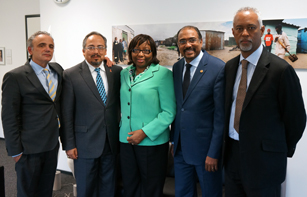
L to R: Luiz Loures, UNAIDS Director of the Political and Public Affairs branch; César Antonio Núñez, Director of the Regional Support Team for Latin America; Dr Carissa Etienne, Director elected of the Pan American Health Organization; Michel Sidibé, Executive Director of UNAIDS; and Ernest Massiah, Director of the Regional Support Team for the Caribbean.
UNAIDS Executive Director Michel Sidibé met on 7 November with the recently appointed Director of the Pan American Health Organization (PAHO) Dr Carissa Etienne at the UNAIDS Headquarters in Geneva to strengthen collaboration towards putting an end to AIDS in the Americas.
"We can build on the successes of the Americas, a region that was one of the first to eliminate measles and polio,” said Mr Sidibé. “There is no reason why this region cannot be the first to end AIDS.”
During the meeting, they exchanged ideas on how to increase joint efforts to achieve the Millennium Development Goals by 2015 and to ensure that health and HIV are part of the post 2015 agenda.
"As we look forward, HIV and health are key for the region, and for global development,” said Dr Etienne. “PAHO will play a key role in moving this agenda forward and with UNAIDS, the Americas can be the first region to see the end of AIDS.”
Dr Carissa Etienne, a native of Dominica, was elected as the new PAHO Director during the 28th Pan American Sanitary Conference that took place from 17-21 September 2012 in Washington D.C. and will begin her five-year term on 1 February 2013. Dr Etienne is currently Assistant Director General, Health Systems and Services, of the World Health Organization (WHO) in Geneva.
Feature Story
New generation of fashion designers supports UNAIDS in “Getting to Zero”
09 November 2012
09 November 2012 09 November 2012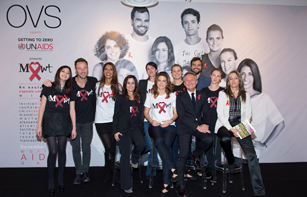
UNAIDS Chief of Resource Mobilization Mariangela Bavicchi Lerner and General Manager of OVS Francesco Sama pose with the young fashion designers who participated in the Make Love With campaign. Credit: OVS
Eleven young designers, the new generation of international fashion, joined together to create an exclusive collection of tops and t-shirts for Italian fashion retailer OVS as their personal contribution to the response to AIDS. This initiative is part of the Make Love With campaign, launched by OVS in partnership with the Joint United Nations Programme on HIV/AIDS (UNAIDS).
The campaign aims to raise both funds and awareness towards the UNAIDS vision of “zero new infections, zero discrimination, zero AIDS-related deaths”. The money that is raised will support the work of UNAIDS in improving HIV treatment and prevention, as well as eliminating stigma and discrimination against people living with HIV.
"It seemed fitting for a company like OVS, which primarily targets and engages with young people, to commit to this issue,” said Stefano Beraldo, CEO of Gruppo Coin, which owns OVS. “We were keen to launch and develop this campaign in collaboration with an international partner like UNAIDS, to work both within and outside the country borders, especially in light of our international expansion.”
The group of young designers include: Lavinia Biagiotti, Rachele Cavalli, Louis Marie de Castelbajac, Maria Sole Ferragamo, Marta Ferri, Alessandra Gucci, Alice Lemoine, Talitha Puri Negri, Lola Toscani, Rocco Toscani and Francesca Versace. Rocco Toscani, son of famous photographer Oliviero Toscani, also took the official campaign shots, featuring the young designers each wearing their own creation.
Young people aged 15-24 are the group most affected by HIV, accounting for 40% of all new adult HIV infections. In 2011, about 5 million young people were living with HIV worldwide, with more than 2 400 being newly infected every day. According to the most recent population-based surveys in low- and middle-income countries, only 24% of young women and 36% of young men have an adequate knowledge of HIV prevention and transmission. Addressing the needs of young people and keeping them educated and informed encourages them to make responsible choices and drastically decreases their risk of being exposed to HIV.
This partnership with OVS presents an exciting opportunity to reach young people with HIV prevention messages.
UNAIDS Executive Director Michel Sidibé
“This partnership with OVS presents an exciting opportunity to reach young people with HIV prevention messages,” said Michel Sidibé, Executive Director of UNAIDS. “Young people are leading the HIV prevention revolution around the world. Through our joint campaign, we will harness the energy and creativity of youth and the fashion world in support of the global HIV response.”
In recent years, UNAIDS has supported a number of other youth initiatives, including CrowdOutAIDS, an online collaborative policy project which leveraged social media and online collaboration tools to develop the first ever crowdsourced strategy document in the history of the United Nations. Over 5,000 young activists from 79 countries participated in the initiative.
The collection will be launched officially in the newly-renovated OVS store in Milan on November 27th. It will be available to the public worldwide on World AIDS Day (December 1st) in stores and online at www.ovs.it /makelovewith. Special events will be also organized in OVS stores in Russia, India and China.
Multimedia
Multimedia
Related


Feature Story
Costa Rica to develop HIV strategies to reach male sex workers
06 November 2012
06 November 2012 06 November 2012
UNAIDS Executive Director Michel Sidibé and the Minister of Health of Costa Rica, Dr Daisy Corrales. UNAIDS HQ, Geneva. 6 November 2012. Credit: UNAIDS
The Minister of Health of Costa Rica, Dr Daisy Corrales, aims to strengthen the AIDS response among key populations at higher risk in her country, which is where the epidemic remains concentrated. During a meeting with UNAIDS Executive Director Michel Sidibé on 6 November at the UNAIDS Headquarters in Geneva, Dr Corrales highlighted the focus of her Ministry in developing HIV communications and educational strategies for organizations working with male sex workers.
“We need to develop our strategies to reach male sex workers with HIV information and education that is relevant to their needs and in agreement with their particular work schedules,” said Dr Corrales.
Costa Rica’s HIV prevalence among adults 15 to 49 years of age is 0.3%. The country’s HIV epidemic is concentrated among key populations at higher risk of infection such as the migrant indigenous population, men who have sex with men (MSM), sex workers and their clients. A study conducted in 2010 found HIV prevalence among MSM of 10.9% and 11% among female sex workers.
“It is not always easy to talk about men who have sex with men, sex workers or drug users but we have an obligation to ensure they have access to HIV services that are free from stigma and discrimination,” said Mr Sidibé.
We need to develop strategies to reach male sex workers with information and education that is relevant to their needs and in agreement with their particular work schedules
Minister of Health of Costa Rica, Dr Daisy Corrales
Mr Sidibé also commended the Government of Costa Rica for its efforts in scaling up HIV treatment for people with HIV—an estimated 65% coverage—as well as their success in stopping new HIV infections among children. “Costa Rica’s transmission rate of HIV from mother-to-child is consistently under 2%, a very impressive feat and a bold example for Latin America that an HIV free generation is within our reach.”
Mr Sidibé assured the Minister of Health that UNAIDS will continue providing support to Costa Rica to design its strategy for an effective and sustainable response to AIDS.
Related
Feature Story
Interview with J.V.R.Prasada Rao, United Nations Secretary-General’s Special Envoy for AIDS in Asia and the Pacific
02 November 2012
02 November 2012 02 November 2012The United Nations Secretary-General’s Special Envoys for AIDS are committed individuals selected by the United Nations Secretary-General to help advance the AIDS agenda at global level and to ensure that AIDS is kept high as a political priority in their respective regions. In a series of interviews with Unaids.org, the Special Envoys for AIDS shared their views on the state of the AIDS epidemic and their own role in the global effort to end the epidemic.

J.V.R.Prasada Rao, United Nations Secretary-General’s Special Envoy for AIDS in Asia and the Pacific.
Credit: UNAIDS
J.V.R.Prasada Rao, a national of India, was appointed United Nations Secretary-General’s Special Envoy for AIDS in Asia and the Pacific effective July 2012.
Mr Rao was the Director of India’s National AIDS Control Organization for five years before serving as India’s Permanent Secretary for Health and Family Welfare. There, he played an instrumental role in implementing a comprehensive and decentralized national AIDS control programme. He then joined UNAIDS in 2004, where he was appointed Regional Director for Asia and Pacific and subsequently Senior Advisor to the Executive Director. He has served as Member Secretary of two independent commissions on AIDS in Asia and the Pacific and is currently a Commissioner of the Global Commission on HIV and the Law.
During his work, Mr Rao consistently advocated for the empowerment of vulnerable communities and people living with HIV as an essential element to achieving an effective AIDS response in Asia and the Pacific.
UNAIDS.org: As one of the United Nations Secretary-General’s Special Envoys for AIDS, what do you consider to be your role in the response to the epidemic?
The United Nations Secretary-General Ban Ki Moon and the UNAIDS Executive Director Michel Sidibé share the vision of getting to zero new HIV infections, zero discrimination and zero AIDS-related deaths. This includes Asia and the Pacific, a region which represents more than half of the world’s population. Although the region has seen progress in the areas of HIV prevention and treatment, we still have a long way to go to get to zero. Thus, my aim is to bring this message to top political leaders across the region.
We must use the critical three-year period before 2015 to reach the Millennium Development Goal on combatting HIV. I would like to share this message with political leaders, parliamentarians, community representatives and donors.
What motivates you in this role?
The biggest motivating factor for working as Special Envoy on AIDS is the historical opportunity we have to reverse the spread of HIV in Asia Pacific and to achieve the Millennium Development Goals.
I have been working on AIDS programmes for the past 15 years, first in the Government of India and later at UNAIDS, and faced enormous challenges—particularly in the early days of the AIDS response. Things have changed a lot since then, but I learned some important lessons which I can now pass on to others to make our collective efforts in responding to the epidemic more efficient.
The number of new HIV infections has stabilized in Asia and decreased in the Pacific in recent years. What has changed in the region?
In the last 10 years, some countries have shown remarkable progress in terms of HIV prevention, which has helped bring down new HIV infections. As a whole, the number of new HIV infections in the region is declining, but I am still not happy with the rate of this decline, and in many countries new HIV infections continue to rise.
We need to work with the leadership in these countries to ensure that the response to AIDS does not lose momentum. We cannot afford a second wave of the epidemic in the region.
J.V.R.Prasada Rao, United Nations Secretary-General’s Special Envoy for AIDS in Asia and the Pacific
Successful countries, such as Thailand, Cambodia, India and Malaysia, have invested wisely in HIV prevention programmes for key populations at higher risk. In the Pacific, countries like Fiji and Samoa have demonstrated that a determined leadership and a strong commitment to the AIDS response can make a big difference. Regional inter-governmental bodies like the Association of Southeast Asian Nations (ASEAN) and the United Nations Economic and Social Commission for Asia and the Pacific (ESCAP) have kept AIDS a priority, and this has contributed greatly to the stabilisation of HIV infections in member countries.
What key issues and challenges remain in the response to AIDS in Asia and the Pacific?
I would like to highlight the threat that comes from political leadership being complacent and claiming victory too early. AIDS is becoming less of a priority in some of the Asian countries that have seen improvement in recent years. We need to work with the leadership in these countries to ensure that the response to AIDS does not lose momentum. We cannot afford a second wave of the epidemic in the region.
The region is lagging behind the global average in the provision of HIV treatment and prevention services to stop new HIV infections among children. Programme managers and political leaders should be aware of this and work to improve access to treatment to vulnerable communities, women and children.
Adverse legal environments continue to be a challenge in many countries in the region. Key populations such as men who have sex with men, sex workers and people who use drugs are still criminalised in most countries. I will encourage political leaders and legislators to reform both the laws themselves and the way they are enforced. Small countries like Fiji and Nepal have demonstrated that when leaders commit, they can alter the environment of stigma and discrimination surrounding AIDS.
Throughout your career you have consistently advocated for the empowerment of vulnerable communities. What is the role of key populations in Asia and the Pacific in the response to AIDS?
People living with HIV and key populations at higher risk such as men who have sex with men, sex workers and people who use drugs play a central role in the response to AIDS. The Asia Commission report and country-specific surveillance data show that countries need to invest in programmes to prevent HIV infections among key populations, yet many countries are still not dedicating appropriate resources. I would like to see constructive activism from leaders and members of key populations in pressuring governments to provide adequate funding for HIV prevention and treatment services for the most vulnerable communities.
At this critical juncture of the AIDS response, the unity and commitment of community leaders is crucial. Some have successfully demonstrated how community-owned HIV programmes for HIV prevention and treatment can be cost-effective and produce positive results. We need to see more of these community-owned HIV programmes implemented in various countries. This is bound to make a difference to the course of the epidemic.