

Feature Story
Red Ribbon Award recognizes the work of Sri Lankan Women Living with HIV
06 December 2012
06 December 2012 06 December 2012
US congressman Jim McDermott presents the Red Ribbon Award to Princy Mangalika, founder of the Sri Lankan Positive Women’s Network (PWN+) during the International AIDS conference in Washington, on 25 July, 2012
Credit: UNAIDS/Y.Gripas
Princy Mangalika knows what it’s like to be ostracized. Twelve years ago when she became infected with HIV, her house was torched, she was chased out of her village and her children were banned from attending school in Sri Lanka.
Ms Mangalika’s husband, from whom she got the virus, committed suicide unable to cope with the stigma and discrimination of living with HIV. Homeless and hungry, she didn’t know what to do or where to turn.
That was in 2001. Since those dark days, she has emerged from despair to become a role model and symbol of hope in Sri Lanka.
Ms Mangalika, 53, founded the Positive Women’s Network (PWN+), an organization that raises awareness about HIV prevention in Sri Lanka—particularly among women, works towards reducing stigma and discrimination and advocates for access to health care for women.
“Asian culture confines women to the house. They do not access necessary information, they are not aware about their rights, the public health aspect of their lives,” said Ms Mangalika.
“For example, when your husband goes abroad, or is away from the family for a long time, women here in Sri Lanka are not courageous enough to ask him to wear a condom. That culture and environment do not exist, making women more vulnerable,” she added.
It means that people in the United States are talking about a small group of women in Sri Lanka who are active in dealing with HIV. It has brought us more respect both internationally and from within our local society
Princy Mangalika, founder of the Sri Lankan Positive Women’s Network (PWN+)
Ms Mangalika’s organization is dedicated to creating a positive and empowering environment for women and girls. PWN+ also runs two drop-in centers to provide a safe, secure, confidential and stigma-free environment for counseling services, financial and emotional support.
“Most women become infected with HIV from their husbands. And in Sri Lankan society, the women shoulder the burden. They face stigma and discrimination from society and within their own families. The men act as if AIDS has nothing to do with them,” said Ms Mangalika. “Human rights are not broadly discussed, they are not part of the education system… women and girls are ranked much lower than men,” she said.
According to Ms Mangalika, the group’s biggest challenge is to convince the government in conservative Sri Lanka to implement effective education and HIV prevention campaigns focusing specifically at women and girls.
PWN+ has been working with the UNAIDS country office to campaign for the inclusion of women and girls in Sri Lanka’s national AIDS response.
At the XIX International AIDS Conference that took place in Washington D.C. in July 2012, the organization received the Red Ribbon Award for their outstanding community work in the response to AIDS.
“It was a great moment,” said Ms Mangalika. “It means that people in the United States are talking about a small group of women in Sri Lanka who are active in dealing with HIV. It has brought us more respect both internationally and from within our local society.”
Ms Mangalika’s believes this global recognition will play an important role in reducing stigma and discrimination against women living with HIV in Sri Lanka, a country which has a relatively low incidence of HIV, but where new HIV infections have increased by more than 25% in the past 10 years.
Feature Story
Eastern Europe’s growing HIV epidemic under scrutiny
05 December 2012
05 December 2012 05 December 2012
Igor Radziewicz-Winnicki, Under Secretary of State, Ministry of Health of Poland and Chair of the upcoming UNAIDS Board meeting and UNAIDS Deputy Executive Director, Management and Governance, Jan Beagle. 03 December 2012, Warsaw, Poland.
Government officials, civil society representatives—including people living with HIV—and other experts in the AIDS response gathered in Warsaw, Poland to discuss the challenges faced by the region with the fastest growing HIV epidemic in the world.
At the 19th annual conference on HIV, which took place from 3-4 December hosted by the Ministry of Health of Poland, participants shared best practices and explored opportunities to strengthen the AIDS response in Eastern and Central Europe.
“For obvious reasons, we are trying to focus on the situation of Eastern Europe, as this is the region where the epidemic dynamic is the highest in the world,” said Igor Radziewicz-Winnicki, Under Secretary of State, Ministry of Health. “It is one of the major epidemiological challenges at the moment,” he added.
According to UNAIDS, between 2001 and 2011, the estimated number of people living with HIV in Eastern Europe and Central Asia increased by more than 50% from 970,000 to 1.4 million. Furthermore, despite the scale up of antiretroviral coverage in the last years only an estimated 25% of people eligible for HIV treatment are receiving it.
The epidemics in the region continue to be fuelled by injecting drug use where countries have had limited progress in slowing the spread of HIV among people who inject drugs. Evidence from recently published studies suggests that accessibility to needle and syringe programmes is low in most countries in the region. Access to other HIV prevention methods such as condoms, HIV testing or treatment is also very limited for people who use drugs.
Leaders in the region need to demonstrate strong political will to focus on the right HIV programmes for the right people, to increase domestic investment, and to be role models in reducing HIV–related stigma and discrimination
UNAIDS Deputy Executive Director, Management and Governance, Jan Beagle
In her keynote address, UNAIDS Deputy Executive Director, Management and Governance, Jan Beagle highlighted the need to scale up evidence-based and country-specific HIV prevention programmes focusing on the needs of key populations at higher risk. She also emphasized the need to increase access to antiretroviral treatment for all eligible persons in the region.
Although funding for HIV prevention programmes for people who inject drugs has increased in some countries, most of this increase results from the efforts of international donors. Domestic public sector sources in the region provide only 15% of spending on HIV prevention programmes for people who inject drugs. Ms Beagle called on political leaders to commit to scale up domestic investment and to increase national ownership of such programmes.
“Leaders in the region need to demonstrate strong political will to focus on the right programmes for the right people, to increase domestic investment, and to be role models in reducing HIV–related stigma and discrimination.” stated Ms Beagle.
Poland: Chairing the UNAIDS Board
The host country of this year’s conference will be the next Chair of the UNAIDS Programme Coordinating board that will take place from 11-13 December in Geneva, Switzerland. Poland is the first country of the region to be elected as Vice-chair and subsequently Chair of the UNAIDS board which is a clear recognition of their leadership in the region. Poland has played a critical role in making the issues affecting the region more visible to the Board.
Ms Beagle pointed out Poland’s exemplary collaboration with civil society organizations in designing and implementing its own national AIDS strategy. “This is a model of political engagement at multiple levels—international, regional, national and local,” stated Ms Beagle.
Related

Feature Story
UNAIDS International Goodwill Ambassador Aishwarya Rai Bachchan supporting pregnant women living with HIV on World AIDS Day
29 November 2012
29 November 2012 29 November 2012
Mrs Rai Bachchan toured the facilities of the Lokmanya Tilak Municipal Medical College and General Hospital in Mumbai where she had the opportunity to speak to pregnant women living with HIV.
On World AIDS Day, UNAIDS International Goodwill Ambassador Aishwarya Rai Bachchan visited local hospital facilities in her hometown of Mumbai, India to learn more about the services provided to HIV positive pregnant women.
Mrs Rai Bachchan toured the facilities of the Lokmanya Tilak Municipal Medical College and General Hospital in Mumbai where she had the opportunity to speak to pregnant women living with HIV benefitting from HIV services. “I am very impressed with what I have been seeing. The women I spoke with will all have healthy babies because they have access to the needed medicines,” said Mrs Rai Bachchan.
Mrs Rai Bachchan emphasised the importance of all pregnant women to go for an HIV test and to know their status. Accessing HIV services on time will contribute to stopping new HIV infections among children and keeping the mothers healthy. “I commit to work towards the elimination of new HIV infections among children not only in India, but globally,” she said.
I am very impressed with what I have been seeing. The women I spoke with will all have healthy babies because they have access to the needed medicines
UNAIDS International Goodwill Ambassador Aishwarya Rai Bachchan
During the visit to the hospital, Mrs Rai Bachchan also met with Aradhana Johri, Additional Secretary of the National AIDS Control Programme. Ms Johri stressed that the HIV prevalence in the country had declined to 0.27% as of 2011, new HIV infections had been reduced by more than half and HIV related deaths had also come down. "We are proud to be associated with what has been recognised as a global success,” said Ms Johri. “We are balancing a prevention approach with treatment and lastly, we are working to ensure that every person who is infected lives a life of dignity."
Feature Story
Gaming for HIV prevention: a public-private partnership in Gabon
29 November 2012
29 November 2012 29 November 2012
Young people from Gabon playing the interactive board game “Vie2Jeune”.
Credit: Aiducators4life
According to the Ministry of Health of Gabon, only 1 out of 2 young Gabonese aged 15-24 have a comprehensive knowledge on HIV in a country where the prevalence rate among youth aged 15-24 is about 4.8%, and 15% of youth have sexual relationships before the age of 15.
In an effort to revolutionise HIV prevention in Gabon, Shell Gabon in co-operation with the non-governmental organization Aiducators4life, the government and UNICEF launched an innovative tool aimed at stimulating discussions on HIV among youth (13+) in the country.
“Shell is truly committed to slow the spread of HIV in this country,” said the Director General of Shell Gabon, Adrian Drewett who officially launched the board game on the 3rd of December at Lycee Paul Indjendjet Gondjout in Libreville.
The new tool consists of an interactive board game called “Vie2Jeune”. Aligned with Gabonese culture and customs, the game provides relevant information for young people on topics like safe sex, sexually transmitted infections, facts about HIV, teenage pregnancies and discrimination against people living with HIV. There are about 60 information cards and 60 question cards that are used while playing the game.
This is a very direct and very ‘fun’ approach to learning about HIV
UNAIDS coordinator in Gabon, Ms Inge Tack
This board game was successfully launched in Zambia in 2009. The new French version was developed by Aiducators4life in cooperation with a French biology teacher and a French language teacher. The game is approved by medical experts and it has been tested extensively in schools in both Libreville and Gamba.
The entertaining format of the game makes it easily acceptable in many cultures and people groups especially where readership is low. “This is a very direct and very ‘fun’ approach to learning about HIV,” said UNAIDS coordinator in Gabon, Ms Inge Tack. “We noticed during the tests that this approach was very effective and also different to the current methods used in schools.”
Shell Gabon will finance 1000 games for secondary schools in Gamba and Libreville. The final objective is to provide all Gabonese secondary schools with the game which has just been approved for educational purpose by the Gabonese Ministry of Education. The distribution of the game will start in January 2013.
External Links
External Links

Feature Story
Haiti’s HIV successes and challenges acknowledged on World AIDS Day
02 December 2012
02 December 2012 02 December 2012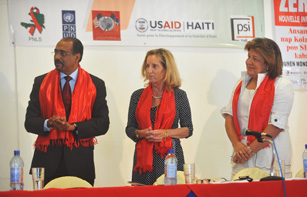
UNAIDS Executive Director Michel Sidibé (left) participates in a World AIDS Day event in Pétionville, Haiti, along with United States Ambassador to Haiti, Pamela White, and Haiti’s First Lady, Sophia Martelly.
On one level, Haiti’s HIV response parallels its earthquake recovery. Although the task is far from over, national and international stakeholders have collaborated to confront the challenge and important gains have been made.
During a World AIDS Day commemoration in Pétionville, Haiti, hosted by the Ministry of Health, UNAIDS Executive Director Michel Sidibé congratulated the country on its progress toward the vision of “getting to zero:” zero new HIV infections, zero discrimination and zero zero AIDS-related deaths.
Over the past decade, the rate of new HIV infections in Haiti fell by 54%. From 2005 to 2011, there was a 47% national decline in AIDS-related deaths. By 2011, 58% of Haitians living with HIV were accessing antiretroviral therapy. Mr Sidibé expressed optimism that this positive trajectory would continue.
“I was honoured yesterday to meet the President of the Republic and I can tell you that during our conversation, it was obvious that he wanted to put AIDS at the centre of his efforts to ensure that all people have access to the information and support systems necessary for life,” Sidibé said.
These efforts, said Mr Sidibé, must focus on the country’s most vulnerable. An estimated 18% of men who have sex with men and 8% of sex workers in Haiti are living with HIV. Nearly half of young Haitians living in camps do not have adequate knowledge about HIV.
Mr Sidibé urged Haiti’s leaders to boost efforts to reach populations at high risk of HIV infection with prevention and treatment services. He called for the passage of an HIV law that would signal zero tolerance for stigma and discrimination.
I am proud to be working alongside the President of the Republic to guarantee education for all, the strengthening of our health care system, women's empowerment and improved living conditions for the whole population.
First Lady Sophia Martelly
Mr Sidibé also urged the leadership of Haiti to increase domestic investments for the HIV response. Currently, more than 75% of funding for Haiti’s HIV response comes from external sources. By taking greater ownership of its national AIDS response, Haiti would join the worldwide paradigm shift “from charity to global solidarity,” said the UNAIDS Executive Director.
During the World AIDS Day ceremony, Haiti’s First Lady, Sophia Martelly, acknowledged the complex network of social issues that increase people’s risk of HIV. “Wherever educating children is problematic, there will be AIDS. Wherever basic social needs are not met, there will be AIDS. Wherever there is violence and rape, there will be AIDS. That is why there must be an in-depth approach to prevention,” said the First Lady.
“I am proud to be working alongside the President of the Republic to guarantee education for all, the strengthening of our health care system, women's empowerment and improved living conditions for the whole population,” she added.
Speeches
Speeches
- First Lady of Haiti (in French)
Feature Story
UNAIDS encourages Haiti to eliminate HIV in children
01 December 2012
01 December 2012 01 December 2012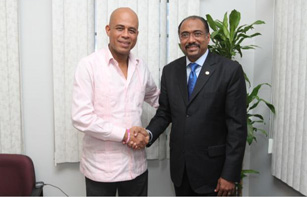
Haiti President Michel Martelly (left) and UNAIDS Executive Director Michel Sidibé at the Ministry of Planning in Port-au-Prince.
Credit: UNAIDS
The President of Haiti ushered in World AIDS Day 2012 commemorations with a note of hope. “It would be a very beautiful success story if we could pull off an HIV-free generation,” declared President Michel Martelly, in a meeting on 30 November with UNAIDS Executive Director Michel Sidibé.
In 2011, an estimated 77% of pregnant women living with HIV in Haiti had access to services that prevent mother-to-child transmission (PMTCT) of HIV. Between 2009 and 2011 the country secured a 25% decrease in the number of children born with HIV.
“Getting to zero HIV infections in children should be the legacy of this administration,” said Mr Sidibé. “It would be a very powerful accomplishment. Two children are born with HIV in Haiti each day. Think of what it would mean if we could leave behind a generation that was born HIV-free,” he added.
It would be a very beautiful success story if we could pull off an HIV-free generation.
Michel Martelly, President of Haiti
President Martelly noted the moral and economic imperatives of preventing HIV in children, saying that while it costs only US $150 to prevent a child being born with HIV, it would cost hundreds of thousands of dollars to treat a person living with the virus over the course of their lives. “If you can save a mother,” he added, “you prevent a child from becoming an orphan.”
In separate meetings with Haiti’s First Lady, Sophia Martelly, and the Minister of Health, Florence Guillaume Duperval, Mr Sidibé stressed that Haiti has the potential to eliminate HIV in children and dramatically reduce AIDS-related deaths in mothers. The First Lady pointed to national efforts geared toward achieving these twin goals, including a campaign to ensure that more pregnant women—particularly those living in rural areas—access HIV testing and treatment services.

Haiti First Lady Sophia Martelly (left) and UNAIDS Executive Director Michel Sidibé at Haiti's National Palace in Port-au-Prince.
Credit: UNAIDS
The Caribbean has the highest PMTCT coverage of any developing region. Many smaller Caribbean countries are already close to eliminating new HIV infections among children. Further scale-up of PMTCT services in Haiti—one of the region’s most populous countries—will help the entire Caribbean reach closer to the goal of eliminating new HIV infections among children, a key target of the 2011 Political Declaration on HIV/AIDS.
In addition to PMTCT scale-up, Haiti has progressed in other areas of its national HIV response. Between 2001 and 2011, for example, new HIV infections in the country declined by 54%. Haiti also attained a 47% decline in AIDS-related deaths from 2005 to 2011.
Feature Story
South Africa’s savings in procurement of antiretroviral drugs to increase access to treatment for people living with HIV
29 November 2012
29 November 2012 29 November 2012
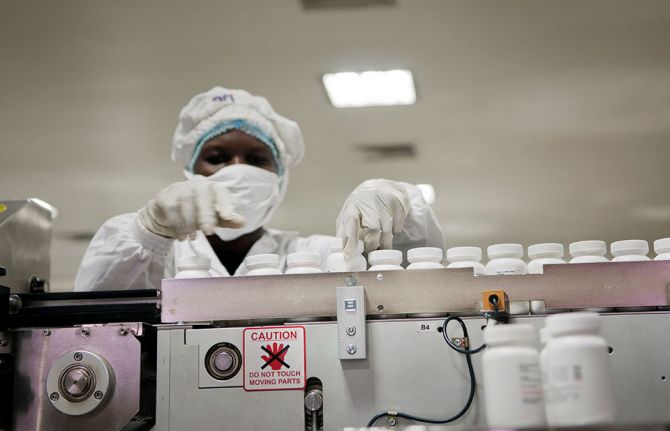
South Africa has, for the second time in a row, reduced the cost of procurement of antiretrovirals. Credit: UNAIDS/ A.Debiky
South Africa has, for the second time in a row, reduced the cost of procurement of antiretrovirals (ARVs) as announced by South African Minister of Health, Dr Aaron Motsoaledi on 29 November. ‘As far as we are concerned, South Africa has become the lowest price setter for ARVs in the world’, said Dr Motsoaledi to an excited audience at a packed press conference. The new agreed prices will save an additional US$250 million approximately.
Earlier in 2010, South Africa reduced for the first time the prices of the ARVs purchased following a change in its procurement approach. Since 2010, the National Department of Health has managed to reduce expenditure of ARVs by 53%. This translates to an estimated saving of US$ 685 million over a two-year period from 2011 to 2012.
‘What this essentially means is that more people in South Africa will have access to life-saving ARVs while keeping expenditure at its lowest. It is wonderful news’, said Dr Catherine Sozi, UNAIDS Country Coordinator in South Africa.
In addition, the Minister of Health announced that the new tender will be for fixed-dose combination ARVs—meaning that people who take ARVs will only have to take one pill once a day instead of three pills twice a day. The simplification of the regimen translates into fewer pills, fewer times a day and fewer side effects and will have a significant impact on the quality of lives of people living with HIV in South Africa. The triple fixed-dose ARV will be a combination of tenofovir, emtricitabine and efavirenz.
As far as we are concerned, South Africa has become the lowest price setter for ARVs in the world
South African Minister of Health, Dr Aaron Motsoaledi
Local manufacturers in South Africa have been awarded 70% of the tender. ‘I am sure suppliers will understand that [the negotiations] are in the best interests of patients’, said Dr Motsoaledi. ‘We are now able to treat more patients with the same budget’.
Fixed-dose combination to all pregnant women
The Minister of Health also announced that all pregnant women in South Africa will receive fixed-dose combination during pregnancy and breastfeeding regardless of their CD4 count. If their CD4 count is below 350 antiretroviral therapy will be life-long.
South Africa has already achieved a significant drop in the rate of mother-to-child transmission (MTCT) of HIV in the last year—from 3.5% in 2010 to 2.7% at six weeks in 2011. With the introduction of fixed-dose combination it is expected that the rate will drop even further and make a difference during the breastfeeding period, which is where most new infections among children currently occur.
All of the changes announced yesterday will be effective from 1 April 2013.
Feature Story
Peru launches campaign to increase HIV testing among men
29 November 2012
29 November 2012 29 November 2012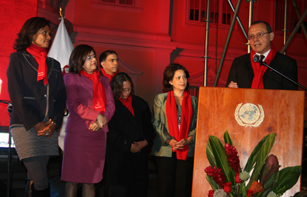
Vice-Minister of Health José del Carmen Sara launching the campaign “It is better to know: Get an HIV test.”
In the lead up to this year’s World AIDS Day, the Ministry of Health of Peru in collaboration with Asociación Dignidad, UNAIDS and the Pan American Health Organization (PAHO), launched the campaign “It is better to know: Get an HIV test.” The initiative aims to increase HIV testing coverage in the country, particularly among men, by providing free HIV tests.
Men aged 18 to 25 years are the main focus of the campaign, which aims to test 10 000 people by 1st December (World AIDS Day). The testing will take place in 16 different venues set up by the Ministry, including in various universities, in order to reach as many young men as possible.
“This is an effort by the Ministry of Health to make HIV testing more accessible for men,” said Vice-Minister of Health José del Carmen Sara during the event.
There are 74 000 people living with HIV in Peru, 77% of whom are men. 56% of new infections occur in men who have sex with men and 9 out of 10 women acquire HIV from their stable partners, who may engage in high-risk behavior such as buying sex or having sex with other men. It is estimated that half of the people living with HIV in Peru were infected before the age of 21.
Although men are at higher risk of HIV infection than women, their access to health services has traditionally been poorer. Despite the fact that 3 of 4 people living with HIV are men, only 7% of men reported having been tested for HIV in 2008. Increased testing would provide greater opportunities for HIV prevention and early treatment.
This is an effort by the Ministry of Health to make HIV testing more accessible for men.
José del Carmen Sara, Vice-Minister of Health, Peru
Peru introduced rapid HIV testing and counseling for pregnant women in 2006, and in 2008 a large scale HIV testing and counseling campaign was organized focusing on women of reproductive age. In the same year the Ministry of Health also increased access to HIV testing and counseling for men who have sex with men, transsexuals and sex workers, but so far HIV tests have only been free for women.
“Half of the people living with HIV in Peru do not know their HIV status. It is important to save lives by increasing access to both HIV diagnosis and treatment,” said Regina Castillo, UNAIDS Country Coordinator for Peru and Bolivia.
The launch on November 21st brought together people living with HIV, UN representatives, government officials, journalists, international organizations, and renowned artists, including entertainer and HIV activist Ernesto Pimentel and singer Eva Ayllon.
Feature Story
UNAIDS and Italian football team up against AIDS
29 November 2012
29 November 2012 29 November 2012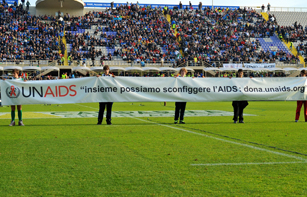
The campaign aims to utilize the influence and outreach of football to raise awareness about AIDS and mobilize resources towards UNAIDS’ response to the epidemic.
To mark World AIDS Day, the Italian football league ‘Serie A’ will dedicate 2 days to UNAIDS. As part of the Together We Will End AIDS initiative, ten football matches on the 2nd and 3rd of December will call attention to and promote action toward the UNAIDS goal of zero new infections, zero discrimination, and zero AIDS-related deaths.
Accompanying the players, young supporters will carry Together We Will End AIDS banners onto the fields, and the club managers will wear red ribbons symbolising solidarity towards people living with HIV. Renowned players such as Robinho from AC Milan, Cavani from Napoli, and Zanetti from Inter will release interviews and photos in support of the initiative. The campaign aims to utilize the influence and outreach of football to raise awareness about AIDS and mobilize resources towards UNAIDS’ response to the epidemic.
On Saturday 24 November, UNAIDS collaborated with the Italian Rugby Federation during a rugby match between Italy and Australia. The match, which ended with a 19-22 victory for Australia, took place at the Franchi stadium in Florence, and was aimed at mobilizing Italian civil society and the general public to support the work of UNAIDS in achieving its target of Getting to Zero.
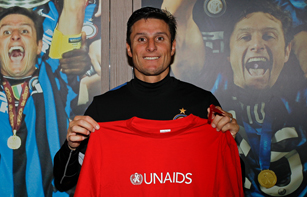
Renowned players such as Robinho from AC Milan, Cavani from Napoli, and Zanetti from Inter (in the picture) will release interviews and photos in support of UNAIDS and its work.
Sport can be a powerful force for change, and can play a key role in the response to AIDS, especially when it comes to educating people on HIV prevention and campaigning against stigma and discrimination.
UNAIDS has used football in many occasions to create a greater public awareness of the AIDS epidemic. German football star Michael Ballack and Korean football coach Myong-Bo Hong both support UNAIDS as International Goodwill Ambassadors. In February 2012, Brazilian football legend Pelé and others joined Gabon’s CAN without AIDS campaign. Another Brazilian football star, Ronaldinho, made a commitment last year to use his influence to promote AIDS awareness. A campaign entitled Give AIDS the Red Card was launched at the 2010 FIFA World Cup in South Africa. It saw the players and teams come together in a commitment to eliminate new HIV infections in children and keep their mothers alive by the 2014 World Cup in Brazil.
Feature Story
UNAIDS and Standard Bank Group partner to bring HIV awareness to the workplace
29 November 2012
29 November 2012 29 November 2012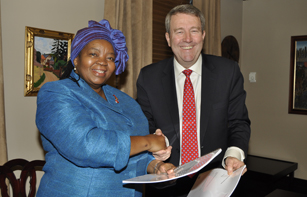
Professor Sheila Tlou, Director of the UNAIDS Regional Support Team for Eastern and Southern Africa and Clive Tasker, Head of Corporate Banking International signed the memorandum of understanding between the Standard Bank Group (SBG) and UNAIDS.
The Standard Bank Group (SBG) and UNAIDS formalised, on 22 November, what had already been a long-term collaboration in the response to AIDS in sub-Saharan Africa. They signed an official memorandum of understanding (MoU) for an initial period of two years to further collaborate on AIDS education and advocacy initiatives in the workplace.
“Healthy staff and communities are high on the agenda for any corporate, especially those operating in developing countries. Without a healthy workforce, economies can’t thrive,” said Clive Tasker, Head of Corporate Banking International. “As the biggest bank in Africa, we believe that we have a role to play in supporting government health objectives. Our partnership with UNAIDS allows us to do so by working with a respected organisation to educate our staff and communities on HIV prevention and treatment, and remove the stigma associated with AIDS,” he added.
The SBG is the largest bank in Africa. It is represented in 33 countries (17 in Africa and 16 in five other continents), has over 600 branches in South Africa and over 400 outside of South Africa and employ more than 50 000 people worldwide (34 891 are in South Africa). Partnering with the SBG is providing UNAIDS with an opportunity to reach out to key communities in countries where the bank operates and where the epidemic is.
“Employers play a critical role in the AIDS response. UNAIDS is committed to bringing the knowledge, solid experience and the capacity of the private sector to the AIDS response,” said Professor Sheila Tlou, Director of the UNAIDS Regional Support Team for Eastern and Southern Africa.
The latest UNAIDS World AIDS Day 2012 report, shows that the acceleration in the AIDS response is producing unprecedented results. According to the report, the number of people accessing HIV treatment in sub-Saharan Africa reached 56%—compared to a global average of 54%. In 5 Southern African countries–Botswana, Namibia, Rwanda, Swaziland and Zambia more than 80% of people living with HIV who are eligible for treatment are receiving antiretroviral therapy. However, 7 million people still do not have access to life saving treatment which negatively impacts their wellbeing and the socio-economic development of their nations.
Project 90/90
Early in the year, the SBG piloted the ‘Project 90/90’, which aims to reach 90% of the Bank’s employees with comprehensive health assessments annually and place people in need on treatment within 90 days, by 2015. A typical 90/90 health assessment includes tests that check sugar levels, blood pressure, cholesterol, and HIV and TB status.
Healthy staff and communities are high on the agenda for any corporate, especially those operating in developing countries. Without a healthy workforce, economies can’t thrive
Clive Tasker, Head of Corporate Banking International
“If a staff member is at risk for any disease, it is our goal to get 90% of those staff onto a proper treatment programme,” said Dr Wendy Orr, Head of Inclusion at Standard Bank Group. During the six months that the pilot run in the Standard Bank Headquarters in South Africa, 6 500 out of the 16 000 of the Bank’s staff members underwent a 90/90 health assessment. Of those, approximately 65% took an HIV test. “We believe that by including an HIV test in a broad health assessment, we are starting to lessen discrimination—one of the key objectives of the UNAIDS ‘zero’ campaign,” said Dr Orr. “Following the success of our pilot, it is our intention to scale up the number of tests we do so that by 2015 all staff across the group will be receiving 90/90 screenings annually,” she added.
Community outreach
In addition to the 90/90 project, SBG remains committed to its ‘wellness champion’ programme. This programme uses voluntary staff members of the Bank as ‘champions’ to conduct awareness and mobilisation activities in order to increase uptake of voluntary HIV counselling and testing as well as condom distribution at the workplace and in communities.
During the 2011 World AIDS Day commemoration period, the ‘champions’ in collaboration with UNAIDS reached communities in Ghana, Nigeria and South Africa where more than 4 000 people voluntarily tested for HIV. “Wellness champions are peer workers who do an amazing education and advocacy work within our organisation and in the communities we serve,” said Dr Orr. “Our ‘wellness champions’ need access to quality healthcare information and our partnership with UNAIDS has been invaluable for the work that they do. They will continue to be crucial to our success as we extend our focus to the Standard Bank Group more broadly.”