Feature Story
El Salvador: Ministerial decree to reduce homophobia in health services
03 April 2009
03 April 2009 03 April 2009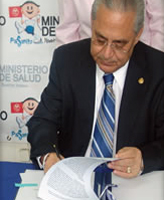 Dr. Guillermo Maza, Minister of Health of El Salvador signing the ministerial decree on 5th March 2009.
The Ministry of Public Health and Social Assistance of El Salvador approved, as part of its National Plan on HIV prevention, a set of actions to reduce homophobia and any type of discrimination based on sexual orientation in the health services.
In its 2008 country progress report El Salvador identified human rights violations as a major barrier to an effective response to the AIDS epidemic. The ministerial decree signed on 5th March 2009 by the Minister of Health Dr. Guillermo Maza, guarantees access to health services and respect of human rights to men who have sex with men, transgender, transvestites and lesbians.
The ministerial order states that all public health services such as hospitals, health clinics, etc. and their staff must facilitate, promote and support actions to eradicate discrimination based on sexual orientation. The decree also calls for all health institutions in the country to report back on the actions taken to reduce homophobia and discrimination.
This ministerial decree reflects the fundamental principle of respect for the human rights of all those who suffer from stigma and discrimination and it reaffirms the spirit of the universal access to HIV prevention, treatment, care and support under a human rights frame.
César Antonio Nuñez, UNAIDS Director Regional Support Team for Latin America
“This ministerial decree reflects the fundamental principle of respect for the human rights of all those who suffer from stigma and discrimination and it reaffirms the spirit of the universal access to HIV prevention, treatment, care and support under a human rights frame,” said César Antonio Nuñez UNAIDS Director Regional Support Team for Latin America.
The decree also encourages multilateral cooperation agencies and International financing institutions to provide funds and technical support directed to effectively respond against discrimination.
According to UNAIDS, El Salvador has an HIV prevalence rate of 17.8% amongst men who have sex with men (MSM).
Aside from the individual pain homophobic attitudes inflict, the continuing stigma attached to same-sex relations is complicating the task of slowing the spread of HIV in the Latin America region in general where sex between men is a leading mode of HIV transmission according to national reports. Stigma and homophobia increase the isolation of gays, bisexuals and transgender people making them more reluctant to come forward, get advice and access HIV services such as treatment, testing and counseling.
By signing the ministerial decree, El Salvador builds on the country’s commitment to seriously expand efforts to address stigma and discrimination in health settings which will facilitate the intake of HIV services by one of the key populations at higher risk of HIV infection
Right Side Content
Feature stories:
The President of El Salvador meets with UNAIDS Executive Director (11 June 2008)
Lions Club International signs Central America agreement with UNAIDS and UNICEF (10 March 2008)
External links:
Ministry of Health of El Salvador (in Spanish)
Feature Story
In memory of Lynde Francis: HIV activist and beacon of hope
03 April 2009
03 April 2009 03 April 2009By Sophie Dilmitis,
World YWCA, HIV and AIDS Coordinator
and International Community of Women Living with HIV and AIDS (ICW) European Regional Representative.
Lynde Francis (8 November 1947 - 31 March 2009)
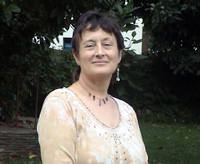
Lynde Francis (8 November 1947- 31 March 2009). Lynde’s achievements, especially in HIV and AIDS are too many too mention in this article – what she managed to achieve in a lifetime – some never do in ten lifetimes.
There are some people who leave a mark on you after you have met them and there are some people whose words you hang on to and whose advice you cherish. Lynde was one such person, not only to me but also to many people around the world.
Lynde was one of the first women in Zimbabwe to disclose her HIV-positive status and did this to support the people of Zimbabwe. She started an organization called the Centre in her own living room at home and this grew into community based organization that supported thousands of people and was run by and for people living with HIV. The centre and the work she did nationally, regionally and internationally have become her legacy.
Lynde will be remembered and respected around the world for her advocacy and education efforts on all aspects of holistic management of HIV, as well as an advocate for the meaningful involvement of People Living with HIV (MIPA). Lynde was also the Southern African Regional Representative for the International Community of Women living with HIV (ICW) and a founding member of the Pan African Treatment Activists movement (PATAM). She served on the boards of Women and AIDS Support Network (WASN), Cedas Trust, Zimbabwe Activists on HIV and AIDS (ZAHA) and was a member of the regional reference group for the ecumenical HIV and AIDS initiative in Africa (EHEIA). Lynde was part of the Country Coordinating mechanism for Zimbabwe and a founding member of the Zimbabwe National Network of People Living with HIV.
Lynde’s achievements, especially in HIV and AIDS are too many too mention in this article – what she managed to achieve in a lifetime – some never do in ten lifetimes.
Lynde had some wonderful qualities and in so many ways Lynde was a pioneer. She was a great listener and a healer, a brave advocate, an inspirational teacher, a friend and a mother to so many of us who were diagnosed HIV positive.
It is with unforgettable gratitude that I reflect and remember on how available she was to me and I wondered if she was like this with everyone that she worked with. The more I saw of Lynde the more I realised that she was like this with everyone and always gave so much of herself. With everything she had going on she really cared about people and I knew Lynde would always be there for me.
Sophie Dilmitis, World YWCA, HIV and AIDS Coordinator and ICW European Regional Representative.
I met Lynde over ten years ago at the age of 22. I had just been diagnosed HIV positive and my doctor had very little information on HIV. Life felt overwhelming and it was Lynde that explained to me what HIV was, how it worked and how I could look after my body. Lynde nurtured and invested in me so that I am fortunate enough to be in the position that I am in today. Ten years ago HIV treatment (ARVs) were not that accessible in Zimbabwe and totally unaffordable to almost all. I was confused and was trying to process many different opinions about what I should be doing. It was Lynde’s calm voice that resonated with me in my decisions about how to deal with my life with HIV. It was Lynde that took the time to deal with the rage that consumed me and she did this whilst working with so many others, running an organization and leading national campaigns.
It is with unforgettable gratitude that I reflect and remember on how available she was to me and I wondered if she was like this with everyone that she worked with. The more I saw of Lynde the more I realised that she was like this with everyone and always gave so much of herself. With everything she had going on she really cared about people and I knew Lynde would always be there for me.
I learnt many things from Lynde and would like to share the following with you:
- You life is your responsibility – Lynde once told me and many others, that she had a little box of tricks that she could have used to end her life. She had created it when she first found out she was positive but she had such a passion for life that it was only ever used a reminder to her that life is worth fighting for and taught many people how to fight for their own lives and to take responsibility for their lives.
- Lynde had the greatest respect for people and their culture. She had an incredible ability to empathise with people and put herself in their shoes, no matter how uncomfortable this may have been sometimes. Lynde taught me that it is important to meet people where they are mentally, emotionally and culturally instead of pushing them to meet you.
- As activists we don’t have to be at every meeting in the world. The world won’t collapse without us. Things do carry on and we can’t be everywhere and do everything. Some people living with HIV have a sense of urgency and this was something that Lynde herself struggled with.
Lynde lived a full life and it is so clear that many people deeply loved Lynde and celebrate all that she was and did. Like some of us, Lynde may have been afraid sometimes but in all the time that I knew her, I never saw her back away from a challenge. She was open and available to all who needed her and she had a heart of gold.
Lynde we will all miss you. You were so much to all of us and all we can do now is hold onto the memory of your great and powerful spirit and ensure that you live on in all of us whose lives you transformed. We celebrate your life and all that you gave.
Lynde celebrated 23 years of living with HIV in March this year. She leaves behind a huge family around the world that includes ten grandchildren. We extend our sincere condolences to Lynde’s family and friends. We cry with you as we appreciate her life of service to women and men, especially those living with HIV and her unwavering commitment to young people.
Lynde will remain a beacon of hope for all of us.

Feature Story
HIV and high food prices
01 April 2009
01 April 2009 01 April 2009Leaders of the Group of Twenty (G-20) countries are gathering in London for a summit to identify steps that can help restore global economic growth.
The current crisis in financial markets and the world economy strains both governments’ global development commitments and national resources. Households already most vulnerable to poverty, risk further impoverishment.
This is the first in a series of articles on how poverty impacts people already affected by HIV and how investment in sustainable financing is critical for AIDS and development responses around the world. Access to affordable food is vital for workers living with HIV, explains Robin Landis, HIV Policy Officer with the World Food Programme.
HIV and high food prices
This article appears in the current edition of AGENDA magazine, published by the International Transport Workers’ Federation.
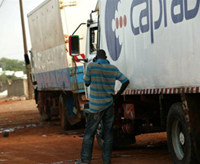
A truck driver in Mali. Credit: UNAIDS/P. Virot
Although antiretroviral drugs (ARVs) are free in Mozambique and access to them is relatively easy, Ana Costa abandoned her treatment some months ago after two years of suffering from nausea and weakness as a result of taking the powerful drugs on an empty stomach. Ana is not alone in facing a gut-wrenching dilemma – her health is so fragile that she is unable to work yet if she does not work she cannot afford to buy food. Although she knows that her health depends on the ARVs, she feels that she has no choice but to abandon the treatment since she cannot eat regularly.
It may not be the first thing one thinks of when the topic of HIV comes up, but food and more precisely, good nutritious food, is often the most pressing need for people living with HIV and their families. Malnutrition and HIV are a deadly combination: HIV attacks the immune system and deteriorates the nutritional status one needs to fend off infections while poor nutritional status hastens the onset of AIDS-related illnesses.
Hunger plays a commanding role in spreading the virus, as it drives people to desperate measures that put their lives and others at risk just to put food on the table.
Hunger plays a commanding role in spreading the virus, as it drives people to desperate measures that put their lives and others at risk just to put food on the table. In parts of southern Africa it is not uncommon for women to be forced into exchanging sex for a meal, a ride to the clinic or school fees for their children. The immediate need to make ends meet can cloud the decisions that impact their long-term future.
The importance of good nutrition for healthy living is well established and it is equally well known that mobile transport workers have less than optimum nutrition due to the demands of the job. It is common for transporters to eat irregular meals of poor nutritional quality for extended periods while they are working. Poor nutrition has a direct impact on the body’s ability to fight off infection and remain strong and productive on the job.
High food prices make a bad situation worse
The impact of climate change and the loss of agricultural land due to biofuel production have both contributed to inflated food and oil prices, which in turn have seriously impacted food production and distribution costs. The current crisis is affecting people around the world, especially those living in developing countries – people in rural areas who depend on agriculture for their livelihood and urban dwellers who must purchase everything they eat.
The sharp rise in global food prices, especially since early 2008, has already resulted in dietary changes that severely affect the health and nutritional status of millions of people. To cope with this crisis many families will avoid more expensive foods that also happen to be the most nutritious (meat, poultry, eggs and fish, fruit and vegetables) and reduce the size and frequency of meals.
Such dramatic changes in food consumption can have dire nutritional and health consequences for the most vulnerable in society: young children, pregnant and lactating women and the chronically ill, especially those with TB, HIV and AIDS. For poor, HIV-affected households the shift to less nutritional foods may happen sooner as a result of the increased burden of care. When the quality of food goes down so does the presence of micronutrients, which in turn can trigger illness and infections, making the already sick even sicker. It can also lead to drug resistance, treatment failure and even new strains of virus as HIV-positive people begin to skip doses or abandon treatment altogether because they have no food to accompany their medication.
The same goes for people on TB treatment. They are at increased risk of dropping out of treatment programmes as they divert money that would be spent on transportation or other needs in favour of buying food. Interrupted TB treatment can result in the proliferation of multi-drug resistant and extremely drug resistant strains of TB – both of which jeopardise the wider public health.
What does this mean for transport workers?
Mobility is a driver of the HIV epidemic. But there are other lesser-known links between the transport sector, HIV incidence and high food prices. In southern Africa, where HIV prevalence is the highest, AIDS has affected transport companies to the point that, even before we see the full impact of this current crisis, there are not enough truck drivers to meet demand. For instance, during the food crisis of 2003-05, the World Food Programme (WFP) contracted over 30 per cent of the total transport business in the region and found it difficult to hire enough vehicles and drivers to deliver food assistance quickly and efficiently. Approximately 80 per cent of WFP’s transport needs are hired locally. The shortage of skilled drivers results in higher transport costs and subsequent higher prices for food and other goods.
WFP is proud to be a core partner, along with TNT, ITF and UNAIDS, of the North Star Foundation, a public-private partnership to improve the health and wellbeing of mobile transport workers and reduce the number of new HIV infections by establishing networks of roadside ‘wellness centres’.
Food aid for HIV
WFP estimates that 22 of the 30 countries in greatest need of food assistance are in sub-Saharan Africa, home to two thirds of the 33 million people living with HIV. In the past, only the poorest 10 per cent of the population has generally needed assistance, but as prices increase more households will slide into poverty and be forced to find ways to cope. Women, who already represent 70 per cent of the world’s poor, will suffer the most as more will be pushed into transactional sex to survive, which increases the risk of new infections.
Providing HIV positive people with a way out of poverty can help ensure that they have nutritious food on the table, an education for their children and access to medical care and treatment. With food prices projected to stay high, incorporating a nutritious food package into HIV treatment programmes can maximise the benefits of the medicine and guard against treatment failure. For as little as US$0.70 an adult living with HIV can receive a nutritious ration of corn-soya blend, maize meal and beans. In addition to food aid, programmes that link households to livelihood support programmes are needed. If markets are able to provide a nutritious diet, cash transfers or micro-financing may be more appropriate than food packages.
What can workers’ unions do?
- Advocate national policies that prioritise HIV and TB treatment programmes and incorporate nutritional packages as part of these programmes.
- Use national and regional meetings to inform and educate union members on issues of food and nutrition insecurity in the context of HIV and AIDS.
- Be the eyes and ears of the community: let the ministries of health and national AIDS committees know when communities are struggling with the decision to either spend on health care or buy food.
- Support workplace HIV programmes and make sure that they address the importance of good nutrition for people living with HIV. Work with the programme manager to offer advice and assistance to HIV-positive employees who may be having difficulty keeping a healthy diet.
- Use union networks to help distribute agricultural inputs like fertilizer, seeds and tools and help link communities to markets.
- Lobby employers to ensure that nutrition information and access to nutritious food is available for mobile transport workers while on the job.
Robin Landis is a Policy Officer in the Policy, Planning and Strategy Division of the WFP in Rome. She is also on the Management Team of the North Star Foundation, a public-private partnership to reduce the impact of HIV in the transport sector.
Right Side Content
Cosponsors:
Partners:
Feature stories:
Minister of Foreign Affairs of the Russian Federation discusses financial crisis with UN agencies (09 March 2009)
As global economy slows International Health Partners push for faster health progress (12 February 2009)
The impact of nutrition and HIV: World Food Programme (26 November 2008)
External links:
Agenda Magazine, Issue 3, 2009 (pdf, 1.49 Mb)
Related

Feature Story
New UNGASS Guidelines for 2010 reporting
31 March 2009
31 March 2009 31 March 2009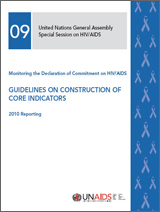
UNGASS Guidelines on Construction of Core Indicators for 2010 reporting.
To assist Member States in preparing and submitting their 2010 Country Progress reports, UNAIDS has released the new UNGASS Guidelines on Construction of Core Indicators for 2010 reporting.
In adopting the 2001 Declaration of Commitment on HIV/AIDS, Member States committed themselves to regularly report to the United Nations General Assembly on the progress made in their country’s response to the AIDS epidemic. The UN Secretary-General assigned the UNAIDS Secretariat the responsibility of developing the reporting process, accepting reports from Member States on his behalf, and preparing a regular report for the General Assembly. Member States submit Country Progress reports to the UNAIDS Secretariat every two years.
The new guidelines provide essential information on the composition of core indicators for reporting including the purpose of the indicator, methods of measurement and a summary interpretation of the indicator. The guidelines are also intended to ensure consistency of information across countries for accurate global progress analysis.
At country level, the progress reports are used to inform programmatic decisions, review national strategic plans and to inform resource mobilization efforts such as the development of proposals for the Global Fund. Furthermore, the country reports have also helped countries identify their gaps and weaknesses regarding data monitoring and evaluation. Country reports also enable open discussion and assessment of progress between the governments, civil society and other key stakeholders engaged in the national AIDS responses.
The data submitted in the next round of reports will be used by UNAIDS to monitor the progress made by countries towards achieving universal access to HIV prevention, treatment and care in 2010 and eventually in reaching the Millennium Development Goal of arresting and halting the spread of HIV by 2015. The data will also form the basis of a number of regular reports including the UN Secretary-General’s report to the General Assembly, the UNAIDS Report on the Global AIDS epidemic and the HIV section of the annual Millennium Development Goals monitoring report.
The 2010 reporting round
While there have been no changes to the UNGASS indicator set from the 2008 round, a number of changes have been made to the reporting process. Amongst these are the new reporting deadline of March 31st 2010, and the development of a system that allows on-line submission of reports through the UNGASS reporting web site. It is anticipated that these two changes will allow for more rigorous data analysis at country level prior to submission, and will streamline the cleaning and reconciliation of all data received.
The new UNGASS Guidelines on Construction of Core Indicators for 2010 reporting are now available electronically - printed copies and translations into French, Spanish and Russian will follow shortly.
Please direct all queries on UNGASS reporting to: ungassindicators@unaids.org.
Right Hand Content
Feature stories:
Much progress to report: UNGASS 2008 (12 March 2008)
UNGASS 2008: Country progress reports (04 February 2008)
Contact:
Please direct all queries on UNGASS reporting to: ungassindicators@unaids.org.
Publications:
UNGASS Guidelines on Construction of Core Indicators for 2010 reporting (pdf, 612 Kb)
Feature Story
Forum seeks to engage men and boys in goal of achieving gender equality
31 March 2009
31 March 2009 31 March 2009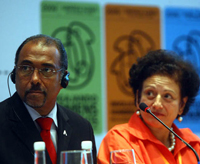 (from left) Mr Michel Sidibé, UNAIDS executive director and Brazil’s Minister of Policies for Women Nilcéa Freire at the opening of Engaging Men Symposium, 30 March 2009.
 Credit: UNAIDS/D.Ramalho
A global symposium on engaging men and boys in achieving gender equality is taking place this week in Rio de Janeiro, Brazil. Addressing the opening ceremony last night, UNAIDS Executive Director Mr Michel Sidibé spoke of the need for all to “work over the long term to end the social acceptance of violence against women and the gender inequality that underpins it.”
“We must engage with men and boys to promote awareness of the need for a “new masculinity,” continued Mr Sidibé.
The event was opened by Brazil’s Minister of Policies for Women, Ms Nilcea Freire. Other speakers at opening ceremony included: UNIFEM Executive Director, Ms Inés Alberdi; UNFPA Deputy Executive Director, Ms Purnima Mane; Ambassador of Canada to Brazil, Mr Paul Hunt; World Health Organization Department of Gender, Women and Health, Coordinator, Peju Olukoya; and UNDP Resident Representative and UN Resident Coordinator, Ms Kim Bolduc.
Three over-arching themes of “men and violence”; “men and health”; and “men and care-giving” will be covered during the conference. Yesterday, before opening the symposium, the Executive Director of UNAIDS Michel Sidibé joined the Brazilian Minister of Women’s Policies, Ms Nilcéa Freire, in inaugurating the first centre in Brazil that focuses on rehabilitating men who abuse women. Located in Nova Iguaçu, a municipality in Rio de Janeiro, the centre will place emphasis on education programmes to put a end to domestic violence. Ten other such centres are planned for throughout the country.
Gender and HIV
We must all work over the long term to end the social acceptance of violence against women and the gender inequality that underpins it
Michel Sidibé, Executive Director, UNAIDS
Gender comprises widely held beliefs, expectations and practices within a society that define ‘masculine’ and ‘feminine’ attributes, behaviours and roles and responsibilities. Given that gender constructions are relational – one sex defined in contrast to the other, the organizers of the Rio symposium believe that men and women must both be involved in the goal of achieving gender equality. Work with men is seen as a vital component, together with, rather than apart from, work to empower women and girls.
Gender norms in many societies may dictate that women and girls are less equal than men in the home, workplace and in negotiating sex. In some societies concepts about masculinity may reinforce a belief that men should seek multiple sexual partners or take risks. These norms work against HIV prevention messages that support protection measures and fidelity. Some notions of masculinity also condone violence against women, or lead to homophobia, which results in stigmatization of men who have sex with men, making these men more likely to hide their sexual behaviour and less likely to access HIV services.
Violence and HIV
According to a 2006 report by United Nations Secretary-General at least one out of every three women around the world has been beaten, coerced into sex, or otherwise abused in her lifetime, with the abuser usually someone known to her.
In the context of HIV, men’s use of physical or sexual violence against women, or the threat of violence increases women’s vulnerability to the disease by making it difficult or impossible to negotiate safer sex and condom use. It can also stop women from accessing HIV prevention, care and treatment services. Women may also avoid HIV testing due to fears of violence and abandonment in a resulting discovery of HIV-positive status.
Moving forward
This week’s Symposium will include dialogue sessions with representatives of the women’s rights movements and other social justice movements. Skills-building workshops to build capacity of participants in designing, implementing and evaluating behaviour change advocacy and community mobilization strategies and also working with young children and teenagers in achieving gender equality.
The participants hope to develop a “Call to Action” for governments to implement policy that engages men and boys in gender equality. Engaging men and boys in achieving gender equality will combine presentations of best practices, skills building workshops, and dialogues between representatives of non-governmental organizations, policymakers, and researchers. It runs until 3 April.
Right Hand Content
Cosponsors:
Partners:
Global Coalition on Women and AIDS
UNIFEM Gender and AIDS
Speeches:
Read speech to Opening of the Global Symposium: Engaging Men and Boys in Achieving Gender Equality by Michel Sidibé, Executive Director, UNAIDS (30 March 2009)
Feature stories:
Commission on the Status of Women opens with call for action to achieve universal access and gender equality (02 March 2009)
External links:
Engaging men and boys in achieving gender equality
MenEngage
Feature Story
UNAIDS Executive Director meets with Brazilian Government and civil society
30 March 2009
30 March 2009 30 March 2009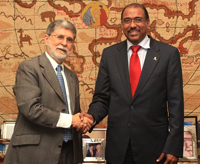
UNAIDS Executive Director Michel Sidibé (right) met with Minister of Foreign Affairs, Mr Celso Amorim.
Credit: UNAIDS/M. Silva
The upcoming Group of Twenty (G20) meeting in London, the global financial crisis, and universal access were some of the main topics Mr Michel Sidibé and Brazilian Government counterparts discussed during his first official visit to Brazil as the Executive Director of UNAIDS.
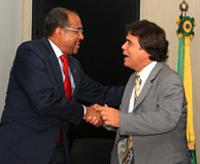
UNAIDS Executive Director Michel Sidibé (left) greets Minister of Health of Brazil, Mr José Gomes Temporão.
Credit: UNAIDS/M. Silva
Mr Sidibé met with the Minister of Foreign Affairs, Mr Celso Amorim, the Minister of Health, Mr José Gomes Temporão, the Minister of Human Rights, Mr Paulo Vanucchi, and the Minister of Women’s Affairs, Ms Nilcéa Freire.
A meeting also took place between Mr Sidibé and the HIV/AIDS Parliamentarian Group, the LGBTT (lesbian, gay, bisexual, transgender and transvestite) Citizenship Group and the Human Rights Commission. The forum which took place at the National Congress in the capital Brasilia, was an opportunity for lively exchange of ideas and viewpoints on a range of issues at the heart of Brazil’s efforts to respond to the HIV epidemic and address human rights. These issues were also underlined in meetings Mr Sidibé had with the President of the Congress and the Senate President.
Civil society share challenges and barriers in responding to diverse epidemics
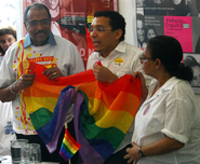
UNAIDS Executive Director Michel Sidibé meets representatives of group Arco-Iris.
Credit: UNAIDS/D. Ramalho
Two separate meetings with civil society groups in Rio de Janeiro provided Mr Sidibé an overview of the challenges facing several populations most affected by HIV, including sex workers, transgenders, gay adolescents and indigenous peoples in the Amazon region.
With ten national representatives of the Brazilian Interdisciplinary Association of AIDS (ABIA), Mr Sidibé was informed of the difficulties in responding to the many faces of Brazil’s epidemics.
HIV prevention was underscored by many representatives as an urgent issue to address, with a lack of resources to reach out to the groups most-at-risk from HIV seen as the biggest hurdle in preventing new infections.
With Grupo Arco-Íris (Rainbow Group), Mr Sidibé heard from several representatives of diverse lesbian, gay, bisexual, transgender and transvestite groups. They explained the concerns and challenges faced by them as LGBTT living in Brazil.
Grupo Arco-Íris is advocating for a change in the law in the federal senate that would make homophobic acts a criminal offence. So far, the group has collected more than 40,000 signatures in support of the law. The group also launched a HIV prevention campaign called “entre garotos” (between boys) that targets gay adolescents between the ages of 16 and 22 through tailored advertising and information displays at cafes, bars, dance halls, and other venues popular with young men who have sex with men.
Mr Sidibé pledged his continuing support to the LGBTT community and encouraged its members to mobilize and rally around efforts to achieve universal access to HIV services in Brazil.
Right Hand Content
Multimedia:
Feature stories:
Brazilian children’s society offers a home from home for children living with HIV (27 March 2009)
TB/HIV, universal access, and human rights key items on UNAIDS Executive Director’s agenda in Brazil (24 March 2009)
External links:
Feature Story
Brazilian children’s society offers a home from home for children living with HIV
27 March 2009
27 March 2009 27 March 2009
UNAIDS Executive Director, Michel Sidibé visiting the Association Viva Cazuza which cares for orphans and adolescents living with HIV in Rio de Janeiro, Brazil, 26 March 2009
Credit: UNAIDS/D. Ramalho
Viva Cazuza has been working for nearly two decades in Rio de Janeiro to give orphaned children and young people living with HIV a safe haven, antiretroviral treatment and access to programmes to gain confidence and build leadership skills.
The society was created in 1990 in the memory of Brazilian rock star Cazuza who died of an AIDS-related illness in the same year. It’s a non-profit organization that provides a home for 20 children and adolescents, aged 2 to 16, who are living with HIV. Many of the home’s residents were abandoned at birth or left in the care of the Society at a later stage in their life.

Cazuza’s mother, Maria Lucia da Silva Araujo, established the society with the support of the musician’s friends and the broader artistic and philanthropic communities. Since its founding, the society has helped more than 80 children.
UNAIDS Executive Director Mr Michel Sidibé took the opportunity to visit the Viva Cazuza Society on 26 March during his official visit to Brazil.

UNAIDS Executive Director, Michel Sidibé visiting the Association Viva Cazuza which cares for orphans and adolescents living with HIV in Rio de Janeiro, Brazil, 26 March 2009
Credit: UNAIDS/D. Ramalho
During Mr Sidibé’s visit of the residence, he was impressed by the passion and committed displayed by Maria Lucia da Silva Araujo in helping children living with HIV and advocating for broader prevention awareness. He said that her work is “more than just helping, but recreating life” for its residents.
Many of the older children are engaged in peer HIV prevention and sex education groups. Fifteen-year-old Leonardo is a member of a group that meets monthly to talk about prevention. He aims, through dialogue, to break down the prejudices of others that are the root of stigma and discrimination.

Viva Cazuza was established by Maria Lucia da Silva Araujo (centre) in memory of her son, Brazilian rock star Cazuza, who died of an AIDS-related illness in 1990.
Credit: UNAIDS/D. Ramalho
Beyond providing assistance to children and adolescents, Viva Cazuza also offers HIV treatment support to adults from the surrounding neighbourhood. Each Wednesday, more than 100 people stop by to get their antiretroviral medicine and, if they need support, have a chat with a counsellor.
The next step for Viva Cazuza is to help its growing young residents prepare for adulthood and their coming independence. Empowering them with a range of skills will help ensure their continued health and well-being after they leave the centre, including management of their treatment.
Right Hand Content
Feature stories:
TB/HIV, universal access, and human rights key items on UNAIDS Executive Director’s agenda in Brazil (24 March 2009)
Rock star’s legacy helps children living with HIV (01 March 2007)
Multimedia:
View photo gallery
Watch video : A home from home for children living with HIV.
Feature Story
UNAIDS Executive Director meets with TB Programme Managers, TB civil society
26 March 2009
26 March 2009 26 March 2009
Michel Sidibé, UNAIDS Executive Director met with National Tuberculosis Programme Managers and Civil Society representatives at the 3rd Stop TB Partners Forum in Rio de Janeiro, Brazil, on 24 March 2009. Credit:UNAIDS/D. Ramalho
Mr Michel Sidibé, the Executive Director of UNAIDS, met with managers of national TB programmes and civil society representatives at the 3rd Stop TB Partners Forum to hear their views on ways to improve the joint response to TB and HIV.
One participant, in sharing his experience of addressing TB and HIV co-infection in Zambia, urged Mr Sidibé to use his position to mobilize greater leadership in confronting the twin epidemics of TB and HIV and to bring the AIDS and TB movements closer together. He stressed that the epidemics of TB and HIV can no longer be addressed in isolation. To illustrate the point one participant from Malawi gave a simple example of how, until recently, the TB movement was rarely visible at international AIDS conferences, and vice versa. This was emphasized when a participant from India asked, “When the virus and the bacteria work so well together, why can’t we?”
When the virus and the bacteria work so well together, why can’t we? It is not acceptable that people living with HIV die from TB.
Meeting participant from India
The participants agreed that TB is undermining the recent successes made in responding to HIV, reiterating the findings of the recent WHO World TB Control report that revealed that the impact of TB among people living with HIV is much greater than previously understood, as a result of better data coming from countries.
More TB screening for people living with HIV—through fully integrated TB/HIV services—would be an important and an essential step to reduce TB’s burden on people living with HIV. Additional points raised by the group were more funds, better trained staff and research to allow for better TB screening and prevention for people living with HIV and more advocacy and public awareness initiatives on TB and HIV co-infection.
Mr Sidibé asked TB programme managers and TB civil society to work closer with their peers in the HIV response to better “reach affected people out in the communities”. He closed this first conversation with TB programme managers and TB civil society by stating that “it is not acceptable that people living with HIV die from TB”—a key message he repeated throughout the three-day Stop TB Partners’ Forum.
Right Hand Content
Cosponsors:
Partners:
Multimedia:
Feature stories:
Need for scale up in integrated TB and HIV screening to address linked epidemics (24 March 2009)
Press centre:
HIV-related TB deaths higher than past estimates (24 March 2009)
UNAIDS Executive Director address to closing session of 3rd Stop TB Partners Forum (pdf, 77 Kb)
External links:
Feature Story
Barber Shops and Beauty Salons promote HIV education in Guyana
26 March 2009
26 March 2009 26 March 2009This story was first published on UNFPA.org
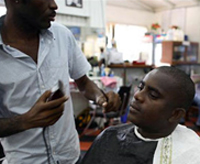
Clients at Kevin's Reflextions have an opportunity to talk about HIV.
Credit: Carina Wint
Barber shops across Georgetown, Guyana, are buzzing with chatter about the latest trends, community happenings, neighbourhood gossip and now, ways to protect young people from AIDS. The United Nations Population Fund (UNFPA), in collaboration with UNAIDS Secretariat, has identified barber shops and beauty salons as information hubs, and is using them to spread the word about HIV prevention.
The project involves the training of shop staff to answer simple HIV-related questions, pass out informational material, dispense both male and female condoms to clients – and even provide on-site counselling and testing. As a result, young people in Guyana are given access to information and resources not readily available elsewhere in their communities. And this is important because their small country (population 751, 223) has one of the highest HIV prevalence levels in the region: about 1.6 per cent for pregnant women, according to UNAIDS. Among sex workers, prevalence rises up to 26.6 per cent.
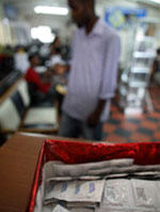
Male and female condoms are available at selected hair salons.
Credit: Carina Wint
Juanita Huburn, a customer at DJ’s Magic Fingers, a hair salon that participates in the programme, described Guyanese society as “closed” when it comes to issues regarding sexuality. “You do not talk about sex, they just say you should not have sex, but this is not realistic,” she said.
Shops and salons were chosen based on their location in malls, parks, popular attractions, or low-income communities. Owners who opened their doors to the project got added marketing exposure for their small businesses and were provided with incentives, such as access to promotional materials. “Shops were informed how their companies would be promoted through the project, and the economic value of participating,” said UNFPA Guyana Liaison Officer, Patrice La Fleur “They would most importantly provide safe places to discuss sexuality and the prevention of HIV.”
Shops were informed how their companies would be promoted through the project, and the economic value of participating. They would most importantly provide safe places to discuss sexuality and the prevention of HIV.
UNFPA Guyana Liaison Officer, Patrice La Fleur
Once the locations were identified, two employees from each shop were sent for training on basic HIV education and prevention means. They were also taught to properly monitor the project and introduced to safe practices within the context of their own work (for example, ensuring the sterility of hair cutting machines, razors, needles for stitching and weaving, manicure and pedicure implements, and tattooing and body piercing equipment).
In addition to training participants about sexual and reproductive health and gender issues, the project also focuses on building life skills such as communication, healthy relationships, and leadership. “Participants expressed personal gains in their quality of relationships with friends, family, and clients,” said UNFPA Programme Officer, Babsie Giddings who monitors the project.

DJ's Magic Fingers hair salon is another venue for building awareness of HIV prevention.
Credit: Carina Wint
Since the programme was put in place businesses report a steady boost in clientele and more shops have come on board. “Business has increased about 5 per cent since we joined this programme,” said Kevin John, owner of the Barber Shop Kevin’s Reflections. He believes it may be partly because people know his salon equipment is sanitized. Currently over 7000 male and 400 female condoms are distributed monthly by requests in the shops and salons.
Work on the project was initiated last year through efforts of the UN Country Theme Group and it has been fully funded by UNAIDS. Also collaborating on the project is a local NGO, Youth Challenge Guyana.
UNFPA provides continuous support with regular follow-ups and monitoring for participating barber shops and salons. The project aims to afford some 2000 young people access to information, skills, services and supplies they can use to protect their health.
Right Hand Content
Cosponsors:
Feature stories:
Condoms and HIV prevention: Position statement by UNAIDS, UNFPA and WHO (19 March 2009)
Challenging violence against women a key task for newly launched Caribbean Coalition on Women, Girls and AIDS (06 March 2009)
More prevention focus needed for the Caribbean to sharpen its response to HIV (22 December 2008)
Publications:
Keeping Score II: A progress report towards universal access to prevention, treatment, care and support in the Caribbean (pdf, 2,87 Mb)
Feature Story
UNODC and Iran sign agreements to reduce vulnerability of women and Afghan refugees to drugs and HIV
24 March 2009
24 March 2009 24 March 2009This story was first published on UNODC.org
Women in Iran. Credit: UNAIDS/P. Virot
The Executive Director of the United Nations Office on Drugs and Crime (UNODC), Antonio Maria Costa, and the Deputy Secretary General of the Islamic Republic of Iran's Drug Control Headquarters, Taha Taheri signed, on 19 March, two projects to provide HIV prevention and care services to Afghan refugees and female drug users in Iran. These projects will be launched thanks to funding from the Government of the Netherlands.
The goal of the first project is to support national efforts to provide comprehensive HIV prevention and care services to Afghan refugees in Iran who are drug users. This is part of a sub-regional project also targeting Afghan drug-dependent refugees in Pakistan as well as those who have returned to Afghanistan. UNODC, in association with the United Nations High Commissioner for Refugees, UNAIDS and the International Organization for Migration, will assist in delivering comprehensive HIV prevention, treatment, care and support services to Afghan refugees under this initiative. The Governments of Afghanistan and Pakistan will also be part of this three-year project.
The hardships of Afghan refugees are compounded, not solved, by drugs. We need to reach out to this vulnerable group, and lower their vulnerability to drug abuse and the spread of HIV/AIDS through injecting drug use.
Antonio Maria Costa, Executive Director of the United Nations Office on Drugs and Crime (UNODC)
According to the latest information, there are more than 900,000 Afghan refugees in Iran, down from a peak of 2 million in 2002/03. This is one of the largest refugee populations in the world. "The hardships of Afghan refugees are compounded, not solved, by drugs. We need to reach out to this vulnerable group, and lower their vulnerability to drug abuse and the spread of HIV/AIDS through injecting drug use", said Mr. Costa. This group has been identified as being high-risk, yet has thus far not fully benefited from Iran's large-scale comprehensive HIV prevention, treatment, care and support services to injecting drug users - including opioid substitution treatment.
The second project targets another vulnerable group; Iranian women who are either drug dependent and/or affected by HIV. The aim of the project is to increase access to quality services tailored to the specific needs of these women, including in prison settings. This will complement the significant resources that the Government of Iran already devotes to prevention and treatment of HIV as well as drug demand reduction measures.
"These agreements are further evidence of UNODC's pro-health approach to drugs, and to a deepening of our partnership with the Islamic Republic of Iran," said Mr. Costa. "UNODC is grateful for the financial assistance from the Netherlands". He urged other funding partners to follow suit and reduce the vulnerability of women and Afghan refugees in Iran to drugs and HIV. "This is an often neglected and humanitarian side of drug control", said the head of UNODC.
Right Hand Content
Cosponsors:
Press centre:
High Commissioner calls for focus on human rights and harm reduction in international drug policy (10 March 2009)
Feature stories:
OPINION: Silence on harm reduction not an option (11 March 2009)
Injecting drug use and HIV: Interview with UNAIDS Team Leader, Prevention, Care and Support team (11 March 2009)
51st session of the Commission on Narcotic Drugs (11 March 2008)
Injecting drug use: focused HIV prevention works (11 May 2007)
Speeches:
“Why we need harm reduction to reach universal access goals” Speech by Michel Sidibé, Executive Director of UNAIDS to Donor Conference Harm Reduction, Amsterdam (28 January 2009) (pdf, 100 Kb)
Publications:
Best Practice Publication: High Coverage Sites (pdf, 1,57 Mb)
Iran UNGASS Country Progress Report 2008 ( en | Persian ) (pdf, 531 Kb | 2,59 Mb )